waec model questions vol1 2019 agricultural_science | Objective

Prepare for your exams with waec model questions vol1 questions? Reviewing past/model questions is one of the most effective ways to guarantee a high score. This practice hub features authentic 2019 agricultural_science (Objective) questions designed to simulate the real exam environment.

Practice these randomly selected questions to test your readiness.

Question 1 View Details
A soil sample has exchangeable calcium 2.5 cmolc/kg, magnesium 1.2 cmolc/kg, potassium 0.8 cmolc/kg and sodium 0.5 cmolc/kg. If the total cation‑exchange capacity (CEC) of the soil is 20 cmolc/kg, what is the base‑saturation percentage of the soil?
A. 35
B. 30
C. 20
Correct D. 25

Correct Answer: D

Want to see the full step-by-step solution? Unlock AI Explanation & Analytics
Question 2 View Details
A farmer has three fields whose areas are in the ratio 2:3:5. The total cultivated area is 200 hectares. What is the area (in hectares) of the largest field?
A. 80
B. 140
C. 120
Correct D. 100

Correct Answer: D

Want to see the full step-by-step solution? Unlock AI Explanation & Analytics
Question 3 View Details
A fish population in a lake follows the logistic growth model \(\frac{dN}{dt}=rN\left(1-\frac{N}{K}\right)\) where the intrinsic growth rate \(r\) is 0.5 per year and the carrying capacity \(K\) is 10,000 fish. What is the maximum sustainable annual harvest (in fish) that can be taken without driving the population to extinction?
A. 5000
B. 625
C. 2500
Correct D. 1250

Correct Answer: D

Want to see the full step-by-step solution? Unlock AI Explanation & Analytics
Question 4 View Details
For a particular timber species the form factor (F) varies linearly with the diameter at breast height (D). When D = 30 cm, F = 0.45. Assuming the relationship passes through the origin, determine the total timber volume (in cubic metres, rounded to the nearest whole number) that can be obtained from a stand of 120 trees, each having D = 45 cm and a height of 20 m. Use the volume formula \(V = F \times \frac{\pi}{4} D^{2} H\) where D is in metres.
A. 240
B. 328
C. 172
Correct D. 258

Correct Answer: D

Want to see the full step-by-step solution? Unlock AI Explanation & Analytics
Question 5 View Details
A farmer plans to sell 500 kg of tomatoes. Fixed costs amount to ₦20,000, the variable cost is ₦30 per kilogram, and a marketing charge equal to 5% of total revenue is applied. If the farmer wants to earn a profit of ₦15,000, what minimum price per kilogram (in Naira, to two decimal places) must be charged?
A. 105.00
Correct B. 105.26
C. 100.00
D. 115.00

Correct Answer: B

Want to see the full step-by-step solution? Unlock AI Explanation & Analytics
Question 6 View Details
A farmer wants to sow 2 hectares of maize. The recommended row spacing is 75 cm and the seed spacing within a row is 15 cm. The expected germination rate is 85% and each seed weighs 0.025 g. Assuming the field is a perfect square, how many kilograms of seed should be purchased?
Correct A. 5.23 kg
B. 4.87 kg
C. 5.80 kg
D. 6.12 kg

Correct Answer: A

Want to see the full step-by-step solution? Unlock AI Explanation & Analytics
Question 7 View Details
Late blight of tomato was first observed in a field on day 20 of the cropping season. The recommended control is a fungicide spray every 10 days after the first appearance. The season lasts 120 days. Each spray covers 0.75 ha, and the farmer has a 3 ha field. How many total spray applications are required to protect the whole field for the season?
A. 42 spray applications
B. 48 spray applications
Correct C. 44 spray applications
D. 40 spray applications

Correct Answer: C

Want to see the full step-by-step solution? Unlock AI Explanation & Analytics
Question 8 View Details
A farmer rears 25 goats that are expected to gain an average of 2.5 kg each over a 90‑day feeding period. The feed conversion ratio (FCR) is 5 kg of feed per kg of weight gain. Because of storage losses, 10% of the purchased feed is wasted. How many kilograms of feed must the farmer purchase for the entire herd?
A. 312.50 kg
Correct B. 347.22 kg
C. 350.00 kg
D. 345.00 kg

Correct Answer: B

Want to see the full step-by-step solution? Unlock AI Explanation & Analytics
Question 9 View Details
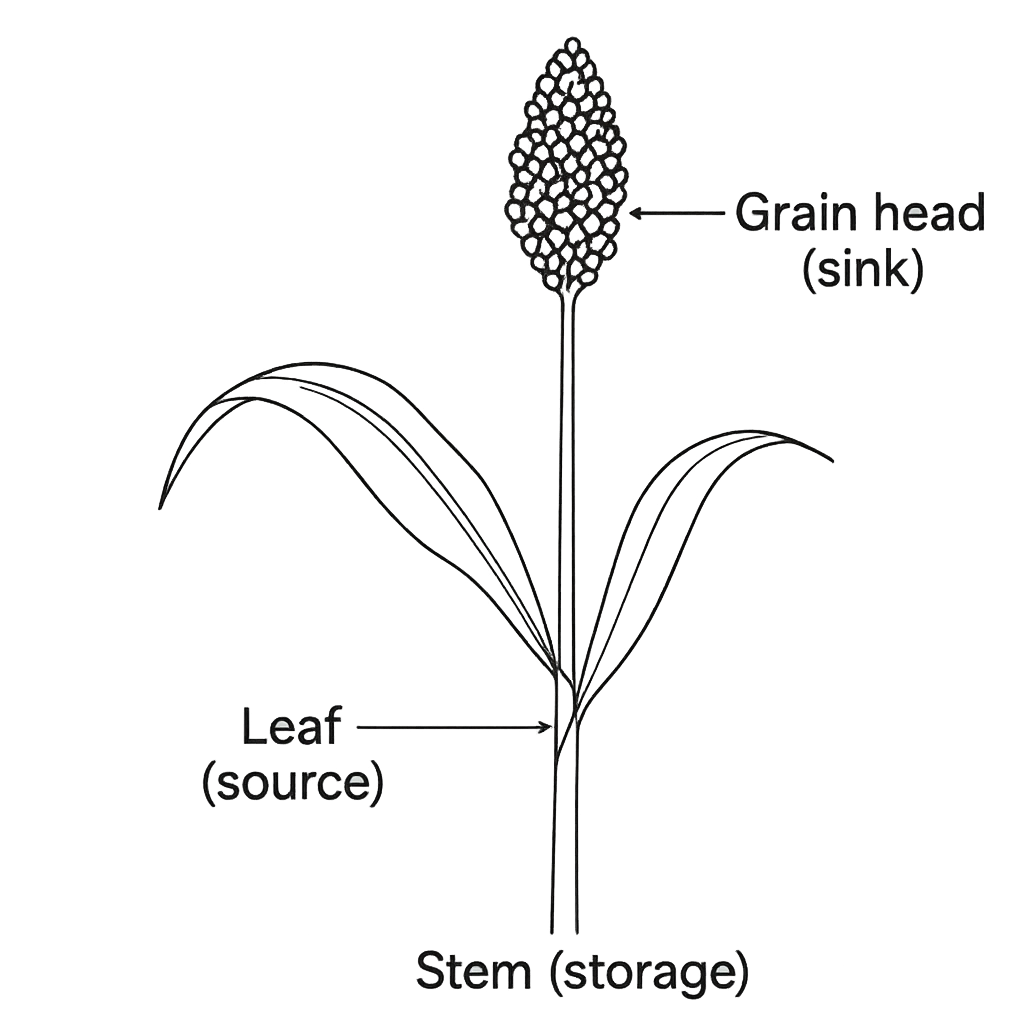
The diagram shows a sorghum plant with its leaf, stem and grain head labelled. Each plant produces a total of 1200 g of photosynthates during the growing season. Of this, 45% is allocated to the grain head, 35% to the stem and 20% to the leaf. Only 85% of the assimilates reaching the grain head are converted into grain dry matter. If the field density is 30 000 plants per hectare, what is the expected grain yield per hectare (in kilograms)?
A. 16,200 kg per hectare
B. 13,500 kg per hectare
C. 14,400 kg per hectare
Correct D. 13,770 kg per hectare

Correct Answer: D

Want to see the full step-by-step solution? Unlock AI Explanation & Analytics
Question 10 View Details
A tractor equipped with a 2.5‑m wide plough operates at a forward speed of 5 km/h. The field efficiency for the operation is 75%. How many hours will be required to cultivate a 15‑hectare field?
A. 18.0 hours
Correct B. 16.0 hours
C. 13.3 hours
D. 22.5 hours

Correct Answer: B

Want to see the full step-by-step solution? Unlock AI Explanation & Analytics
Question 11 View Details
A farmer uses a plough that can be set to three depths: 10 cm, 15 cm or 20 cm. The field (2 ha) has loamy soil. For loamy soil, each additional 5 cm depth increases the crop yield by 8% of the base yield, but the fuel consumption rises by 0.5 litre per hectare for each 5 cm increase. The farmer has only 3 litres of diesel available for the whole field. What plough depth should be chosen to obtain the greatest possible yield increase without exceeding the fuel limit?
Correct A. 15
B. 12
C. 10
D. 20

Correct Answer: A

Want to see the full step-by-step solution? Unlock AI Explanation & Analytics
Question 12 View Details
A farmer harvests 500 kg of fresh cassava roots with a moisture content of 70% (wet basis). The roots are sliced into chips and first dried in a solar dryer that removes water at a constant rate of 20 kg per hour. After 6 hours the chips are transferred to a mechanical dryer that removes water at a constant rate of 10 kg per hour. The safe storage moisture content is 12% (wet basis). How many additional hours must the chips spend in the mechanical dryer to reach the target moisture content?
A. 18
B. 15
Correct C. 21
D. 24

Correct Answer: C

Want to see the full step-by-step solution? Unlock AI Explanation & Analytics
Question 13 View Details
A farmer has a 0.5‑hectare field whose soil pH is 5.2. To raise the pH to 6.5, lime is applied at a rate of 2.5 tonnes per hectare for every 0.5‑unit increase in pH. How many tonnes of lime are required for the 0.5‑hectare field?
A. 2.5
Correct B. 3.25
C. 4.0
D. 5.2

Correct Answer: B

Want to see the full step-by-step solution? Unlock AI Explanation & Analytics
Question 14 View Details
A goat weighing 45 kg shows fever (40.5°C), nasal discharge and swollen lymph nodes. The most likely disease is contagious caprine pleuropneumonia (CCPP). Treatment is oxytetracycline injection at 10 mg per kg body weight, given once daily for 5 days. What total amount of oxytetracycline (in grams) will be administered over the whole treatment course?
Correct A. 2.25
B. 0.45
C. 4.5
D. 1.8

Correct Answer: A

Want to see the full step-by-step solution? Unlock AI Explanation & Analytics
Question 15 View Details
A farmer intends to grow maize on 3 hectares. Expected yield is 4 tonnes per hectare. Variable cost is ₦120,000 per tonne produced and fixed cost is ₦500,000. The market price is ₦150,000 per tonne, but if more than 10 tonnes are sold the price drops by 5% for all tonnes sold. Should the farmer sell all the produce or limit sales to 10 tonnes? Compute the net profit (or loss) for each option and state the better choice.
A. sell all produce
B. sell only 8 tonnes
Correct C. limit to 10 tonnes
D. sell 12 tonnes

Correct Answer: C

Want to see the full step-by-step solution? Unlock AI Explanation & Analytics
Question 16 View Details
A government agricultural extension programme intends to train small‑holder maize farmers. The fixed overhead cost of the programme is ₦200 000. Each farmer trained incurs a variable cost of ₦1 500 for materials and trainer fees. After training, each farmer is expected to increase maize yield by 1.2 t ha⁻¹ on the 1.5 ha he/she cultivates. The market price of maize is ₦45 kg⁻¹ and the variable production cost (excluding training) is ₦12 kg⁻¹. What is the minimum number of farmers that must adopt the new practice for the total net profit from the increased production to equal the total programme cost? Give your answer as the smallest whole number of farmers.
A. 5
B. 6
C. 3
Correct D. 4

Correct Answer: D

Want to see the full step-by-step solution? Unlock AI Explanation & Analytics
Question 17 View Details
A farmer practices a two‑year rotation of maize and cowpea on a 4‑ha field. In the maize year the crop yields 3.5 t ha⁻¹ and requires 120 kg N ha⁻¹. In the cowpea year the crop yields 1.8 t ha⁻¹ and fixes 45 kg N ha⁻¹, which becomes fully available to the subsequent maize crop. Assuming no synthetic nitrogen is applied to the cowpea year, calculate the average amount of synthetic nitrogen fertilizer the farmer must apply per hectare per year over the two‑year rotation. Express your answer in kg N ha⁻¹ yr⁻¹ (to one decimal place).
Correct A. 37.5
B. 42.5
C. 35.0
D. 40.0

Correct Answer: A

Want to see the full step-by-step solution? Unlock AI Explanation & Analytics
Question 18 View Details
A soil sample has a gravimetric moisture content of 18 % at field capacity and 12 % at the wilting point. The bulk density of the soil is 1.4 g cm⁻³. Determine the available water holding capacity (AWHC) of the soil in millimetres of water per metre depth. (1 mm of water over 1 m² equals 1 L.)
Correct A. 84
B. 96
C. 72
D. 108

Correct Answer: A

Want to see the full step-by-step solution? Unlock AI Explanation & Analytics
Question 19 View Details
A veterinarian must vaccinate 45 goats against peste des petits ruminants (PPR). The vaccine is supplied as a lyophilised powder that must be reconstituted with sterile water at a ratio of 1 ml per 10 mg of powder. Each goat requires 0.5 ml of the reconstituted vaccine. One vial contains 2.5 g of powder. After reconstitution, a vial can be used to vaccinate at most 30 goats because the vaccine remains effective for only 6 hours. Determine the minimum number of vials that must be opened to vaccinate the entire herd.
A. 3
B. 1
Correct C. 2
D. 4

Correct Answer: C

Want to see the full step-by-step solution? Unlock AI Explanation & Analytics
Question 20 View Details
A rabbit farm wants to produce a 100 kg batch of pelleted feed with a target crude protein (CP) content of 18 % (dry matter basis). Three ingredients are available: - Ingredient A: 24 % CP, cost ₦150 kg⁻¹ - Ingredient B: 12 % CP, cost ₦100 kg⁻¹ - Ingredient C: 5 % CP, cost ₦60 kg⁻¹ (used as filler) At least 5 kg of the filler (C) must be included, and each of ingredients A and B must be present in quantities of at least 25 kg. Determine the quantities (in kilograms) of A, B and C that minimise the total cost while meeting the protein target. Give your answer to the nearest kilogram.
A. 50 kg, 45 kg, 5 kg
B. 55 kg, 40 kg, 5 kg
C. 60 kg, 35 kg, 5 kg
Correct D. 53 kg, 42 kg, 5 kg

Correct Answer: D

Want to see the full step-by-step solution? Unlock AI Explanation & Analytics
Question 21 View Details
A farmer intends to grow soybeans on a 1‑hectare field. Fixed costs (land preparation, labour, etc.) are ₦20,000 per hectare and seed costs are ₦500 per hectare. Fertiliser is applied at a rate of F kg per hectare. The government gives a subsidy of ₦0.50 per kg for the first 100 kg of fertiliser; beyond 100 kg the farmer pays the full price of ₦2.00 per kg. The yield (in tonnes per hectare) depends on the amount of fertiliser as follows: \[ Y(F)=\begin{cases}0.5+0.02F,&F\le 100\\2.5+0.01(F-100),&F>100\end{cases} \] The market price of soybeans is ₦150,000 per tonne. Determine the smallest amount of fertiliser (in whole kilograms, multiple of 10 kg) that will give the farmer a profit of at least ₦300,000.
A. 100
B. 110
Correct C. 90
D. 80

Correct Answer: C

Want to see the full step-by-step solution? Unlock AI Explanation & Analytics
Question 22 View Details
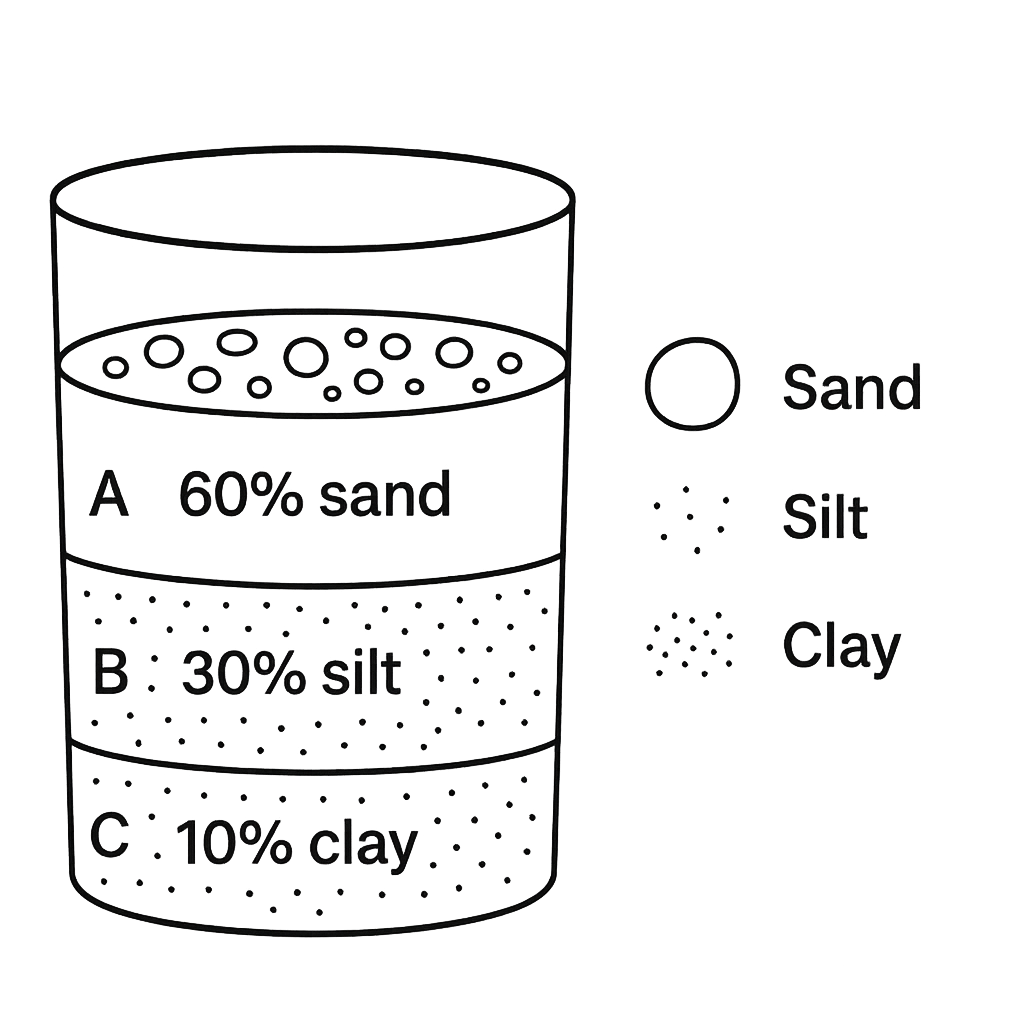
The diagram shows a soil profile in a pot divided into three layers. Layer A (top) contains 60% sand, 30% silt and 10% clay by volume. Using the USDA soil‑texture triangle, what is the texture class of the soil?
A. Sandy clay loam
B. Loam
C. Clay loam
Correct D. Sandy loam

Correct Answer: D

Want to see the full step-by-step solution? Unlock AI Explanation & Analytics
Question 23 View Details
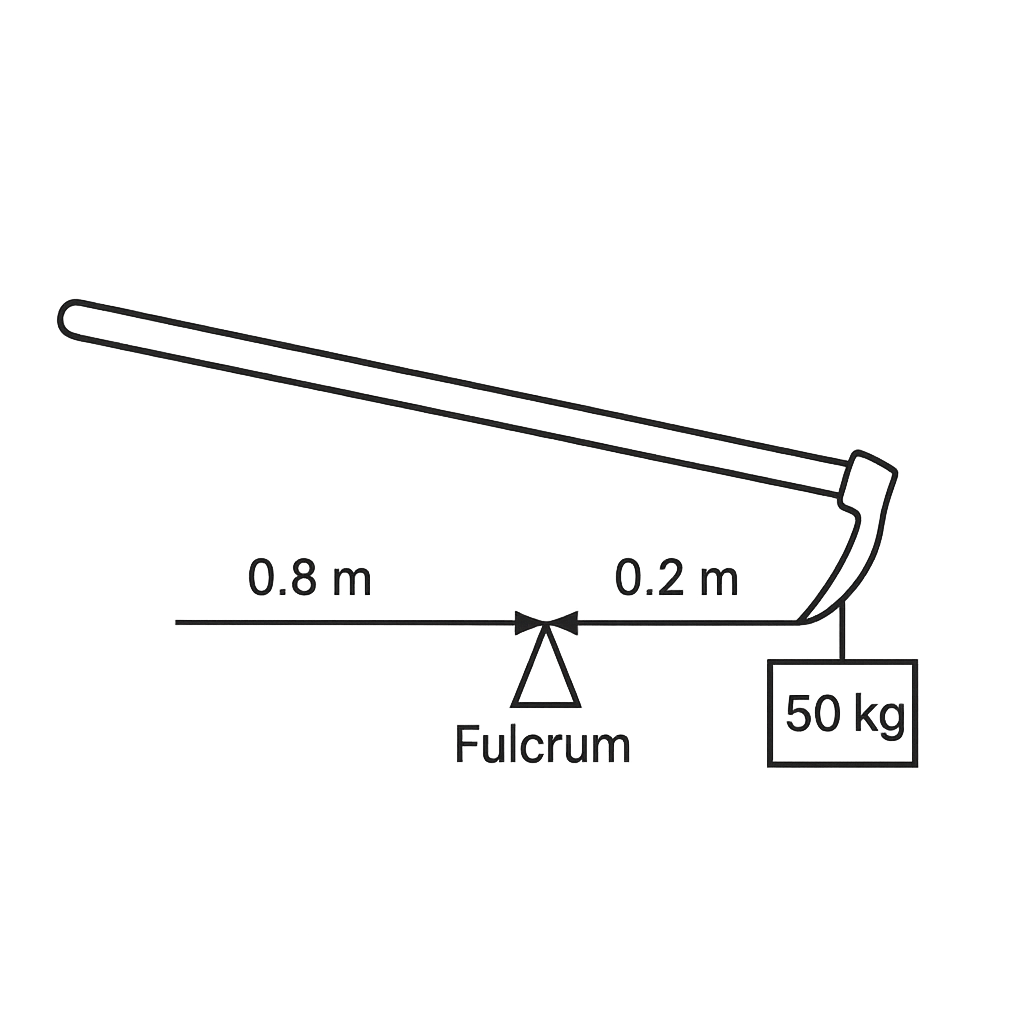
In the diagram of a simple lever used as a hand hoe, the effort arm (distance from the hand to the fulcrum) is 0.8 m and the load arm (distance from the fulcrum to the soil resistance point) is 0.2 m. If the soil resistance equals the weight of a 50 kg mass, calculate the magnitude of the effort force the farmer must apply (ignore friction).
A. 61.25
B. 150
C. 102.5
Correct D. 122.5

Correct Answer: D

Want to see the full step-by-step solution? Unlock AI Explanation & Analytics
Question 24 View Details
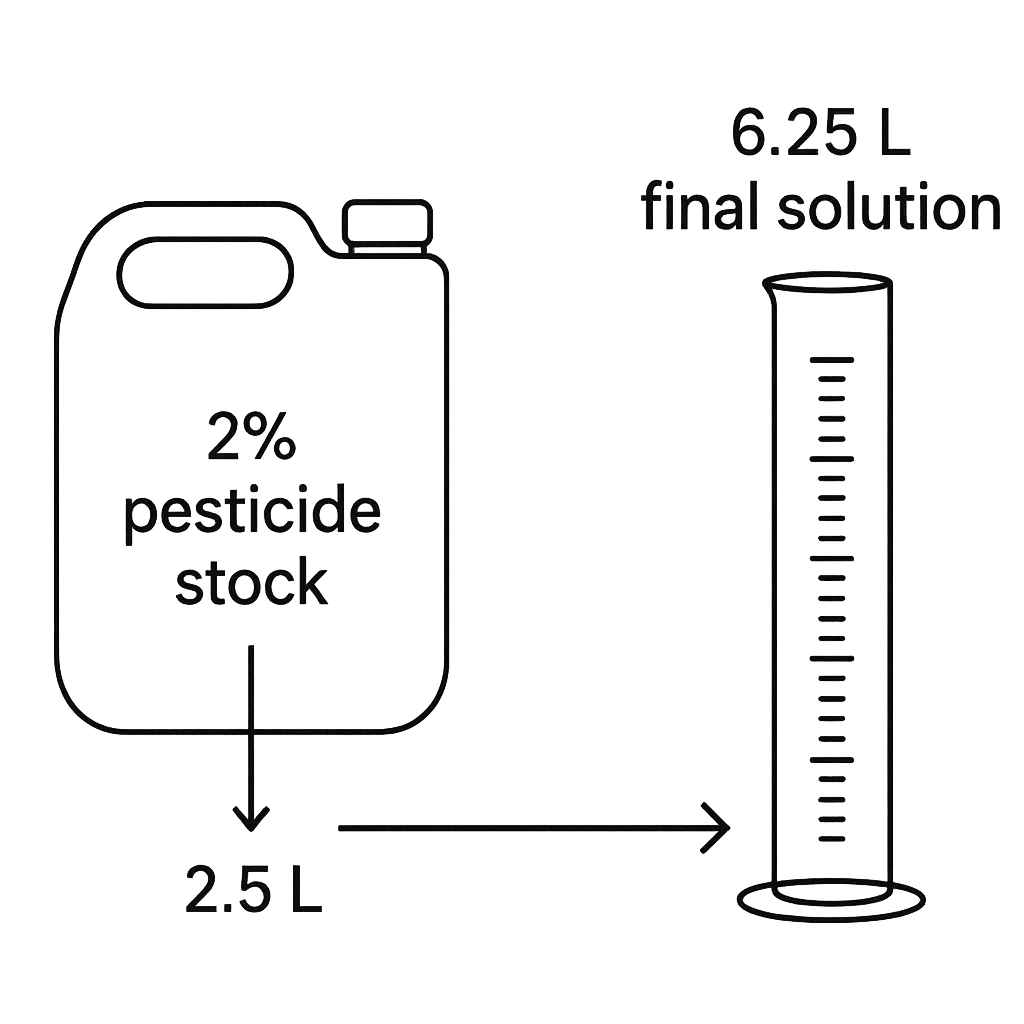
A farmer has a 2.5‑hectare field infested with a pest. The recommended pesticide dosage is 2.5 L per hectare of a 0.8% (w/v) solution. The farmer possesses a 5‑L stock solution that is 2% (w/v). How many litres of the stock solution must be mixed with water to obtain the required amount of pesticide for the whole field?
A. 5
Correct B. 2.5
C. 1.25
D. 3.75

Correct Answer: B

Want to see the full step-by-step solution? Unlock AI Explanation & Analytics
Question 25 View Details
Cassava chips exiting the dryer have a moisture content of 55% (wet basis). The dryer follows first‑order drying kinetics: dM/dt = -k(M - M_e), where M is the moisture content (% wet basis), M_e is the equilibrium moisture content (10%), and k = 0.3 h⁻¹. How long (in hours, to one decimal place) will it take to reduce the moisture content to 12%?
Correct A. 10.4
B. 12.5
C. 8.2
D. 9

Correct Answer: A

Want to see the full step-by-step solution? Unlock AI Explanation & Analytics

Master the Exam!

You've seen a preview, but there are thousands more questions plus AI tutor to break down complex solutions.

Unlock Full Access Available for Android & Windows
Help others prepare! Share this practice hub:
Chat with Support