waec model questions vol1 2018 geography | Objective

Prepare for your exams with waec model questions vol1 questions? Reviewing past/model questions is one of the most effective ways to guarantee a high score. This practice hub features authentic 2018 geography (Objective) questions designed to simulate the real exam environment.

Practice these randomly selected questions to test your readiness.

Question 1 View Details
Two types of buses are available for a city route. Type A carries 70 passengers per trip and makes 9 trips per day; its operating cost is ₦90 000 per day. Type B carries 40 passengers per trip and makes 12 trips per day; its operating cost is ₦55 000 per day. The daily passenger demand is 12 000. At least 10 % of the total buses must be Type A and the total number of buses may not exceed 30. Determine the number of Type A buses in the cost‑minimising solution.
A. 3
B. 5
C. 6
Correct D. 4

Correct Answer: D

Want to see the full step-by-step solution? Unlock AI Explanation & Analytics
Question 2 View Details
A vegetation type requires a mean annual temperature between 15 °C and 20 °C and at least 1 200 mm of annual rainfall. Sea‑level temperature is 30 °C and decreases at a lapse rate of 6.5 °C per 1 000 m. Rainfall at sea level is 1 900 mm. Rainfall decreases at 0.4 mm per metre for the first 800 m of altitude and at 0.6 mm per metre above 800 m. Determine whether any altitude on the mountain satisfies both the temperature and rainfall requirements, and state the result.
Correct A. No suitable altitude; the required temperature range occurs above the altitude where rainfall falls below 1200 mm.
B. Yes, an altitude of about 1 200 m satisfies both the temperature and rainfall requirements.
C. Yes, altitudes between 800 m and 1 000 m meet both the temperature and rainfall criteria.
D. No suitable altitude; the temperature range is met, but rainfall remains above 1200 mm at all relevant elevations.

Correct Answer: A

Want to see the full step-by-step solution? Unlock AI Explanation & Analytics
Question 3 View Details
Leachate from a landfill contaminates groundwater. The concentration at a distance \(x\) km from the landfill follows \(C = C_0 e^{-kx}\) where \(C_0 = 120\) mg L⁻¹ and \(k = 0.8\) km⁻¹. The permissible limit for drinking water is 10 mg L⁻¹. A community well is located somewhere between 0.5 km and 2 km from the landfill. (a) Find the minimum distance the well must be from the landfill to meet the limit. (b) If a treatment plant reduces the concentration by 40 % before consumption, what is the new minimum distance? State whether either distance lies within the 0.5-2 km range.
Correct A. No feasible location; minimum distance ≈3.11 km without treatment and ≈2.47 km with 40 % treatment, both beyond the 0.5-2 km range.
B. No feasible location; minimum distance ≈3.11 km without treatment and ≈2.0 km with 40 % treatment, the latter within the 0.5-2 km range.
C. No feasible location; minimum distance ≈2.9 km without treatment and ≈2.3 km with 40 % treatment, both beyond the 0.5-2 km range.
D. Feasible location; minimum distance ≈1.8 km without treatment and ≈1.5 km with 40 % treatment, both within the 0.5-2 km range.

Correct Answer: A

Want to see the full step-by-step solution? Unlock AI Explanation & Analytics
Question 4 View Details
A 2.5 km² catchment is 40 % impervious (C=0.85), 30 % residential (C=0.55) and 30 % agricultural (C=0.30). The design storm intensity for a 10‑year return period is 70 mm h⁻¹. Using the Rational Method, calculate the peak discharge (m³ s⁻¹). Then, design a rectangular concrete channel to convey this flow. The channel slope is 0.0015, Manning's n = 0.013, and the chosen depth is 1.2 m. Determine the required channel width (b) to the nearest 0.1 m.
A. 9.2
B. 7.9
C. 10.1
Correct D. 8.5

Correct Answer: D

Want to see the full step-by-step solution? Unlock AI Explanation & Analytics
Question 5 View Details
A commuter bus travels a 30 km route with five equally spaced stops. Each stop adds a dwell time of 45 seconds. The bus may choose an average cruising speed \(v\) (km h⁻¹) between 30 and 60 km h⁻¹. Fuel consumption per kilometre is \(f(v)=0.05v+\frac{2}{v}\) L km⁻¹. Fuel price is ₦165 per litre. The operator assigns a time penalty of ₦500 for every minute of total travel time (cruising plus dwell). Determine the cruising speed (to the nearest km h⁻¹) that minimises the total cost (fuel cost plus time penalty).
A. 45
B. 55
C. 50
Correct D. 60

Correct Answer: D

Want to see the full step-by-step solution? Unlock AI Explanation & Analytics
Question 6 View Details
A town had a population of 150,000 in the year 2000. From 2000 to 2005 the population grew at an annual compound rate of 2.5%. From 2005 to 2010 the annual compound growth rate fell to 1.8%. After 2010 the growth rate increased to 2.2% per year. In which year will the population first exceed 200,000?
A. 2016
Correct B. 2014
C. 2013
D. 2015

Correct Answer: B

Want to see the full step-by-step solution? Unlock AI Explanation & Analytics
Question 7 View Details
The total annual rainfall recorded for a city is 1,200 mm. Rainfall during the first six months accounts for 45% of the total. June recorded 80 mm of rain. July receives 20% more rain than June, and the combined rainfall for July and August equals 10% of the annual total. What was the rainfall in August (in mm)?
A. 32
B. 28
Correct C. 24
D. 20

Correct Answer: C

Want to see the full step-by-step solution? Unlock AI Explanation & Analytics
Question 8 View Details
A manufacturing plant follows the production function Q = 50 L^0.6 K^0.4, where Q is output (units), L is labour (number of workers) and K is capital (number of machines). The plant currently employs 64 workers and 16 machines. Management wants to raise output by 20% while keeping the number of machines unchanged. How many additional workers are required? (Round up to the nearest whole worker.)
A. 19
B. 31
C. 27
Correct D. 23

Correct Answer: D

Want to see the full step-by-step solution? Unlock AI Explanation & Analytics
Question 9 View Details
A soil sample contains 40% sand, 35% silt and 25% clay by weight. The field capacity (FC) is estimated by FC = 0.2S + 0.1Si + 0.05C (cm³/cm³) and the wilting point (WP) by WP = 0.05S + 0.07Si + 0.10C (cm³/cm³), where S, Si and C are the percentages of sand, silt and clay respectively. What is the available water capacity (AWC = FC - WP) of the soil, expressed to one decimal place?
Correct A. 5.8
B. 4.6
C. 6.3
D. 5.0

Correct Answer: A

Want to see the full step-by-step solution? Unlock AI Explanation & Analytics
Question 10 View Details
A community faces three environmental hazards with the following 10‑year probabilities (P) and estimated economic losses (L) in million naira: Flood - P = 0.12, L = 45; Landslide - P = 0.05, L = 80; Drought - P = 0.20, L = 30. The risk rating for each hazard is R = P × L. Mitigation options are: Flood mitigation costing 10 million and reducing its probability by 30%; Landslide mitigation costing 15 million and reducing its probability by 50%; Drought mitigation costing 8 million and reducing its probability by 25%. With a total mitigation budget of 30 million naira, which combination of measures should be chosen to maximise the total reduction in risk rating, and what is the resulting total risk rating after mitigation?
A. Landslide and drought mitigation; total risk rating = 13.56
Correct B. Flood and landslide mitigation; total risk rating = 11.78
C. Flood, landslide, and drought mitigation; total risk rating = 9.87
D. Flood and drought mitigation; total risk rating = 12.34

Correct Answer: B

Want to see the full step-by-step solution? Unlock AI Explanation & Analytics
Question 11 View Details
A factory has fixed monthly costs of ₦2,500,000 and a variable cost of ₦150 per widget produced. The marked price of each widget is ₦500. A trade discount of 10% is given to wholesale buyers, followed by a cash discount of 2% on the discounted price for payment within 30 days. The government imposes a sales tax of 5% on the selling price. Assuming all widgets produced are sold to wholesale buyers, what is the minimum number of widgets that must be produced and sold in a month to achieve a profit of at least ₦1,000,000?
Correct A. 13014
B. 13500
C. 14000
D. 12500

Correct Answer: A

Want to see the full step-by-step solution? Unlock AI Explanation & Analytics
Question 12 View Details
A soil sample contains 45% sand, 35% silt and 20% clay by weight. The field capacity (FC) can be estimated by FC = 0.2 S + 0.3 C + 0.1 Si (where S, C and Si are the percentages of sand, clay and silt respectively). The wilting point (WP) is given by WP = 0.1 S + 0.2 C + 0.05 Si. Calculate the available water holding capacity (AWHC = FC - WP) in percent and state whether the soil is suitable for a crop that requires a minimum AWHC of 12%.
A. 9.75%; not suitable
B. 10.50%; not suitable
Correct C. 8.25%; not suitable
D. 12.00%; suitable

Correct Answer: C

Want to see the full step-by-step solution? Unlock AI Explanation & Analytics
Question 13 View Details
A farmer intends to grow maize on 5 ha. The expected yield per hectare (in tonnes) as a function of nitrogen fertilizer applied per hectare (F kg) is Y = 2 + 0.05F - 0.0002F². The market price of maize is ₦150,000 per tonne. Fertilizer costs ₦50 per kg and transport to market costs a flat ₦10,000 per hectare. Determine the amount of fertilizer (kg ha⁻¹) that maximises profit and calculate the maximum total profit for the whole 5 ha farm.
Correct A. 124.2 kg/ha; ₦3,762,605
B. 126.8 kg\/ha; ₦3,650,000
C. 118.0 kg\/ha; ₦3,800,000
D. 130.5 kg\/ha; ₦3,700,000

Correct Answer: A

Want to see the full step-by-step solution? Unlock AI Explanation & Analytics
Question 14 View Details
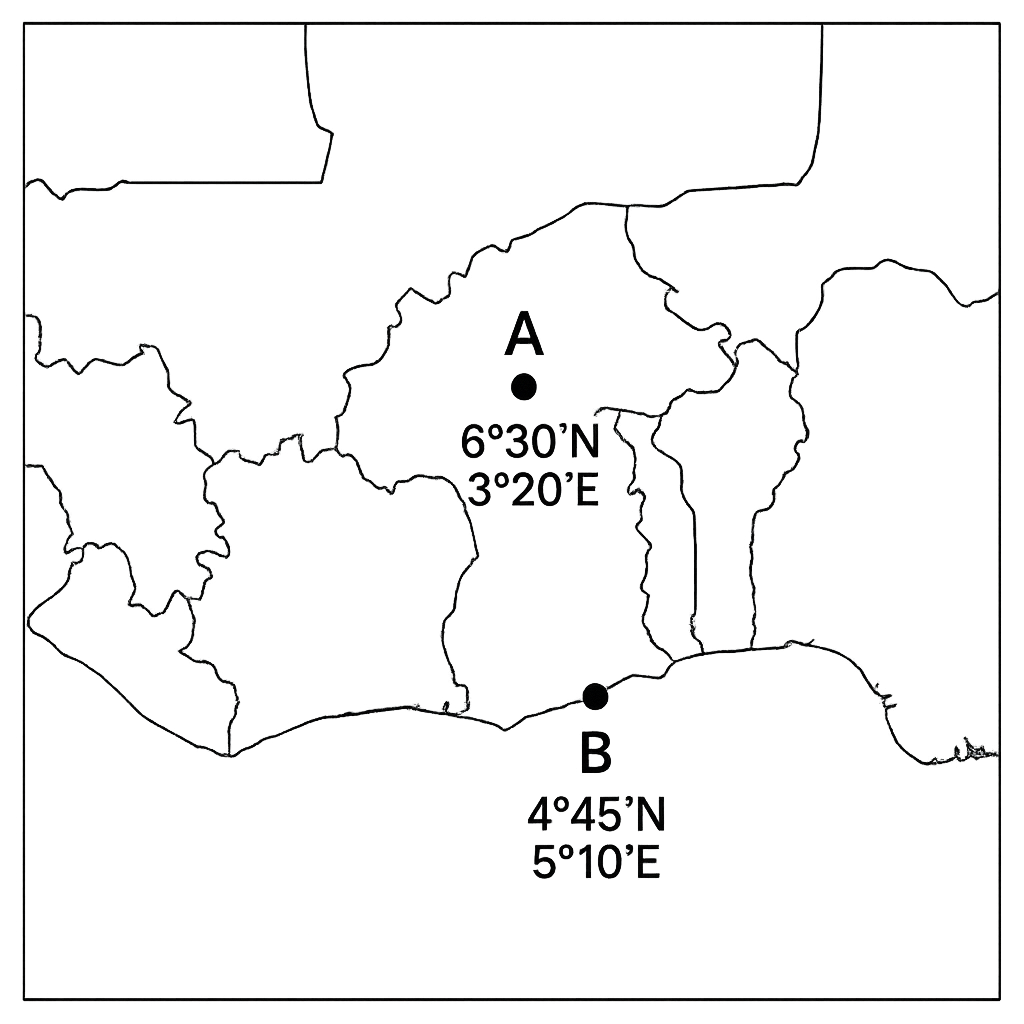
The map shows two towns. Town A is located at latitude 6°30'N, longitude 3°20'E. Town B is located at latitude 4°45'N, longitude 5°10'E. What is the difference in latitude between the two towns expressed in degrees and minutes?
A. 1°55'
B. 2°00'
C. 1°30'
Correct D. 1°45'

Correct Answer: D

Want to see the full step-by-step solution? Unlock AI Explanation & Analytics
Question 15 View Details
A region records the following average monthly rainfall (mm) and temperature (°C):\nJan 120 mm, 28°C; Feb 80 mm, 27°C; Mar 60 mm, 26°C; Apr 40 mm, 24°C; May 20 mm, 22°C; Jun 10 mm, 20°C; Jul 5 mm, 19°C; Aug 5 mm, 19°C; Sep 15 mm, 21°C; Oct 30 mm, 23°C; Nov 70 mm, 25°C; Dec 110 mm, 27°C.\n(a) Calculate the total annual rainfall.\n(b) Identify the month with the highest average temperature.\n(c) Using the Köppen criteria for a tropical savanna climate (Aw): the coldest month must have an average temperature ≥18°C, and the driest month must receive less than 60 mm and also less than 100 - (annual rainfall/25) mm. State whether this region qualifies as Aw, giving a brief justification.
A. 565 mm; January; No, Aw
Correct B. 565 mm; January; Yes, Aw
C. 560 mm; January; Yes, Aw
D. 565 mm; February; Yes, Aw

Correct Answer: B

Want to see the full step-by-step solution? Unlock AI Explanation & Analytics
Question 16 View Details
A map states a scale of 1 cm : 3 km, but the printed scale bar is 20% longer than it should be. The distance between Town X and Town Y on the map measures 4.5 cm. What is the actual distance between the two towns in kilometres?
A. 16.2 km
B. 13.5 km
Correct C. 11.25 km
D. 10.8 km

Correct Answer: C

Want to see the full step-by-step solution? Unlock AI Explanation & Analytics
Question 17 View Details
The following table gives the average monthly high temperature (°C) and average monthly rainfall (mm) for a city. Month | Temp (°C) | Rainfall (mm) Jan | 28 | 20 Feb | 30 | 25 Mar | 32 | 40 Apr | 33 | 80 May | 31 | 120 Jun | 29 | 150 Jul | 27 | 200 Aug | 26 | 180 Sep | 25 | 100 Oct | 24 | 70 Nov | 23 | 40 Dec | 22 | 30 Using the Köppen climate classification, decide whether the city falls under Aw (tropical savanna), Cw (humid subtropical with dry winter) or Cf (no dry season). Show your work.
Correct A. Aw (tropical savanna)
B. Cw (humid subtropical with dry winter)
C. Cf (no dry season)
D. Cfa (humid subtropical with no dry season)

Correct Answer: A

Want to see the full step-by-step solution? Unlock AI Explanation & Analytics
Question 18 View Details
A manufacturing firm produces widgets according to the production function Q = 5 L^{0.6} K^{0.4}, where L is the number of workers and K is the number of machines. The firm has a total monthly budget of ₦200,000 for labour and capital. Each worker costs ₦2,000 per month and each machine costs ₦20,000. Labour regulations require at least 30 workers. Determine the numbers of workers and machines that maximise output and state the maximum output (rounded to one decimal place).
A. 55 workers, 5 machines, maximum output ≈98.3 units
Correct B. 60 workers, 4 machines, maximum output ≈101.5 units
C. 65 workers, 3 machines, maximum output ≈102.7 units
D. 50 workers, 6 machines, maximum output ≈95.2 units

Correct Answer: B

Want to see the full step-by-step solution? Unlock AI Explanation & Analytics
Question 19 View Details
On a map the north arrow points to true north. A road runs from point P to point Q at an angle of 135° measured clockwise from north. Express the bearing of the road in the conventional bearing notation (e.g., S45°E).
A. N45°E
B. E45°S
C. S45°W
Correct D. S45°E

Correct Answer: D

Want to see the full step-by-step solution? Unlock AI Explanation & Analytics
Question 20 View Details
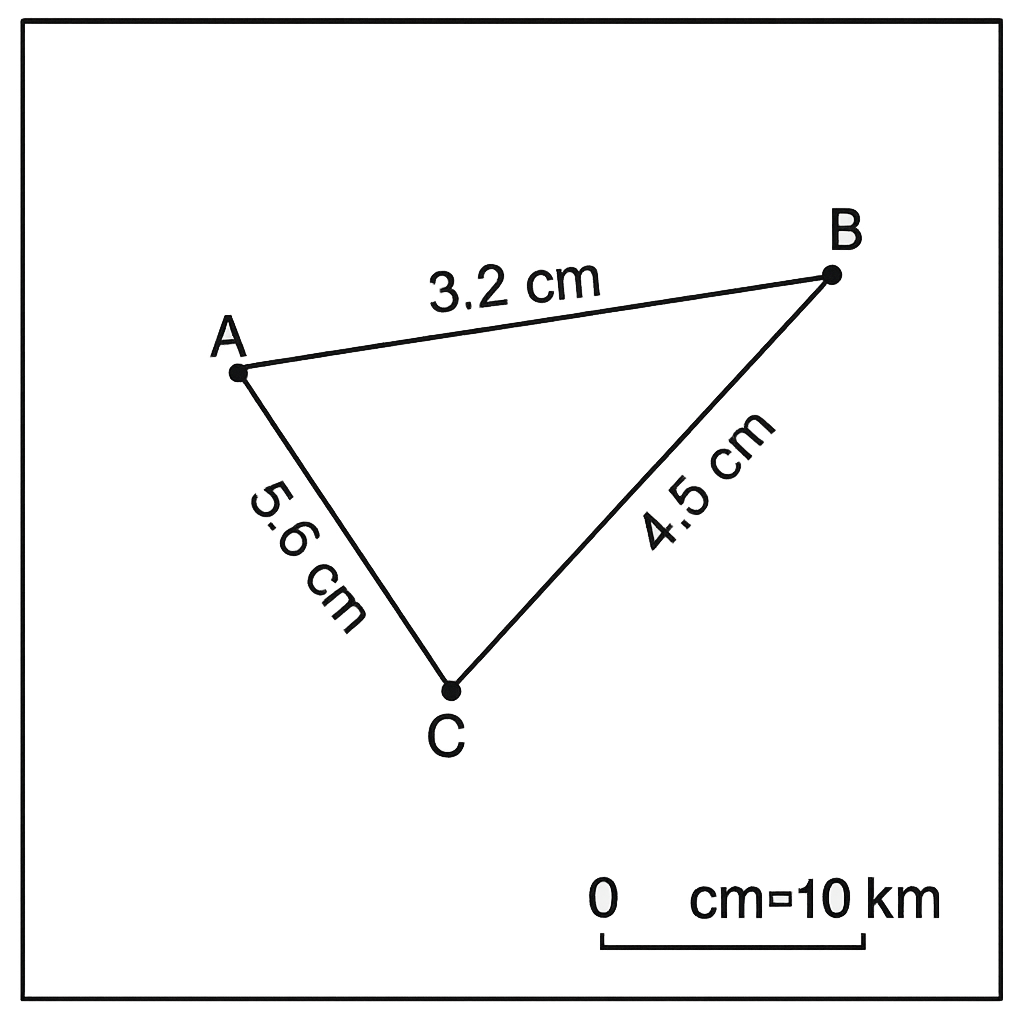
The map shows three towns A, B and C forming a triangle. The map scale is 1 cm = 10 km. Measured on the map, the distances are AB = 3.2 cm, BC = 4.5 cm and AC = 5.6 cm. Calculate the actual area of the triangle formed by the three towns in square kilometres, rounded to the nearest whole number.
Correct A. 720 km²
B. 950 km²
C. 800 km²
D. 650 km²

Correct Answer: A

Want to see the full step-by-step solution? Unlock AI Explanation & Analytics
Question 21 View Details
Town A had a population of 80,000 in 2010 and grew at a constant rate of 2.5 % per annum (compounded annually). Town B also had 95,000 inhabitants in 2010; each year it experienced a natural increase of 1.8 % (compounded) and a net migration gain of 1,200 persons. In 2018, the WAEC definition of a city requires a population of at least 100,000 and the presence of a university. Only Town A possesses a university. Which, if any, of the two towns qualifies as a city in 2018?
A. Town B qualifies as a city in 2018.
B. Town A qualifies as a city in 2018.
C. Both towns qualify as a city in 2018.
Correct D. No town qualifies as a city in 2018.

Correct Answer: D

Want to see the full step-by-step solution? Unlock AI Explanation & Analytics
Question 22 View Details
A catchment area of 250 km² receives an average annual rainfall of 1,200 mm. Of the rainfall, 40 % is lost to evapotranspiration, 10 % infiltrates to groundwater and the remainder becomes surface runoff. A dam is constructed that can store 15 % of the annual runoff. What is the maximum annual volume of water (in million cubic metres) that can be stored in the dam?
A. 25.0
B. 20.0
Correct C. 22.5
D. 18.0

Correct Answer: C

Want to see the full step-by-step solution? Unlock AI Explanation & Analytics
Question 23 View Details
A coastal town suffers on average each year from flood damage costing ₦45 million (standard deviation ₦12 million) and from coastal erosion costing ₦8 million (standard deviation ₦3 million). A proposed Integrated Coastal Management (ICM) plan requires an upfront investment of ₦30 million, reduces expected flood damage by 40 % and erosion loss by 25 %, and adds an annual maintenance cost of ₦2 million. Ignoring discounting and using only expected values, should the town adopt the ICM plan over a 5‑year horizon? Show the total expected cost with and without the plan and state the decision.
A. No; the plan saves only ₦5 million over 5 years, insufficient to adopt.
Correct B. Yes; the plan saves ₦60 million over 5 years, so it should be adopted.
C. No; the plan costs ₦15 million more over 5 years, so it should not be adopted.
D. Yes; the plan saves ₦30 million over 5 years, so it should be adopted.

Correct Answer: B

Want to see the full step-by-step solution? Unlock AI Explanation & Analytics
Question 24 View Details
A region receives a mean annual rainfall of 1,100 mm and a mean annual temperature of 24 °C. Potential evapotranspiration (PET) for the region is estimated by PET = 0.6 × temperature (°C) × 10 mm. Calculate the net water balance (rainfall - PET) and, using the WAEC classification, state the likely vegetation type: rainforest (net > 200 mm), savanna (0 ≤ net ≤ 200 mm), or desert (net < 0 mm).
A. Net balance = 1085.6 mm; vegetation type = rainforest.
B. Net balance = -50 mm; vegetation type = desert.
C. Net balance = 800 mm; vegetation type = savanna.
Correct D. Net balance = 956 mm; vegetation type = rainforest.

Correct Answer: D

Want to see the full step-by-step solution? Unlock AI Explanation & Analytics
Question 25 View Details
A sedimentary rock sample after weathering contains 55 % quartz, 30 % feldspar, 10 % mica and 5 % clay by weight. The weathering process removed 10 % of the original feldspar mass while leaving the other minerals unchanged. Determine the original proportion of feldspar in the rock before weathering and, using the WAEC classification, state whether the original rock is a sandstone, an arkose (quartz 40‑60 % and feldspar > 25 %) or a graywacke (quartz > 60 % with significant clay).
Correct A. Original feldspar ≈ 33.3 %; the rock is classified as an arkose.
B. Original feldspar ≈ 40 %; the rock is classified as a sandstone.
C. Original feldspar ≈ 30 %; the rock is classified as a sandstone.
D. Original feldspar ≈ 35 %; the rock is classified as a graywacke.

Correct Answer: A

Want to see the full step-by-step solution? Unlock AI Explanation & Analytics

Master the Exam!

You've seen a preview, but there are thousands more questions plus AI tutor to break down complex solutions.

Unlock Full Access Available for Android & Windows
Help others prepare! Share this practice hub:
Chat with Support