waec model questions vol1 2018 chemistry | Essay

Prepare for your exams with waec model questions vol1 questions? Reviewing past/model questions is one of the most effective ways to guarantee a high score. This practice hub features authentic 2018 chemistry (Essay) questions designed to simulate the real exam environment.

Practice these randomly selected questions to test your readiness.
Question 1 View Details
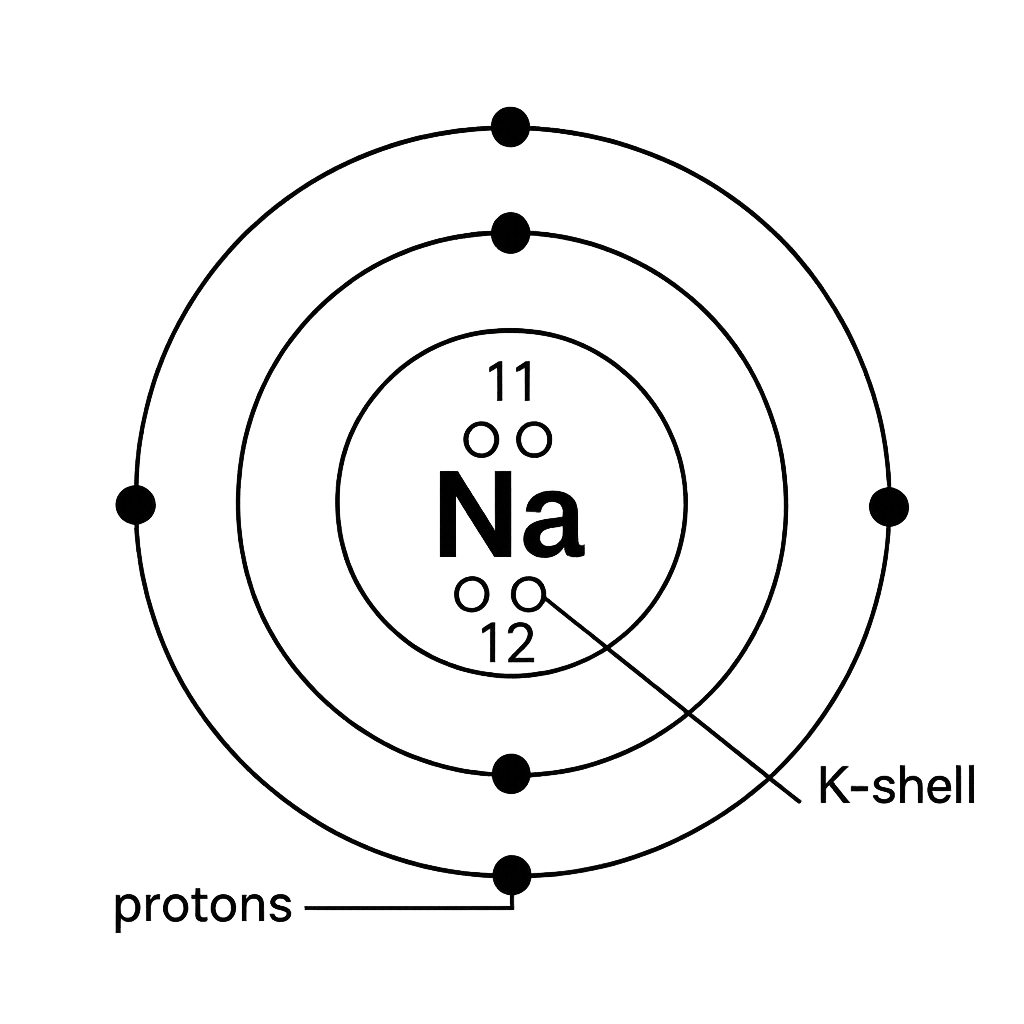
The diagram shows a neutral atom of sodium (Na). The nucleus contains protons and neutrons, and the electron shells are labelled K, L and M with the indicated numbers of electrons.
Question Parts
(a)
State the atomic number, mass number and the number of neutrons of the atom shown.
(b)
Write the full electron configuration of sodium in the order of increasing energy levels.
(c)
When the atom is placed in an electric discharge tube it emits yellow light of wavelength 589.0 nm. Identify the electronic transition responsible for this emission and, using the Bohr model, explain why this wavelength is observed.
(d)
An isotope of sodium, Na‑24, has a mass number of 24. Calculate the percentage of neutrons in this isotope relative to its mass number (express your answer to one decimal place).
Detailed Essay Solution & Marking Scheme Available

Get the step-by-step mathematical proofs, key points required by examiners, and a comprehensive breakdown from our AI Tutor.
Question 2 View Details
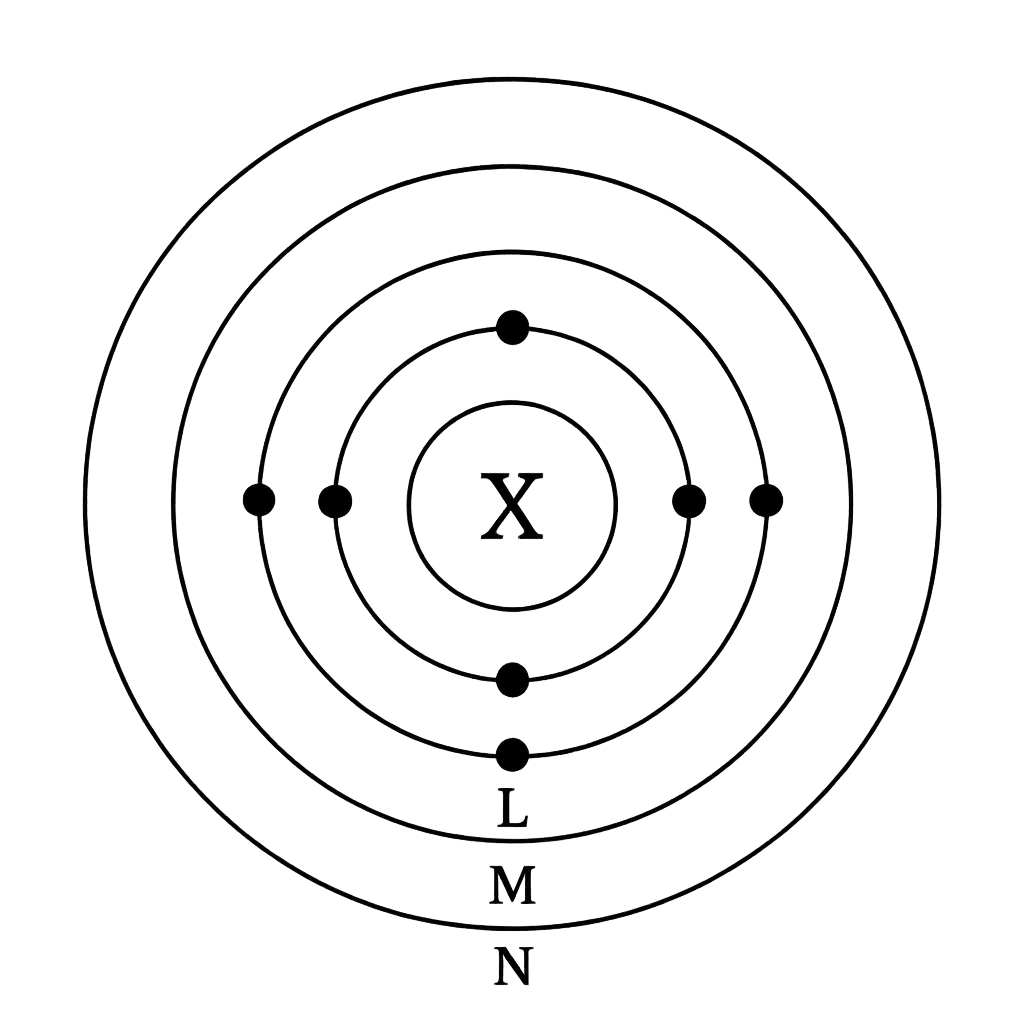
The diagram shows the Bohr model of an unknown element X. The model displays four electron shells labelled K, L, M and N containing 2, 8, 8 and 2 electrons respectively.
Question Parts
(a)
Identify the element X. State its chemical symbol and atomic number.
(b)
Write the ground‑state electron configuration of element X in (i) long form and (ii) noble‑gas shorthand.
(c)
When element X reacts with a halogen (group 17 element), what ion does X form? Write the chemical formula of the binary compound formed with chlorine.
(d)
Using periodic trends, explain why the first ionisation energy of element X is lower than that of its immediate predecessor in the same period.
Detailed Essay Solution & Marking Scheme Available

Get the step-by-step mathematical proofs, key points required by examiners, and a comprehensive breakdown from our AI Tutor.

Question 3 View Details
A metal M from the first transition series forms an ionic compound with chlorine. In this compound the metal exhibits a +2 oxidation state and the compound has a high melting point. The metal also forms a covalent oxide MO₂ in which the metal exhibits a +4 oxidation state.
Question Parts
(a)
Write the chemical formula of the ionic compound formed between the metal M and chlorine.
(b)
Explain qualitatively why the lattice energy of MCl₂ is relatively high. In your answer discuss the effect of ionic charge and ionic radius and compare with a hypothetical compound MX where the metal is in the +1 oxidation state.
(c)
The metal also forms a covalent oxide MO₂ in which the metal has a +4 oxidation state. Compare the physical properties (melting point and electrical conductivity) of the ionic compound MCl₂ and the covalent oxide MO₂ and explain the differences on the basis of the type of bonding present.
Detailed Essay Solution & Marking Scheme Available

Get the step-by-step mathematical proofs, key points required by examiners, and a comprehensive breakdown from our AI Tutor.

Question 4 View Details
The diagram shows the structural formula of an unknown organic acid X.
Question Parts
(a)
Determine the empirical formula of compound X from the structural diagram.
(b)
A 0.0180 g sample of X is dissolved in water and titrated with 0.0200 M NaOH. The equivalence point is reached after 10.0 mL of NaOH solution. Calculate the molar mass of X.
(c)
Using the empirical formula obtained in part (a) and the molar mass from part (b), determine the molecular formula of X and state the common name of the compound.
Detailed Essay Solution & Marking Scheme Available

Get the step-by-step mathematical proofs, key points required by examiners, and a comprehensive breakdown from our AI Tutor.

Question 5 View Details
A 20.0 g mixture of calcium carbonate (CaCO₃) and magnesium carbonate (MgCO₃) contains 12.0 g of CaCO₃ and 8.0 g of MgCO₃. The mixture is reacted with excess hydrochloric acid according to the equations: CaCO₃ + 2HCl → CaCl₂ + CO₂ + H₂O MgCO₃ + 2HCl → MgCl₂ + CO₂ + H₂O (a) Calculate the theoretical mass of carbon dioxide gas that can be evolved when the mixture reacts completely. (b) The CO₂ produced is collected over water at 25 °C and a total pressure of 760 mmHg, giving a volume of 5.00 L. Determine the percent yield of CO₂ based on the theoretical mass obtained in part (a). (c) Explain why excess HCl is required for the reaction and discuss two practical considerations when collecting the gas over water.
Question Parts
(a)
Calculate the theoretical mass of carbon dioxide gas that can be evolved when the mixture reacts completely.
(b)
The CO₂ produced is collected over water at 25 °C and a total pressure of 760 mmHg, giving a volume of 5.00 L. Determine the percent yield of CO₂ based on the theoretical mass obtained in part (a).
(c)
Explain why excess HCl is required for the reaction and discuss two practical considerations when collecting the gas over water.
Detailed Essay Solution & Marking Scheme Available

Get the step-by-step mathematical proofs, key points required by examiners, and a comprehensive breakdown from our AI Tutor.

Question 6 View Details
A rigid sealed container of volume 2.00 L contains a mixture of nitrogen (N₂) and oxygen (O₂) gases at 298 K. The total pressure of the mixture is 1.20 atm and the partial pressure of nitrogen is 0.78 atm. (a) Determine the number of moles of N₂ and O₂ present in the container. (b) The container is then cooled to 273 K while the volume remains constant. Calculate the new total pressure of the gas mixture. (c) Using the kinetic molecular theory, explain why the pressure changes as observed in part (b).
Question Parts
(a)
Determine the number of moles of N₂ and O₂ present in the container.
Detailed Essay Solution & Marking Scheme Available

Get the step-by-step mathematical proofs, key points required by examiners, and a comprehensive breakdown from our AI Tutor.

Question 7 View Details
A buffer solution is prepared by mixing a weak monoprotic acid HA (pK_a = 4.75) with its sodium salt NaA. The total volume of the solution after mixing is 1.00 L.
Question Parts
(a)
Write the expression for the acid dissociation constant K_a of HA and derive the Henderson–Hasselbalch equation relating pH, pK_a and the ratio [A⁻]/[HA].
(b)
Calculate the pH of the buffer when 0.250 mol of HA and 0.150 mol of NaA are dissolved in the 1.00 L solution.
(c)
If 0.050 mol of a strong acid (HCl) is added to the buffer, calculate the new pH, assuming the volume remains 1.00 L.
(d)
Determine the buffer capacity (β) for the addition of a small amount of strong acid, defined as β = Δn/ΔpH, where Δn is the number of moles of H⁺ added. Use the data from part (c) with Δn = 0.010 mol of HCl added to the original buffer (before any acid was added).
Detailed Essay Solution & Marking Scheme Available

Get the step-by-step mathematical proofs, key points required by examiners, and a comprehensive breakdown from our AI Tutor.

Question 8 View Details
A student is investigating the solubility of potassium nitrate (KNO₃) in water using the apparatus shown in the diagram. The set‑up consists of a beaker placed on a water‑bath, a calibrated thermometer, a magnetic stirrer, and a filter funnel with a pre‑weighed dry filter paper. The student records the mass of KNO₃ that dissolves in 100 mL of water at three different temperatures as follows: • 30 °C → 32.0 g per 100 mL • 50 °C → 55.0 g per 100 mL • 70 °C → 84.0 g per 100 mL Using this data, answer the following questions:
Question Parts
(a)
Assuming a linear relationship between solubility (g · 100 mL⁻¹) and temperature (°C), estimate the solubility of KNO₃ at 90 °C.
(b)
Using the van’t Hoff equation \(\ln S = -\dfrac{\Delta H_{sol}}{R}\dfrac{1}{T}+\text{constant}\), where \(S\) is the molar solubility (mol L⁻¹) and \(R = 8.314\,\text{J mol}^{-1}\text{K}^{-1}\), calculate the approximate enthalpy change \(\Delta H_{sol}\) (in kJ mol⁻¹) for the dissolution of KNO₃. Use the data at 30 °C and 70 °C only. Show all steps.
(c)
Explain, in terms of the sign of \(\Delta H_{sol}\), why the solubility of KNO₃ increases with temperature.
(d)
Suggest two practical improvements that could be made to the experimental procedure to increase the reliability of the solubility determination.
Detailed Essay Solution & Marking Scheme Available

Get the step-by-step mathematical proofs, key points required by examiners, and a comprehensive breakdown from our AI Tutor.

Master the Exam!

You've seen a preview, but there are thousands more questions plus AI tutor to break down complex solutions.

Unlock Full Access Available for Android & Windows
Help others prepare! Share this practice hub:
Chat with Support