waec model questions vol1 2018 biology | Objective

Are you preparing for waec model questions vol1 exams? Reviewing past questions is one of the most effective ways to guarantee a high score. This practice hub features authentic 2018 biology (Objective) questions designed to simulate the real exam environment.

Practice these randomly selected questions to test your readiness.

Question 1 View Details
A kidney filters plasma at a glomerular filtration rate of 125 mL/min. The plasma sodium concentration is 140 mmol/L. 98% of the filtered sodium is reabsorbed. The urine flow rate is 1.5 mL/min. What is the concentration of sodium in the urine (mmol/L)?
A. 116.7
B. 200.0
Correct C. 233.3
D. 350.0

Correct Answer: C

Want to see the full step-by-step solution? Unlock AI Explanation & Analytics
Question 2 View Details
A diploid somatic cell undergoes mitosis. Compared with the parent cell, how many chromosomes are present in each daughter cell?
A. Half the number of chromosomes as the parent cell
Correct B. The same number of chromosomes as the parent cell
C. One more chromosome than the parent cell
D. Double the number of chromosomes as the parent cell

Correct Answer: B

Want to see the full step-by-step solution? Unlock AI Explanation & Analytics
Question 3 View Details
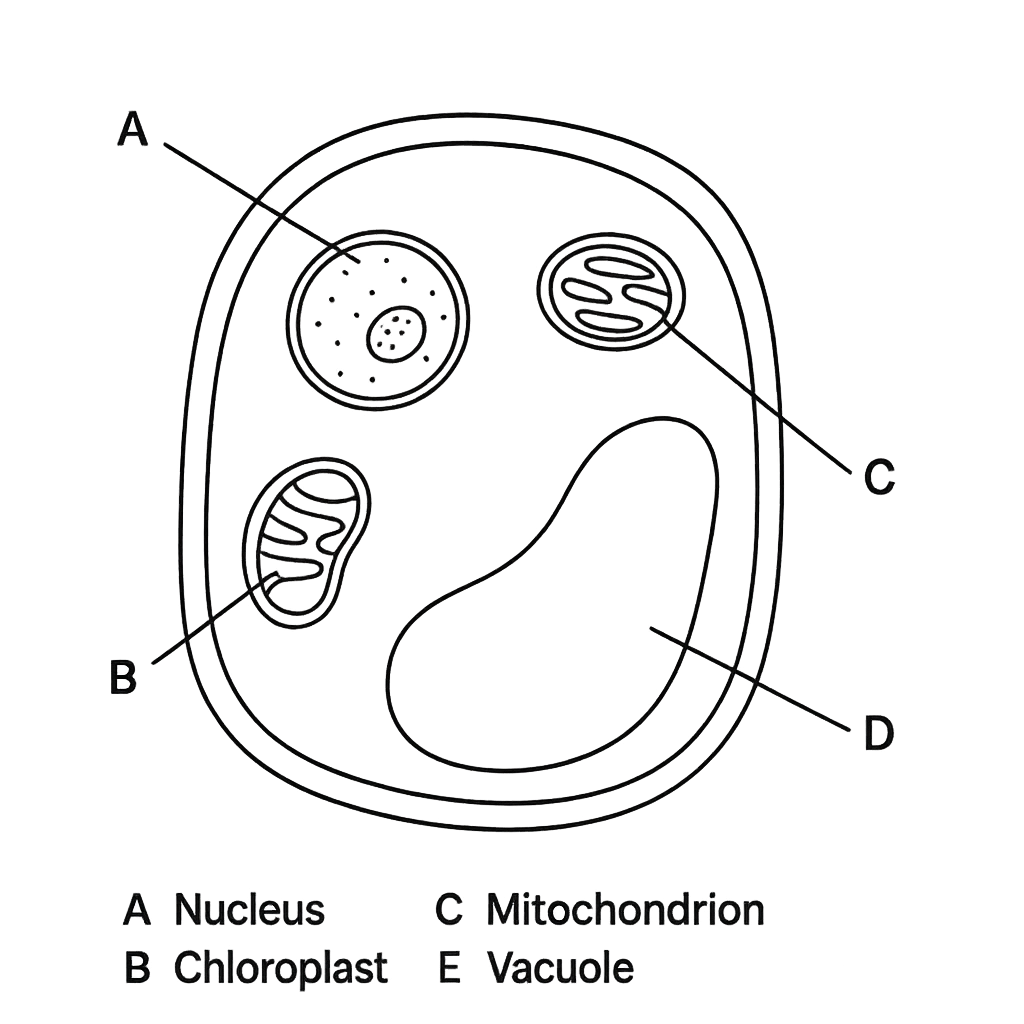
The diagram of a plant cell labels five structures: A - Nucleus, B - Mitochondrion, C - Chloroplast, D - Cell wall, E - Vacuole. Which labelled structure is the primary site of photosynthesis?
A. A
B. B
Correct C. C
D. D

Correct Answer: C

Want to see the full step-by-step solution? Unlock AI Explanation & Analytics
Question 4 View Details
A cactus has a cylindrical stem of radius 5 cm and height 20 cm. Its spines reduce the effective exposed surface area by 30%. Water loss from the stem is proportional to the exposed surface area with a constant k = 0.05 mg·cm⁻²·hr⁻¹. A leaf of the same volume is approximated as a sphere and has no spines. Calculate the hourly water loss from (a) the cactus stem and (b) the leaf, and state which organ loses less water.
A. Cactus ≈ 18 mg\/hr; Leaf ≈ 40 mg\/hr; the cactus loses less water
Correct B. Cactus ≈ 22 mg/hr; Leaf ≈ 33 mg/hr; the cactus loses less water
C. Cactus ≈ 30 mg\/hr; Leaf ≈ 25 mg\/hr; the leaf loses less water
D. Cactus ≈ 25 mg\/hr; Leaf ≈ 20 mg\/hr; the leaf loses less water

Correct Answer: B

Want to see the full step-by-step solution? Unlock AI Explanation & Analytics
Question 5 View Details
A diploid cell containing 24 chromosomes undergoes meiosis. How many chromosomes are present in each of the four resulting haploid gametes?
A. 24
Correct B. 12
C. 48
D. 6

Correct Answer: B

Want to see the full step-by-step solution? Unlock AI Explanation & Analytics
Question 6 View Details
In a lake ecosystem there are four trophic levels: phytoplankton (primary producers), zooplankton (primary consumers), small fish (secondary consumers) and a top‑predator fish (tertiary consumer). The ecological efficiency between each successive level is 12%. If the total biomass of the top‑predator fish population is 250 kg and the system is in steady state, what is the minimum total biomass of phytoplankton required to support this top‑predator population? Give your answer in kilograms, rounded to the nearest kilogram.
Correct A. 144677
B. 150000
C. 200000
D. 130000

Correct Answer: A

Want to see the full step-by-step solution? Unlock AI Explanation & Analytics
Question 7 View Details
A transport company operates a bus that travels from City A to City B (200 km) and then to City C (150 km). The bus travels the first leg at a constant speed that is 20 km/h faster than the speed on the second leg. The total time taken for the whole journey is 6 hours. What is the speed of the bus on the second leg? Give your answer in km/h, rounded to the nearest whole number.
A. 45
B. 60
Correct C. 49
D. 55

Correct Answer: C

Want to see the full step-by-step solution? Unlock AI Explanation & Analytics
Question 8 View Details
A woman has a regular 30‑day menstrual cycle. Her luteal phase is constant at 14 days. She records a sustained rise in basal body temperature beginning on day 17 of her cycle. Assuming the temperature rise starts the day after ovulation, on which day of the cycle did ovulation occur? Provide the day number.
A. 17
B. 14
Correct C. 16
D. 18

Correct Answer: C

Want to see the full step-by-step solution? Unlock AI Explanation & Analytics
Question 9 View Details
A truck carries a load of 10 tonnes over a distance of 400 km. When empty, its fuel consumption is 30 L per 100 km, and the consumption increases by 0.5 L per 100 km for each tonne of load carried. Fuel costs ₦200 per litre. After delivering the load, the truck returns empty over the same distance. What is the total fuel cost for the round trip? Give your answer in naira, without commas.
A. 54000
B. 50000
Correct C. 52000
D. 48000

Correct Answer: C

Want to see the full step-by-step solution? Unlock AI Explanation & Analytics
Question 10 View Details
A diet plan provides 2500 kcal per day. It includes 60 g of protein, 70 g of fat, and the remainder as carbohydrate. Protein and carbohydrate each supply 4 kcal per gram, while fat supplies 9 kcal per gram. What percentage of the total calories comes from carbohydrate? Give your answer to one decimal place.
Correct A. 65.2
B. 71.6
C. 58.4
D. 62

Correct Answer: A

Want to see the full step-by-step solution? Unlock AI Explanation & Analytics
Question 11 View Details
In a closed community of 10,000 people, a newly emerged infectious disease has an incubation period of 5 days and an infectious period of 3 days. Each infectious individual transmits the disease to exactly 2 susceptible persons per day. At the start (day 0) five persons become infected. Assuming no control measures and that the whole population is initially susceptible, how many new infections will occur during the first 10 days?
A. 35
B. 40
Correct C. 30
D. 25

Correct Answer: C

Want to see the full step-by-step solution? Unlock AI Explanation & Analytics
Question 12 View Details
A certain solute X has a plasma concentration of 0.8 mg L⁻¹. In a urine sample its concentration is 4 mg L⁻¹ and the urine flow rate is 1.5 mL min⁻¹. Calculate the renal clearance of X and state whether X is freely filtered (normal glomerular filtration rate ≈ 125 mL min⁻¹).
Correct A. 7.5 mL min⁻¹ (not freely filtered)
B. 12.5 mL min⁻¹ (freely filtered)
C. 9.0 mL min⁻¹ (not freely filtered)
D. 6.0 mL min⁻¹ (freely filtered)

Correct Answer: A

Want to see the full step-by-step solution? Unlock AI Explanation & Analytics
Question 13 View Details
A subject has a plasma osmolarity of 285 mOsm kg⁻¹. After a period of water deprivation, his urine osmolarity rises to 800 mOsm kg⁻¹ and his urine volume for the day is 0.5 L. (a) Calculate the total amount of solute excreted in that day. (b) Considering that the maximal concentrating ability of human kidneys is about 1200 mOsm kg⁻¹, state whether the kidneys are concentrating urine maximally.
Correct A. 400 mOsm; kidneys are not concentrating maximally
B. 200 mOsm; kidneys are concentrating maximally
C. 400 mOsm; kidneys are concentrating maximally
D. 800 mOsm; kidneys are not concentrating maximally

Correct Answer: A

Want to see the full step-by-step solution? Unlock AI Explanation & Analytics
Question 14 View Details
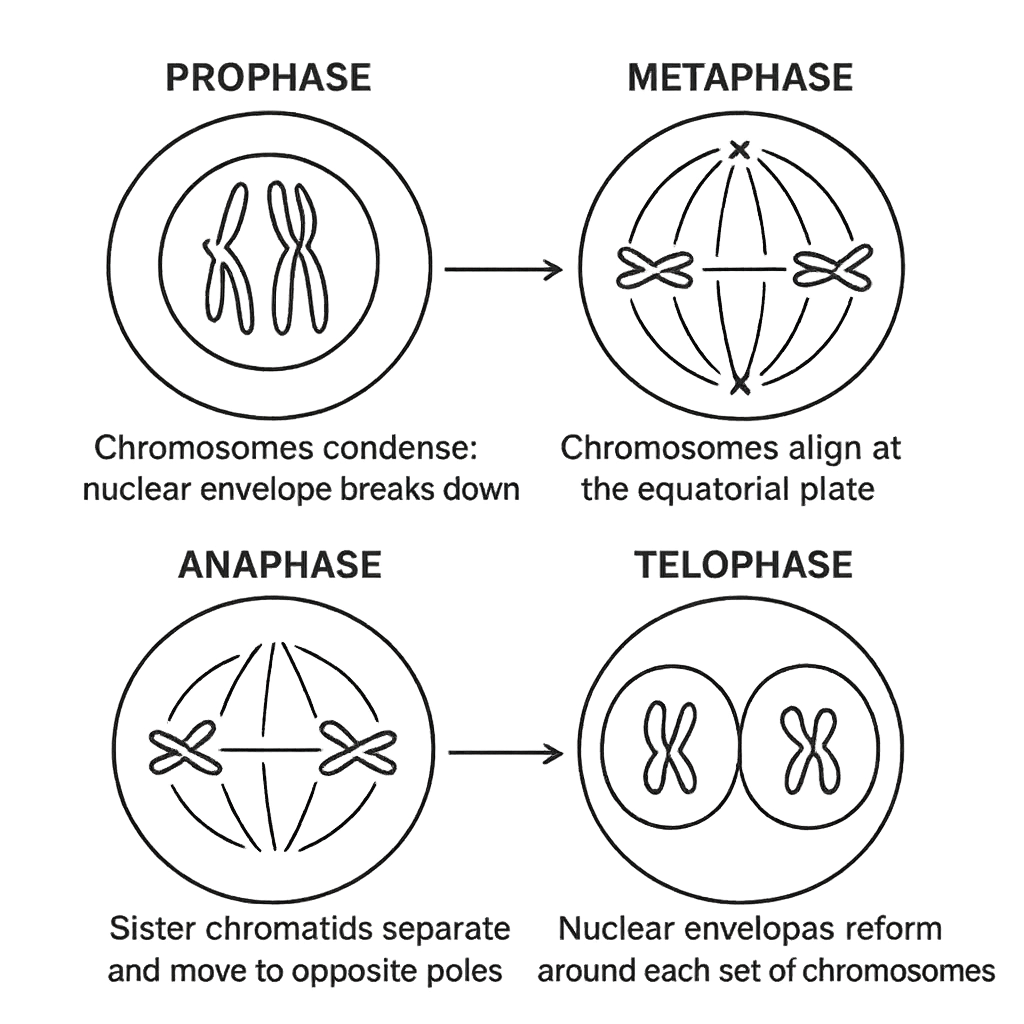
The diagram shows the stages of mitosis in a typical animal cell. Identify the stage in which the chromosomes are aligned at the cell's equatorial plate.
A. Anaphase
B. Telophase
C. Prophase
Correct D. Metaphase

Correct Answer: D

Want to see the full step-by-step solution? Unlock AI Explanation & Analytics
Question 15 View Details
A simple reflex arc consists of a sensory neuron that conducts impulses 0.8 m at 60 m s⁻¹, a single synapse with a delay of 0.5 ms, and a motor neuron that conducts impulses 0.6 m at 50 m s⁻¹. Calculate the total time from the initial stimulus to the onset of muscle contraction, expressing your answer in milliseconds (rounded to the nearest whole number).
A. 31 ms
B. 29 ms
Correct C. 26 ms
D. 24 ms

Correct Answer: C

Want to see the full step-by-step solution? Unlock AI Explanation & Analytics
Question 16 View Details
In a human, the hypothalamic set point for core temperature is unknown. When the core temperature (T_core) exceeds the set point, sweating begins at a rate (L/min) = 0.1 × (T_core - set_point). Each litre of sweat evaporated removes 0.6 °C from the core. A subject initially has T_core = 38 °C. After 5 minutes of exposure, the core temperature falls to 37 °C. Assuming the sweating rate remains constant during this interval, determine the hypothalamic set point (in °C) to one decimal place.
A. 33.9 °C
Correct B. 34.7 °C
C. 36.1 °C
D. 35.2 °C

Correct Answer: B

Want to see the full step-by-step solution? Unlock AI Explanation & Analytics
Question 17 View Details
A bacterial culture starts with 2 × 10⁶ cells. During the exponential phase the population doubles every 30 minutes. After 2 hours an antibiotic is added that reduces the growth rate by 40 % (i.e., the number of generations per hour becomes 60 % of the original). The culture is then allowed to grow for another 3 hours, after which the cell count is measured as 3.9 × 10⁸ cells. Assuming the growth remains exponential after the antibiotic addition, what is the new generation time (in minutes) under the antibiotic?
A. 60 minutes
B. 55 minutes
Correct C. 50 minutes
D. 45 minutes

Correct Answer: C

Want to see the full step-by-step solution? Unlock AI Explanation & Analytics
Question 18 View Details
A human somatic cell contains 46 chromosomes. After the S‑phase of the cell cycle, each chromosome has been replicated. How many chromatids are present in the cell at the end of S‑phase, just before mitosis begins?
Correct A. 92 chromatids
B. 46 chromatids
C. 48 chromatids
D. 94 chromatids

Correct Answer: A

Want to see the full step-by-step solution? Unlock AI Explanation & Analytics
Question 19 View Details
In a population of beetles, two alleles A and a at a single locus have initial frequencies p = 0.7 (A) and q = 0.3 (a). The relative fitnesses of the genotypes are w_{AA}=1.0, w_{Aa}=0.8 and w_{aa}=0.5. After one generation of selection, what is the frequency of allele A in the population?
Correct A. 0.76
B. 0.68
C. 0.70
D. 0.80

Correct Answer: A

Want to see the full step-by-step solution? Unlock AI Explanation & Analytics
Question 20 View Details
A fish population in a lake follows the logistic growth model \(\frac{dN}{dt}=rN\left(1-\frac{N}{K}\right)\), where the intrinsic growth rate r = 0.8 month⁻¹ and the carrying capacity K = 10 000 fish. A constant harvest H (fish per month) is applied. What is the greatest constant harvest (in fish per month) that can be sustained indefinitely without causing the population to decline to extinction?
A. 2500 fish per month
B. 1500 fish per month
C. 1800 fish per month
Correct D. 2000 fish per month

Correct Answer: D

Want to see the full step-by-step solution? Unlock AI Explanation & Analytics
Question 21 View Details
A semi‑aquatic amphibian species occurs in two habitats. In fast‑flowing streams its skin thickness is 0.8 mm and its measured cutaneous respiration rate is 12 ml O₂ h⁻¹ g⁻¹. In stagnant ponds the same species has a skin thickness of 1.2 mm and a respiration rate of 8 ml O₂ h⁻¹ g⁻¹. Assuming oxygen diffusion through the skin obeys Fick's law, where the diffusion rate is proportional to the ratio of skin surface area (A) to thickness (t) (rate ∝ A/t) and that the proportionality constant is the same in both habitats, determine the ratio of the effective skin surface areas (Aₚond / Aₛtream). What does this imply about the primary morphological adaptation that enables the amphibian to maintain higher oxygen uptake in streams?
A. The effective skin surface areas favor the stream (ratio = 0.67); the primary adaptation is a thicker skin in the stream environment.
B. The effective skin surface areas are twice as great in the pond (ratio = 2); the main adaptation is a reduced metabolic demand in the pond habitat.
Correct C. The effective skin surface areas are equal (ratio = 1); the key adaptation is the reduced skin thickness in the stream habitat.
D. The effective skin surface areas are larger in the pond (ratio = 1.5); the key adaptation is an increased surface area in the pond habitat.

Correct Answer: C

Want to see the full step-by-step solution? Unlock AI Explanation & Analytics
Question 22 View Details
In a monosynaptic stretch reflex, the sensory neuron conducts an impulse over a distance of 0.40 m at a velocity of 80 m s⁻¹, then synapses onto the motor neuron with a synaptic delay of 0.5 ms, after which the motor neuron conducts the impulse over 0.60 m at 60 m s⁻¹ to the effector muscle. Calculate the total elapsed time from the onset of muscle stretch to the beginning of muscle contraction. Express your answer in milliseconds (ms).
Correct A. 15.5 ms
B. 18.0 ms
C. 16.0 ms
D. 14.5 ms

Correct Answer: A

Want to see the full step-by-step solution? Unlock AI Explanation & Analytics
Question 23 View Details
A bacterial culture starts with 2.0 × 10⁶ cells. After a total incubation time of 4.5 h, the population reaches 1.6 × 10⁷ cells. The first 30 min of the incubation is a lag phase during which no cell division occurs. Assuming exponential growth during the remaining period, calculate the generation (doubling) time in minutes.
A. 45 minutes
B. 120 minutes
C. 200 minutes
Correct D. 80 minutes

Correct Answer: D

Want to see the full step-by-step solution? Unlock AI Explanation & Analytics
Question 24 View Details
In a disc diffusion test against a clinical isolate of Staphylococcus aureus, the measured inhibition zone diameters are: Antibiotic X - 22 mm, Antibiotic Y - 18 mm, Antibiotic Z - 30 mm. According to CLSI criteria for this organism, a zone diameter ≥20 mm is interpreted as susceptible, 15-19 mm as intermediate, and ≤14 mm as resistant. Identify the antibiotic that is most effective against the isolate and state its susceptibility category.
A. Antibiotic Z - zone 30 mm (intermediate)
B. Antibiotic Y - zone 18 mm (intermediate)
Correct C. Antibiotic Z - zone 30 mm (susceptible)
D. Antibiotic X - zone 22 mm (susceptible)

Correct Answer: C

Want to see the full step-by-step solution? Unlock AI Explanation & Analytics
Question 25 View Details
A woman's serum hormone concentrations on a particular day of her menstrual cycle are: estradiol 350 pg mL⁻¹, progesterone 2 ng mL⁻¹, luteinising hormone (LH) 5 IU L⁻¹. Based on these values, determine the phase of the menstrual cycle (menstrual, follicular, ovulatory, or luteal) she is in.
A. Ovulatory phase (mid‑ovulatory)
Correct B. Follicular phase (mid‑follicular)
C. Menstrual phase (early‑menstrual)
D. Luteal phase (mid‑luteal)

Correct Answer: B

Want to see the full step-by-step solution? Unlock AI Explanation & Analytics

Master the Exam!

You've seen a preview, but there are thousands more questions plus AI tutor to break down complex solutions.

Unlock Full Access Available for Android & Windows
Help others prepare! Share this practice hub:
Chat with Support