waec model questions vol1 2018 agricultural_science | Objective

Prepare for your exams with waec model questions vol1 questions? Reviewing past/model questions is one of the most effective ways to guarantee a high score. This practice hub features authentic 2018 agricultural_science (Objective) questions designed to simulate the real exam environment.

Practice these randomly selected questions to test your readiness.

Question 1 View Details
A fish population in a lake follows the logistic growth model dP/dt = rP(1 - P/K), where r is the intrinsic growth rate and K the carrying capacity. At present the population is stable at 4,000 fish with an annual harvest of 1,000 fish. The intrinsic rate r is 0.5 per year. (a) Determine the carrying capacity K of the fish stock. (b) If a new policy increases the annual harvest by 25% while r remains unchanged, will the population increase, remain stable, or decline? State the expected trend.
A. Carrying capacity K = 10000 fish; the population will remain stable.
Correct B. Carrying capacity K = 8000 fish; the population will decline.
C. Carrying capacity K = 6000 fish; the population will increase.
D. Carrying capacity K = 8000 fish; the population will increase.

Correct Answer: B

Want to see the full step-by-step solution? Unlock AI Explanation & Analytics
Question 2 View Details
A farmer wants to raise maize yield from 2.5 t ha⁻¹ to 4.0 t ha⁻¹. For each additional tonne of grain, the crop requires 25 kg N ha⁻¹, 12 kg P₂O₅ ha⁻¹ and 20 kg K₂O ha⁻¹. Soil tests show the soil already supplies 30 kg N, 15 kg P₂O₅ and 40 kg K₂O per hectare. The farmer intends to apply a single fertilizer blend that contains 20 % N, 10 % P₂O₅ and 15 % K₂O by weight. What is the minimum amount of this blend (kg ha⁻¹) needed to meet the nutrient deficits for the target yield, and will any nutrient be supplied in excess?
Correct A. 200 kg ha⁻¹ of the blend; nitrogen and phosphorus will be supplied in slight excess.
B. 220 kg ha⁻¹ of the blend; nitrogen will be supplied in slight excess.
C. 200 kg ha⁻¹ of the blend; all nutrients will be supplied exactly to the deficit.
D. 180 kg ha⁻¹ of the blend; potassium will be supplied in slight excess.

Correct Answer: A

Want to see the full step-by-step solution? Unlock AI Explanation & Analytics
Question 3 View Details
A soil sample has a pH of 8.2 and is classified as a calcareous loam. Which major nutrient is most likely to become less available to plants because of this high pH?
Correct A. Phosphorus
B. Calcium
C. Potassium
D. Nitrogen

Correct Answer: A

Want to see the full step-by-step solution? Unlock AI Explanation & Analytics
Question 4 View Details
Explain the role of nitrogen‑fixing bacteria in legume cultivation and how they contribute to soil fertility.
A. They release oxygen into the soil, improving root respiration for the legume.
B. They fix carbon dioxide into sugars that the legume uses as an energy source.
C. They produce ethylene gas, which stimulates legume seed germination.
Correct D. They convert atmospheric nitrogen into ammonia, providing usable nitrogen to the legume and enriching the soil after plant residues decompose.

Correct Answer: D

Want to see the full step-by-step solution? Unlock AI Explanation & Analytics
Question 5 View Details
A tomato farmer observes lower leaves turning yellow, wilting of the whole plant, and brown discoloration of the vascular tissue in the stem. Laboratory analysis isolates a soil‑borne fungus that produces microsclerotia. Identify the disease and propose an integrated management plan that includes cultural, chemical, and genetic control measures.
A. Verticillium wilt of tomato; manage by crop rotation with non‑hosts, soil solarisation or deep ploughing, apply a systemic fungicide (e.g., metalaxyl) as seed‑treatment or soil‑drench, and use Verticillium‑resistant tomato varieties.
Correct B. Fusarium wilt of tomato; manage by crop rotation with non‑hosts, soil solarisation or deep ploughing, apply a systemic fungicide (e.g., carbendazim) as seed‑treatment or soil‑drench, and use Fusarium‑resistant tomato varieties.
C. Bacterial wilt of tomato; manage by crop rotation with non‑hosts, soil solarisation or deep ploughing, apply a systemic fungicide (e.g., carbendazim) as seed‑treatment or soil‑drench, and use bacterial‑resistant tomato varieties.
D. Late blight of tomato; manage by crop rotation with non‑hosts, soil solarisation or deep ploughing, apply a systemic fungicide (e.g., carbendazim) as seed‑treatment or soil‑drench, and use late‑blight‑resistant tomato varieties.

Correct Answer: B

Want to see the full step-by-step solution? Unlock AI Explanation & Analytics
Question 6 View Details
A farmer cultivates 2 hectares of maize. Under disease‑free conditions the crop yields 5 tonnes per hectare. If a particular disease is left untreated, it reduces the yield by 20%. A fungicide can be applied at a cost of ₦12,000 per hectare and restores 90% of the loss caused by the disease. The market price of maize is ₦150 per kilogram. Should the farmer apply the fungicide? State the increase or decrease in profit (in Naira) that results from applying the fungicide.
A. Yes, profit increases by ₦300,000
B. Yes, profit increases by ₦210,000
C. No, profit decreases by ₦30,000
Correct D. Yes, profit increases by ₦246,000

Correct Answer: D

Want to see the full step-by-step solution? Unlock AI Explanation & Analytics
Question 7 View Details
A rabbit farm has 120 breeding does. Each doe produces on average 5 litters per year and each litter contains 6 kits. The survival rate from birth to weaning is 85%. Weanlings are sold at ₦250 each. The feed cost per kit from birth to weaning is ₦40 and the fixed overhead per doe per year is ₦1,200. Calculate the net annual profit of the farm.
A. ₦480,300
B. ₦450,000
C. ₦520,000
Correct D. ₦498,600

Correct Answer: D

Want to see the full step-by-step solution? Unlock AI Explanation & Analytics
Question 8 View Details
A pine plantation is managed on a 30‑year rotation. At the end of the rotation each hectare yields 120 m³ of timber, selling at ₦2,500 per m³. Replanting after harvest costs ₦150,000 per hectare. Annual management (thinning, protection, etc.) costs ₦12,000 per hectare each year. Using a discount rate of 8 % per annum, calculate the Net Present Value (NPV) of one rotation per hectare. State whether the rotation is economically viable (NPV > 0).
A. NPV ≈ -₦95,400; not viable
B. NPV ≈ -₦130,500; viable
Correct C. NPV ≈ -₦120,200; not viable
D. NPV ≈ ₦15,300; viable

Correct Answer: C

Want to see the full step-by-step solution? Unlock AI Explanation & Analytics
Question 9 View Details
A smallholder intends to run a 2.5 kW water pump using a diesel engine that runs at 1500 rpm. The engine's mechanical efficiency is 85 %. Power is transmitted to the pump through a belt drive that has an efficiency of 92 % and a speed‑reduction ratio of 3:1 (engine pulley : pump pulley). Determine the actual power available at the pump shaft and state whether it meets the pump's 2.5 kW requirement.
A. ≈ 1.75 kW; insufficient for the pump
B. ≈ 2.10 kW; sufficient for the pump
C. ≈ 2.50 kW; sufficient for the pump
Correct D. ≈ 1.96 kW; insufficient for the pump

Correct Answer: D

Want to see the full step-by-step solution? Unlock AI Explanation & Analytics
Question 10 View Details
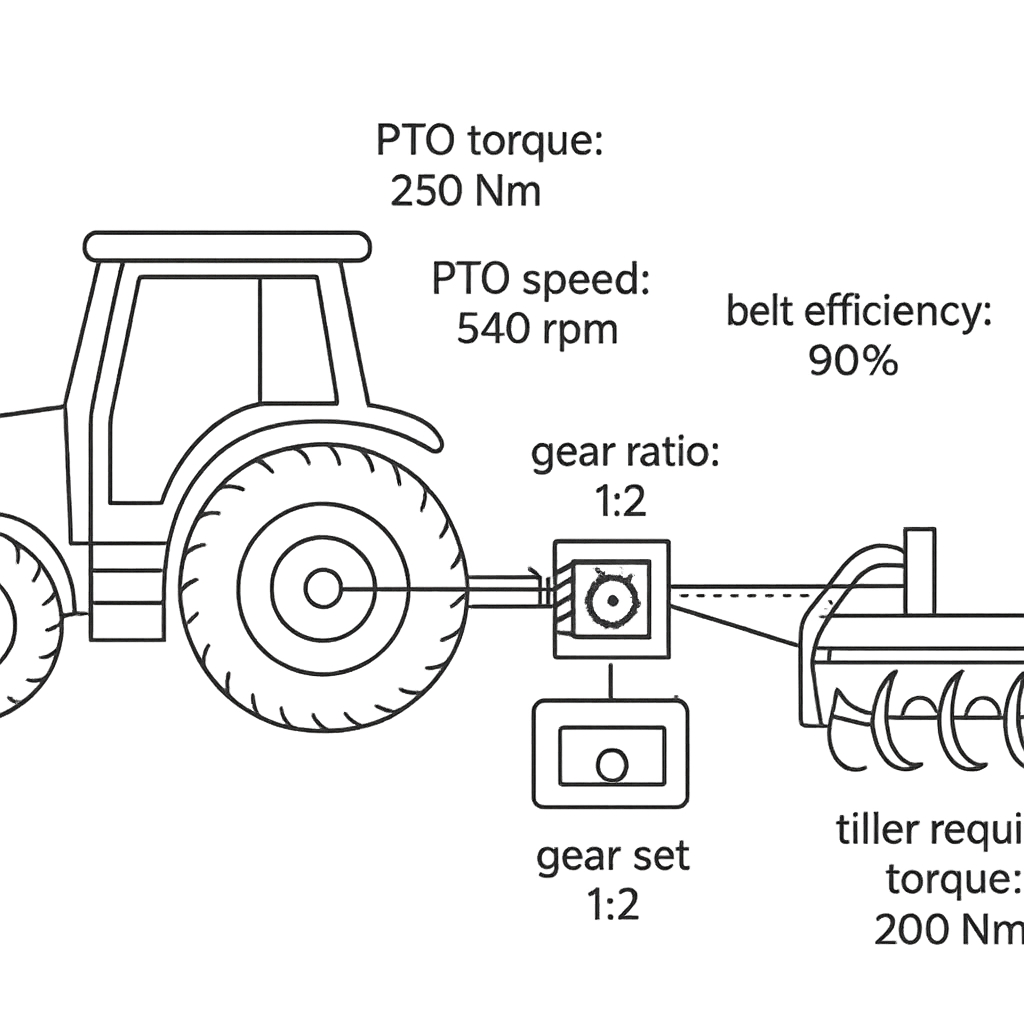
The diagram shows a tractor equipped with a power take‑off (PTO) shaft that drives a rotary tiller. The PTO delivers a torque of 250 Nm at 540 rpm. A gear set reduces the speed to half (ratio 1:2) before it reaches the tiller. The belt drive between the gear set and the tiller has an efficiency of 90 %. The tiller requires a minimum torque of 200 Nm to overcome soil resistance. Using the information in the diagram, determine whether the tractor can operate the tiller and state the maximum torque available at the tiller shaft (in Nm).
Correct A. Yes; 450 Nm available
B. No; 225 Nm available
C. Yes; 500 Nm available
D. Yes; 300 Nm available

Correct Answer: A

Want to see the full step-by-step solution? Unlock AI Explanation & Analytics
Question 11 View Details
A soil sample contains 40% sand, 35% silt and 25% clay. Using the soil texture triangle, what is the texture class of this soil?
A. Clay loam
B. Sandy loam
C. Silt loam
Correct D. Loam

Correct Answer: D

Want to see the full step-by-step solution? Unlock AI Explanation & Analytics
Question 12 View Details
A tractor must pull a plough that requires a drawbar pull of 12 kN while moving forward at 5 km/h. The transmission efficiency is 85% and the engine operates at 90% of its rated power. What minimum rated power (in kW) should the tractor have?
Correct A. 22 kW
B. 24 kW
C. 20 kW
D. 26 kW

Correct Answer: A

Want to see the full step-by-step solution? Unlock AI Explanation & Analytics
Question 13 View Details
A farmer uses a hand hoe as a first‑class lever to lift a 15 kg rock from the soil. The fulcrum is 0.30 m from the handle end (where the farmer applies force) and 0.10 m from the rock. Assuming the farmer pulls vertically upward, what minimum force (in newtons) must he exert?
A. 45 N
Correct B. 49 N
C. 63 N
D. 55 N

Correct Answer: B

Want to see the full step-by-step solution? Unlock AI Explanation & Analytics
Question 14 View Details
A poultry farmer incurs fixed monthly costs of ₦30,000. The variable cost is ₦12 per egg for packaging. Eggs sell for ₦20 each for the first 500 eggs; any additional eggs are sold at a 10 % discount. How many eggs must be sold in a month to break even?
Correct A. 4,834 eggs
B. 3,900 eggs
C. 5,200 eggs
D. 4,500 eggs

Correct Answer: A

Want to see the full step-by-step solution? Unlock AI Explanation & Analytics
Question 15 View Details
A field receives 120 kg of nitrogen from fertilizer. If 30 % of this nitrogen is lost by leaching and 20 % is taken up by the crop, how much nitrogen remains in the soil after the season?
A. 48 kg
B. 96 kg
Correct C. 60 kg
D. 84 kg

Correct Answer: C

Want to see the full step-by-step solution? Unlock AI Explanation & Analytics
Question 16 View Details
A farmer sells 500 kg of maize at a market price of ₦120 per kilogram. The farmer incurs a fixed cost of ₦20 000 and a variable cost of ₦45 per kilogram. If the buyer purchases more than 400 kg, the farmer gives a 10 % discount on the total price, and an additional 5 % discount on the discounted price when payment is made within 30 days. The buyer pays within 30 days, and a sales tax of 2 % is applied on the final discounted amount, which the farmer must remit. What is the farmer's net profit (in naira) from this transaction?
Correct A. 7774
B. 7550
C. 7200
D. 8005

Correct Answer: A

Want to see the full step-by-step solution? Unlock AI Explanation & Analytics
Question 17 View Details
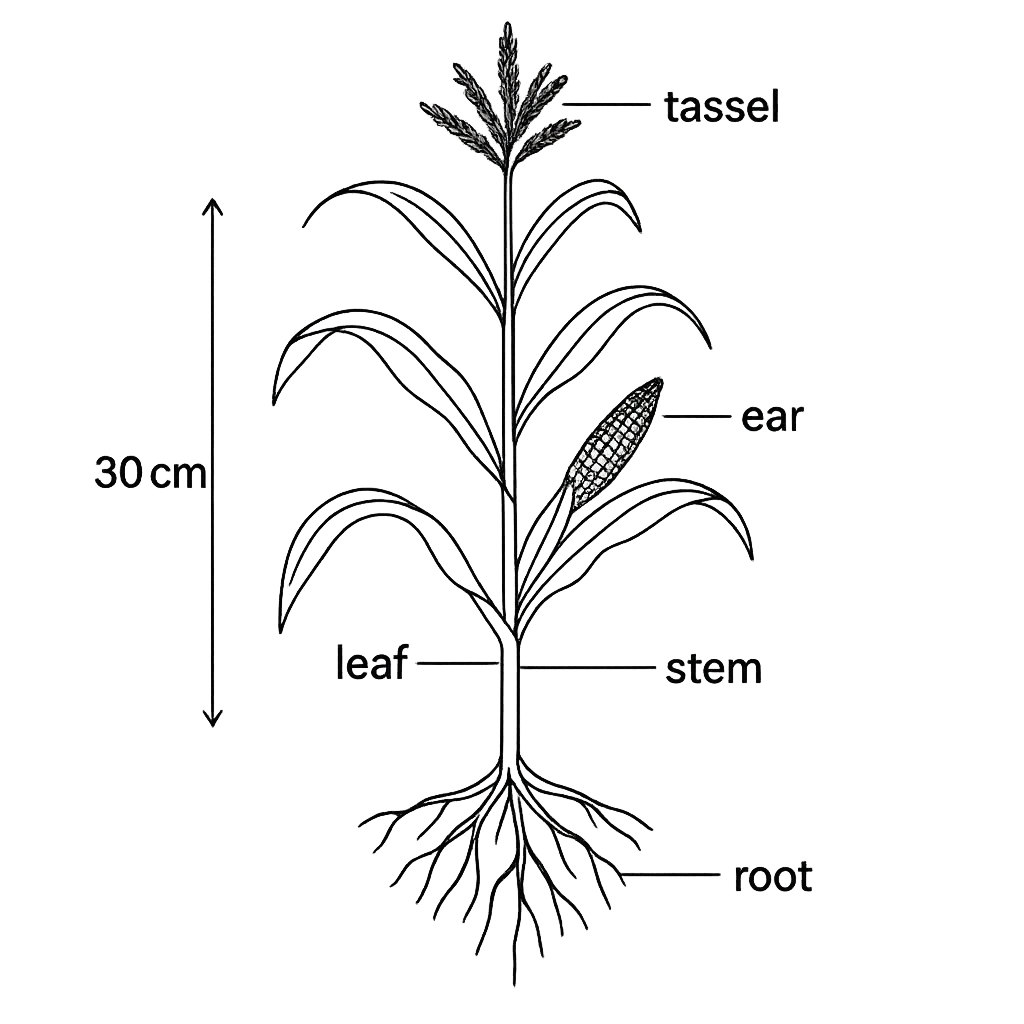
The diagram shows a mature maize plant. Each leaf is 30 cm long and 5 cm wide, and the plant bears 8 leaves. The ground area occupied by the plant is 0.5 m². Assuming leaf area can be approximated by a rectangle, calculate the leaf‑area index (LAI) of the plant. (LAI = total leaf area ÷ ground area).
Correct A. 0.24
B. 0.18
C. 0.30
D. 0.27

Correct Answer: A

Want to see the full step-by-step solution? Unlock AI Explanation & Analytics
Question 18 View Details
A herd of 200 goats is at risk of Peste des petits ruminants (PPR). The basic reproduction number (R₀) for PPR in goats is estimated at 3.5, and the vaccine used has an efficacy of 85 %. Using the herd‑immunity threshold formula H = (1 - 1/R₀) ÷ E, where E is vaccine efficacy expressed as a decimal, determine the minimum number of goats that must be vaccinated to achieve herd immunity. Round up to the nearest whole goat.
A. 170
B. 160
C. 168
Correct D. 169

Correct Answer: D

Want to see the full step-by-step solution? Unlock AI Explanation & Analytics
Question 19 View Details
A farmer applies 120 kg of nitrogen fertilizer per hectare. Of this, 30 % is taken up by the crop, 20 % is lost by volatilisation, and 10 % is lost by denitrification. The remaining nitrogen is lost by leaching. How many kilograms of nitrogen are lost by leaching per hectare?
A. 50
B. 60
C. 42
Correct D. 48

Correct Answer: D

Want to see the full step-by-step solution? Unlock AI Explanation & Analytics
Question 20 View Details
Tomatoes stored in a sealed container lose weight due to respiration. At 25 °C the respiration rate is 0.8 % of the initial weight per day. For each 5 °C decrease in temperature, the respiration rate is reduced by 40 % (i.e., multiplied by 0.6). The farmer wishes the total weight loss over 12 days to be no more than 5 % of the initial weight. What is the highest storage temperature (in °C) that satisfies this condition? Assume the temperature can only be set at 5 °C intervals (25 °C, 20 °C, 15 °C, …).
A. 10
B. 20
C. 25
Correct D. 15

Correct Answer: D

Want to see the full step-by-step solution? Unlock AI Explanation & Analytics
Question 21 View Details
In a forest stand the mean diameter at breast height (DBH) of a tree after t years is given by D = 30(1 - e^{-0.03 t}) cm. Tree height (in metres) can be approximated by H = 0.8 D. The volume per tree (in m³) is estimated by V = 0.00004 D² H. At what age (in whole years) will the average volume per tree reach 0.5 m³? Round to the nearest year.
A. 55
B. 65
C. 70
Correct D. 60

Correct Answer: D

Want to see the full step-by-step solution? Unlock AI Explanation & Analytics
Question 22 View Details
A farmer feeds each goat a concentrate that costs ₦150 per kilogram. When a goat is given 1.2 kg of concentrate per day, it gains an average daily gain (ADG) of 0.08 kg. To increase ADG to 0.10 kg the farmer must increase the concentrate amount proportionally. For every additional 0.2 kg of concentrate fed per day, the price per kilogram rises by 12% over the original price. What is the new daily cost of concentrate per goat (in naira) required to achieve the 0.10 kg ADG? Round to the nearest naira.
Correct A. 266
B. 322
C. 240
D. 300

Correct Answer: A

Want to see the full step-by-step solution? Unlock AI Explanation & Analytics
Question 23 View Details
A batch of cassava chips has an initial moisture content of 45% (wet basis) and must be dried to a final moisture content of 12% (wet basis). The equilibrium moisture content is 8% (wet basis). Drying follows Newton's law: M_t - M_eq = (M_0 - M_eq) e^{-k t}. The dryer operates in two stages: for the first 30 minutes the drying constant k_1 = 0.04 min⁻¹, after which the constant changes to k_2 = 0.02 min⁻¹. How many total minutes are required to reach the target moisture content? Round to the nearest minute.
A. 75
B. 100
C. 90
Correct D. 81

Correct Answer: D

Want to see the full step-by-step solution? Unlock AI Explanation & Analytics
Question 24 View Details
A farmer can produce maize and sell it in a market where the price per kilogram follows the linear demand function P = 300 - 0.02 Q (₦/kg), Q being the total quantity supplied (kg). The variable cost of production is ₦120 per kilogram and fixed costs amount to ₦200,000 per season. Determine the quantity of maize (in kg) that maximizes the farmer's profit and state the maximum profit (in naira).
A. 5000 kg; ₦210,000
Correct B. 4500 kg; ₦205,000
C. 4000 kg; ₦190,000
D. 4500 kg; ₦200,000

Correct Answer: B

Want to see the full step-by-step solution? Unlock AI Explanation & Analytics
Question 25 View Details
A farm has 120 labor‑days available in a season. Crop A requires 3 labor‑days per hectare and yields a profit of ₦40,000 per hectare. Crop B requires 5 labor‑days per hectare and yields a profit of ₦70,000 per hectare. At least 10 hectares must be planted to Crop A because of a contract. How many hectares of each crop should be planted to maximise total profit?
A. 10 ha of Crop A and 20 ha of Crop B
B. 12 ha of Crop A and 16 ha of Crop B
Correct C. 10 ha of Crop A and 18 ha of Crop B
D. 8 ha of Crop A and 20 ha of Crop B

Correct Answer: C

Want to see the full step-by-step solution? Unlock AI Explanation & Analytics

Master the Exam!

You've seen a preview, but there are thousands more questions plus AI tutor to break down complex solutions.

Unlock Full Access Available for Android & Windows
Help others prepare! Share this practice hub:
Chat with Support