waec model questions vol1 2017 mathematics | Essay

Are you preparing for waec model questions vol1 exams? Reviewing past questions is one of the most effective ways to guarantee a high score. This practice hub features authentic 2017 mathematics (Essay) questions designed to simulate the real exam environment.

Practice these randomly selected questions to test your readiness.

Question 1
A farmer has a rectangular plot of land with a length of 100 meters and a width of 60 meters. The farmer intends to plant crops in the plot. After planting, he realizes that the area available for planting is reduced by 15% due to pathways that were constructed. Calculate the area available for planting crops. Additionally, if the farmer plans to plant maize which requires 1.5 square meters per plant, determine how many maize plants he can plant in the available area.
Question Parts
(a)
Calculate the area available for planting crops after the reduction.
(b)
Determine how many maize plants can be planted in the available area.
Detailed Essay Solution & Marking Scheme Available

Get the step-by-step mathematical proofs, key points required by examiners, and a comprehensive breakdown from our AI Tutor.
Question 2
A school organized a sports day where the students participated in various events. The number of students who participated in football, basketball, and athletics are in the ratio 3:4:5 respectively. If a total of 120 students participated, determine the number of students in each event. Furthermore, if 25% of the students who participated in athletics won medals, how many medals were awarded?
Question Parts
(a)
Determine the number of students who participated in each event.
(b)
Calculate the number of medals awarded to students who participated in athletics.
Detailed Essay Solution & Marking Scheme Available

Get the step-by-step mathematical proofs, key points required by examiners, and a comprehensive breakdown from our AI Tutor.
Question 3
A shopkeeper sells two types of fruits: apples and oranges. The price of an apple is ₦20 and the price of an orange is ₦30. If the total revenue from selling 50 apples and a certain number of oranges is ₦1,200, determine the number of oranges sold. Additionally, if the shopkeeper decides to increase the price of apples by 10% and the price of oranges by 5%, calculate the new total revenue if he sells the same quantity of fruits as before.
Question Parts
(a)
Determine the number of oranges sold.
(b)
Calculate the new total revenue after the price increase.
Detailed Essay Solution & Marking Scheme Available

Get the step-by-step mathematical proofs, key points required by examiners, and a comprehensive breakdown from our AI Tutor.
Question 4
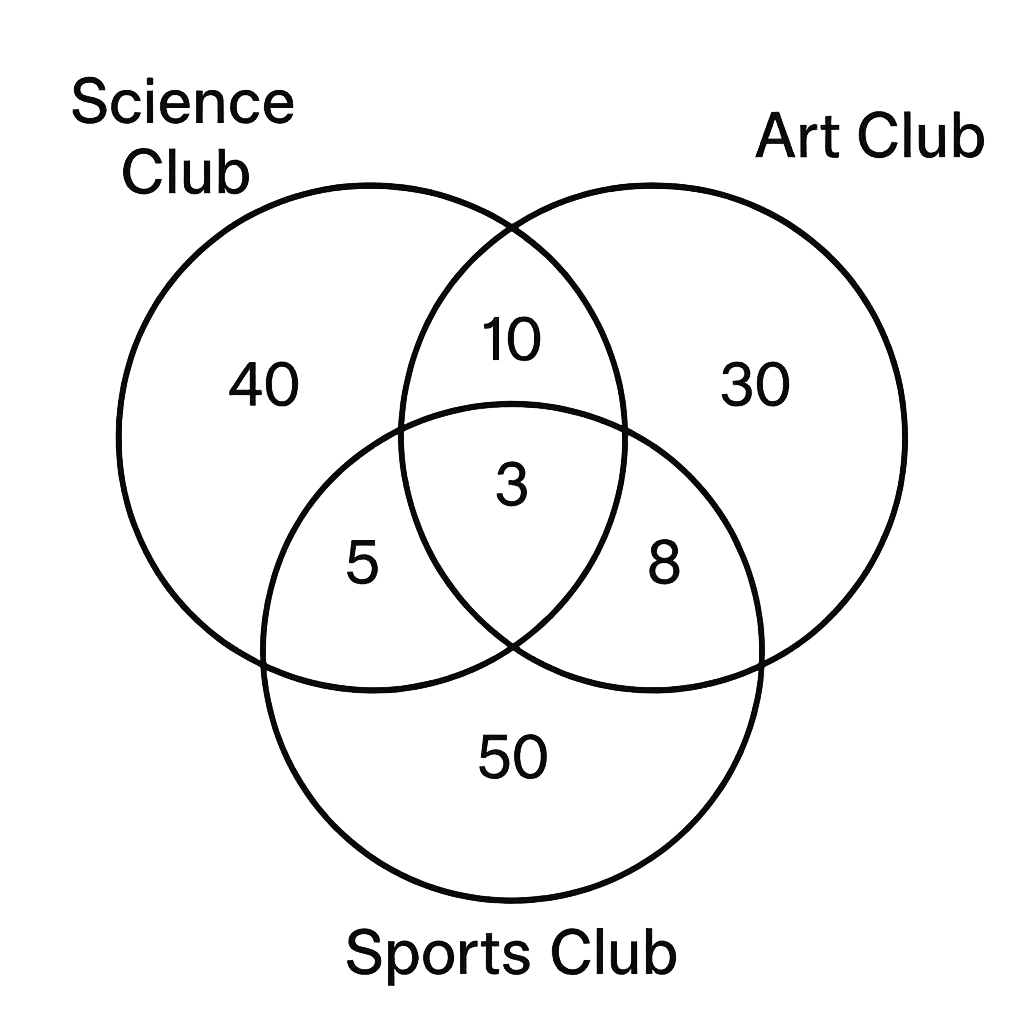
In a school, there are three clubs: the Science Club, the Art Club, and the Sports Club. The number of students in each club is represented in a Venn diagram. If the total number of students in the Science Club is 40, in the Art Club is 30, and in the Sports Club is 50, with 10 students participating in both Science and Art, 5 in both Science and Sports, and 8 in both Art and Sports, while 3 students are members of all three clubs, calculate the number of students who are members of only one club. Present your findings using the Venn diagram.
Question Parts
(a)
Calculate the number of students in each section of the Venn diagram.
(b)
Using the results from part (a), fill in the Venn diagram to represent the distribution of students in the clubs.
Detailed Essay Solution & Marking Scheme Available

Get the step-by-step mathematical proofs, key points required by examiners, and a comprehensive breakdown from our AI Tutor.

Question 5
A school is organizing a mathematics competition. The total number of students participating is represented by the variable S. Each student is required to pay a registration fee of ₦200. The school plans to use 30% of the total registration fees collected to purchase prizes for the competition. The remaining amount will be used to cover administrative costs. (a) Write an expression for the total registration fees collected in terms of S. (b) If the school expects 150 students to participate, calculate the total registration fees collected. (c) Determine the amount allocated for prizes and the amount left for administrative costs based on the expected number of participants. (d) If the school decides to increase the registration fee to ₦250, what will be the new total registration fees collected if the number of participants remains the same? How much will be allocated for prizes in this case?
Question Parts
(a)
Write an expression for the total registration fees collected in terms of S.
(b)
If the school expects 150 students to participate, calculate the total registration fees collected.
(c)
Determine the amount allocated for prizes and the amount left for administrative costs based on the expected number of participants.
(d)
If the school decides to increase the registration fee to ₦250, what will be the new total registration fees collected if the number of participants remains the same? How much will be allocated for prizes in this case?
Detailed Essay Solution & Marking Scheme Available

Get the step-by-step mathematical proofs, key points required by examiners, and a comprehensive breakdown from our AI Tutor.

Question 6
A local market sells fruits at different prices. Apples are sold at ₦150 each, bananas at ₦100 each, and oranges at ₦200 each. A customer buys a total of 20 fruits, spending a total of ₦3,000. Let the number of apples, bananas, and oranges purchased be represented by the variables A, B, and O respectively. (a) Set up a system of equations to represent the situation described. (b) Using the equations, determine how many apples, bananas, and oranges the customer bought. (c) If the customer had spent ₦500 more, how many additional fruits could they have purchased if the prices remained the same? (d) Discuss how the solution to the system of equations can be interpreted in the context of the fruit market.
Question Parts
(a)
Set up a system of equations to represent the situation described.
(b)
Using the equations, determine how many apples, bananas, and oranges the customer bought.
(c)
If the customer had spent ₦500 more, how many additional fruits could they have purchased if the prices remained the same?
(d)
Discuss how the solution to the system of equations can be interpreted in the context of the fruit market.
Detailed Essay Solution & Marking Scheme Available

Get the step-by-step mathematical proofs, key points required by examiners, and a comprehensive breakdown from our AI Tutor.

Question 7
A quadratic equation is represented by the expression ax^2 + bx + c = 0. Given that the roots of the equation are -3 and 5, determine the values of a, b, and c if a = 1. Additionally, verify the relationship between the roots and the coefficients using Vieta's formulas.
Question Parts
(a)
Using the given roots, write the quadratic equation in its standard form.
(b)
Calculate the values of b and c in the quadratic equation using the standard form obtained in part (a).
(c)
Using Vieta's formulas, verify the relationship between the roots and the coefficients of the quadratic equation.
Detailed Essay Solution & Marking Scheme Available

Get the step-by-step mathematical proofs, key points required by examiners, and a comprehensive breakdown from our AI Tutor.

Question 8
Consider the inequality 2x - 3 < 5. Solve the inequality and represent the solution on a number line. After that, explain the significance of the solution in the context of real-world applications.
Question Parts
(a)
Solve the inequality 2x - 3 < 5 and express the solution in interval notation.
(b)
Draw a number line to represent the solution of the inequality from part (a).
(c)
Discuss the significance of the solution in a real-world context, providing at least one example.
Detailed Essay Solution & Marking Scheme Available

Get the step-by-step mathematical proofs, key points required by examiners, and a comprehensive breakdown from our AI Tutor.

Question 9
A student is studying the behavior of a particular arithmetic sequence. The first term of the sequence is 5 and the common difference is 3. The student wants to find the 20th term of the sequence and the sum of the first 20 terms. Additionally, they are interested in determining how many terms of this sequence are less than 100. Calculate these values and provide a detailed explanation of your reasoning.
Question Parts
(a)
Calculate the 20th term of the arithmetic sequence.
(b)
Determine the sum of the first 20 terms of this arithmetic sequence.
(c)
Identify how many terms of this sequence are less than 100.
Detailed Essay Solution & Marking Scheme Available

Get the step-by-step mathematical proofs, key points required by examiners, and a comprehensive breakdown from our AI Tutor.

Question 10
A researcher is studying the relationship between two variables, x and y, which vary directly. When x = 4, y = 12. The researcher wants to find the value of y when x = 10 and also determine the value of x when y = 30. Finally, they need to confirm if the relationship holds true for these new values. Present your calculations and reasoning clearly.
Question Parts
(a)
Determine the constant of variation.
(b)
Find the value of y when x = 10.
(c)
Determine the value of x when y = 30.
(d)
Confirm whether the relationship holds true for the newly calculated values.
Detailed Essay Solution & Marking Scheme Available

Get the step-by-step mathematical proofs, key points required by examiners, and a comprehensive breakdown from our AI Tutor.

Question 11
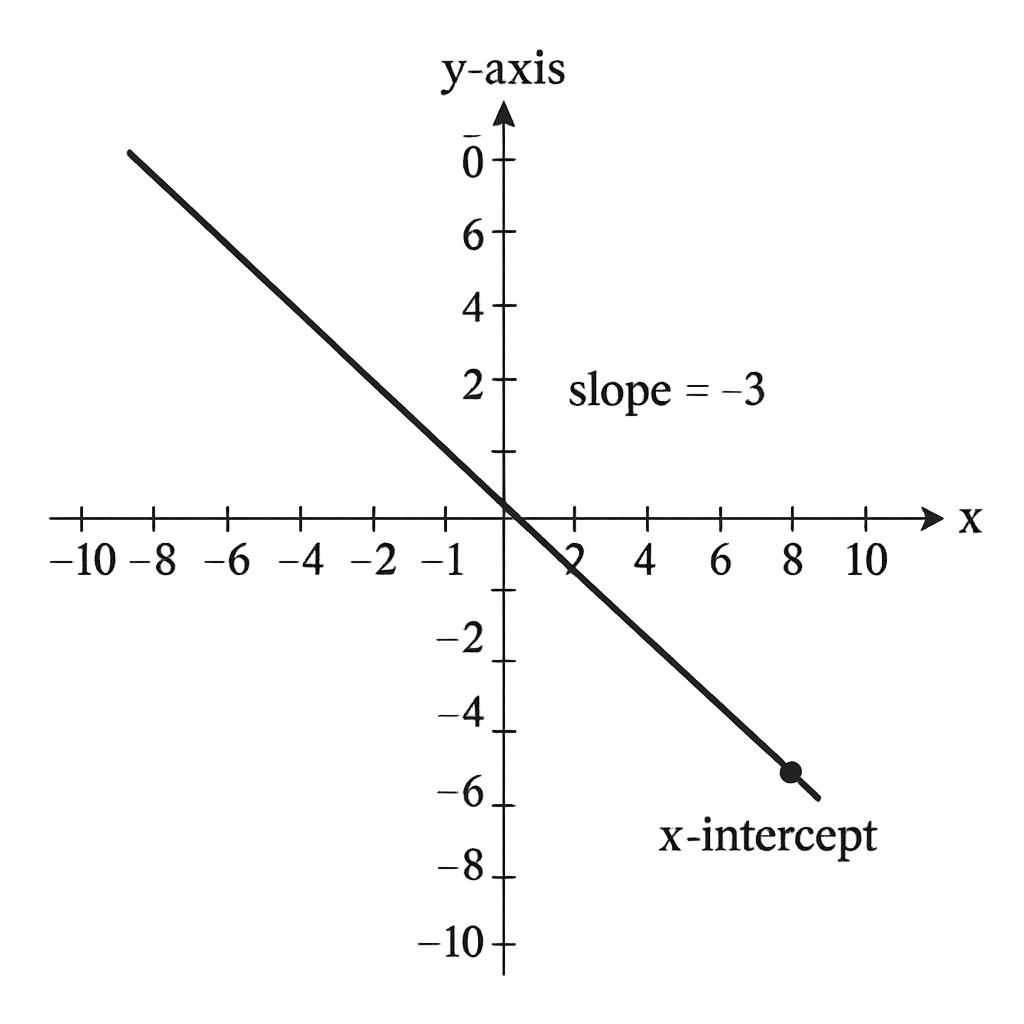
The graph of a linear equation intersects the y-axis at the point (0, 5) and has a slope of -3. Using this information, answer the following questions.
Question Parts
(a)
Write the equation of the line in slope-intercept form.
(b)
Determine the x-intercept of the line.
(c)
Sketch the graph of the line on the coordinate plane, labeling the x-intercept and y-intercept clearly.
Detailed Essay Solution & Marking Scheme Available

Get the step-by-step mathematical proofs, key points required by examiners, and a comprehensive breakdown from our AI Tutor.

Question 12
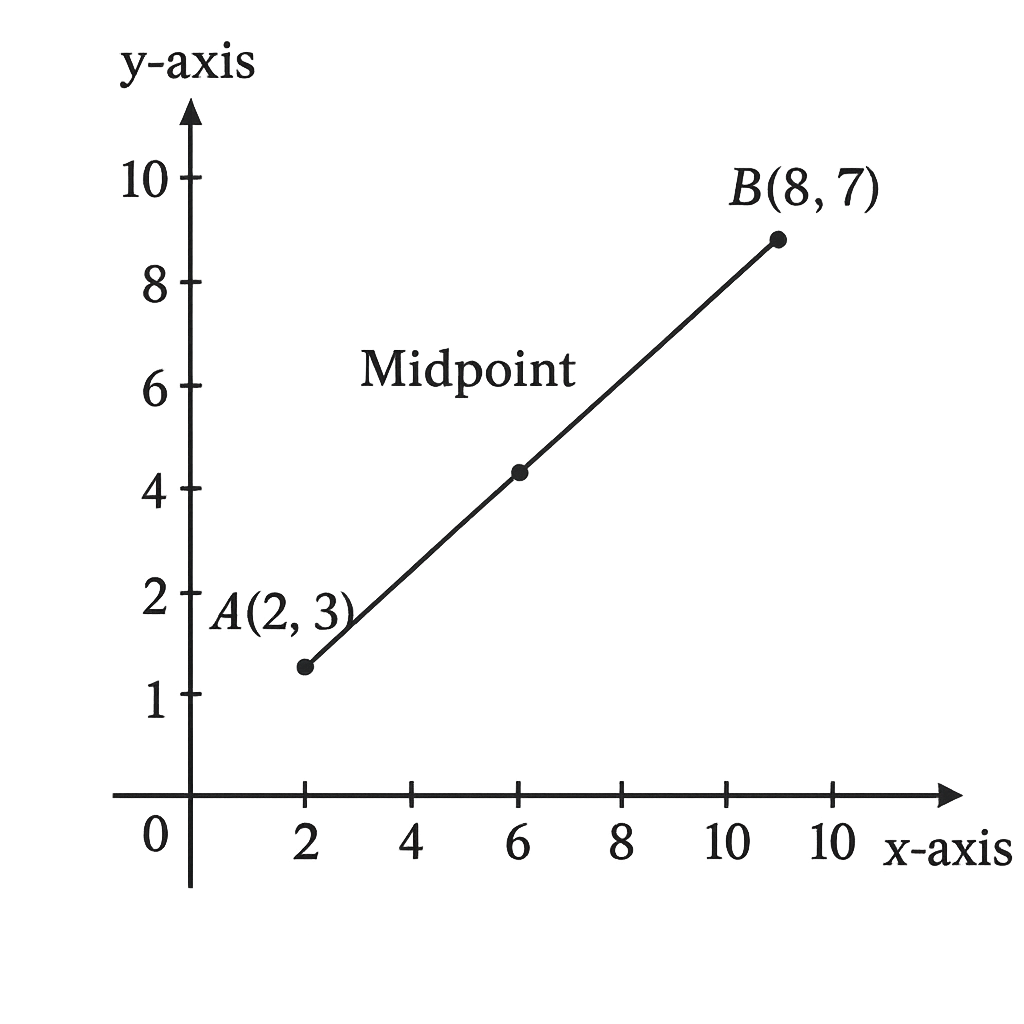
In a coordinate plane, two points A(2, 3) and B(8, 7) are given. Using these points, answer the following questions.
Question Parts
(a)
Calculate the distance between points A and B.
(b)
Find the midpoint of the line segment AB.
(c)
Determine the slope of the line passing through points A and B.
Detailed Essay Solution & Marking Scheme Available

Get the step-by-step mathematical proofs, key points required by examiners, and a comprehensive breakdown from our AI Tutor.

Question 13
A farmer has a rectangular field that measures 120 meters in length and 80 meters in width. He wants to plant a fence around the entire field and also create a pathway of uniform width around the fence. The total area of the field with the pathway is to be 12,000 square meters. Determine the width of the pathway.
Question Parts
(a)
Calculate the area of the rectangular field.
(b)
Let the width of the pathway be x meters. Write an equation that represents the total area of the field including the pathway.
(c)
Solve the equation from part (b) to find the width of the pathway.
Detailed Essay Solution & Marking Scheme Available

Get the step-by-step mathematical proofs, key points required by examiners, and a comprehensive breakdown from our AI Tutor.

Master the Exam!

You've seen a preview, but there are thousands more questions plus AI tutor to break down complex solutions.

Unlock Full Access Available for Android & Windows
Help others prepare! Share this practice hub:
Chat with Support