waec model questions vol1 2017 chemistry | Objective

Are you preparing for waec model questions vol1 exams? Reviewing past questions is one of the most effective ways to guarantee a high score. This practice hub features authentic 2017 chemistry (Objective) questions designed to simulate the real exam environment.

Practice these randomly selected questions to test your readiness.

Question 1 View Details
A 10.0 g sample of impure copper metal contains 85% copper and 15% zinc by mass. The sample is treated with dilute nitric acid which dissolves only the zinc, forming Zn(NO₃)₂. The solution is then treated with excess Na₂CO₃ to precipitate ZnCO₃, which is filtered, dried and heated to convert it completely to ZnO (loss of CO₂). After heating, 1.80 g of ZnO is obtained. Calculate the percent recovery of zinc as ZnO based on the original amount of zinc in the impure copper sample. Give your answer to one decimal place.
A. 84.5
B. 90.0
Correct C. 96.4
D. 102.3

Correct Answer: C

Want to see the full step-by-step solution? Unlock AI Explanation & Analytics
Question 2 View Details
A buffer solution is prepared by dissolving 0.250 mol of acetic acid (CH₃COOH, Ka = 1.8×10⁻⁵) and 0.150 mol of sodium acetate (CH₃COONa) in 2.00 L of water. After the buffer is formed, 0.050 mol of HCl is added. What is the pH of the solution after the addition of HCl? Give your answer to two decimal places.
A. 4.55
B. 4.12
Correct C. 4.27
D. 3.98

Correct Answer: C

Want to see the full step-by-step solution? Unlock AI Explanation & Analytics
Question 3 View Details
A 5.00 g sample of calcium carbonate is heated in a closed vessel, producing calcium oxide and carbon dioxide: CaCO₃ → CaO + CO₂. The CO₂ is collected over water at 25 °C and a total pressure of 760 mmHg. The water vapour pressure at 25 °C is 23.8 mmHg. If the volume of dry CO₂ collected is 1.20 L, calculate the percent yield of CO₂ based on the amount of CaCO₃ used. Give your answer to one decimal place.
A. 88.3
B. 73.5
C. 101.2
Correct D. 94.9

Correct Answer: D

Want to see the full step-by-step solution? Unlock AI Explanation & Analytics
Question 4 View Details
1.20 g of a secondary alcohol having molecular formula C₅H₁₂O is reacted with excess acetic anhydride, (CH₃CO)₂O, to give its acetate ester. The ester is then completely hydrolysed, and the amount of acetic acid formed is determined by titration with 0.100 M NaOH, requiring 12.5 mL of the NaOH solution to reach the endpoint. Assuming 100 % yield for both the esterification and the hydrolysis steps, (i) calculate the percentage of the original alcohol that actually reacted, and (ii) list all possible structural isomers of a secondary alcohol with formula C₅H₁₂O. Give the percentage to one decimal place.
A. 3.9; 2‑Pentanol, 3‑Pentanol, 2‑Methyl‑2‑butanol
B. 5.2; 2‑Pentanol, 3‑Pentanol, 2‑Methyl‑1‑butanol, 3‑Methyl‑2‑butanol
C. 6.1; 1‑Pentanol, 2‑Pentanol, 3‑Pentanol, 2‑Methyl‑2‑butanol, 3‑Methyl‑2‑butanol
Correct D. 4.6; 2‑Pentanol, 3‑Pentanol, 2‑Methyl‑2‑butanol, 3‑Methyl‑2‑butanol

Correct Answer: D

Want to see the full step-by-step solution? Unlock AI Explanation & Analytics
Question 5 View Details
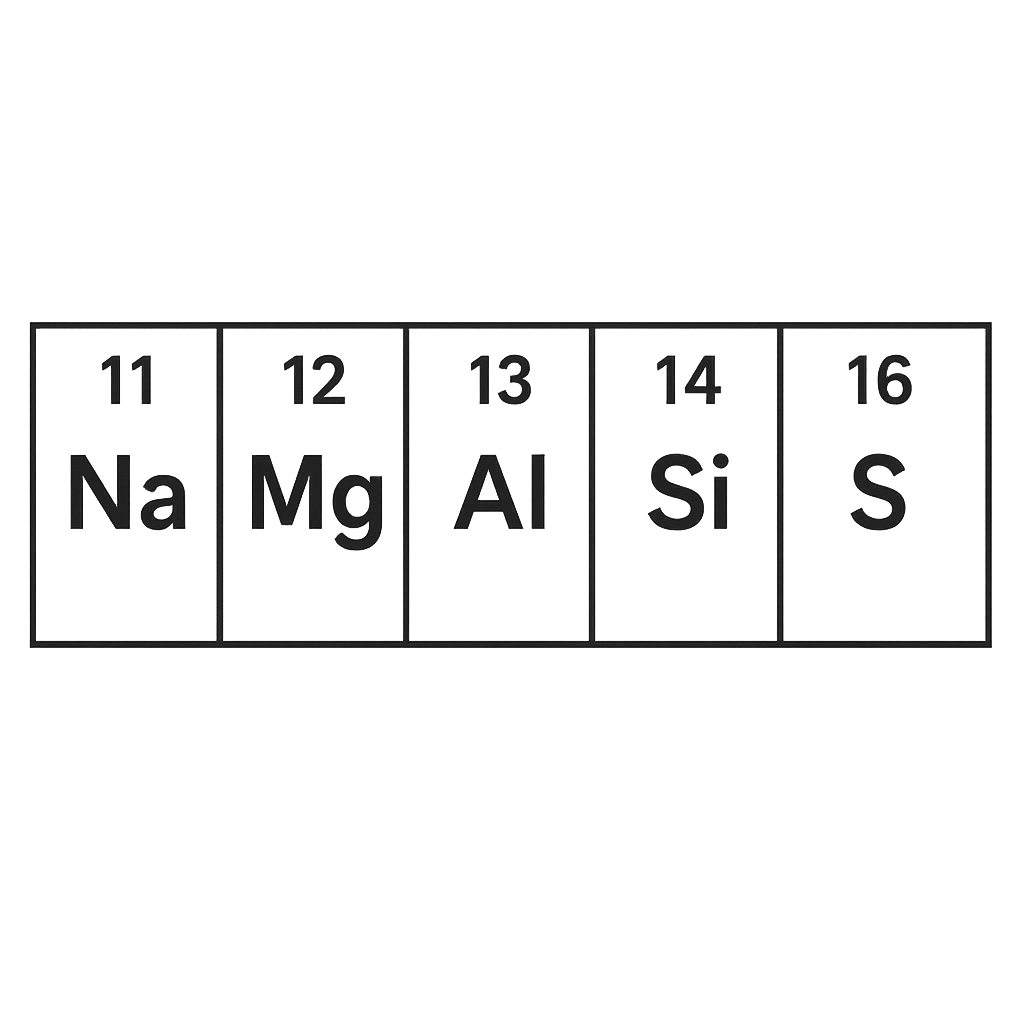
The diagram shows a segment of the periodic table containing six elements arranged in order of increasing atomic number: Na, Mg, Al, Si, P, and S. Which of these elements has the highest electronegativity?
A. Al
Correct B. S
C. Si
D. P

Correct Answer: B

Want to see the full step-by-step solution? Unlock AI Explanation & Analytics
Question 6 View Details
A 500 g block of ice at -10 °C is placed in an insulated container and heated with a heater that supplies 2.0 kJ per minute for 30 minutes. The specific heat capacities are 2.1 J g⁻¹ °C⁻¹ for ice and 4.18 J g⁻¹ °C⁻¹ for water, and the latent heat of fusion of ice is 334 J g⁻¹. Determine the final state of the system and the mass of ice that has melted.
A. All ice at -10 °C, with 0 g of ice melted
B. All water at 0 °C, with 500 g of ice melted
Correct C. Mixture of ice and water at 0 °C, with 148.2 g of ice melted
D. Mixture of ice and water at 0 °C, with 200.0 g of ice melted

Correct Answer: C

Want to see the full step-by-step solution? Unlock AI Explanation & Analytics
Question 7 View Details
Potassium dichromate reacts with iron(II) sulfate in acidic medium according to the equation: K₂Cr₂O₇ + FeSO₄ + H₂SO₄ → products. When 10.0 g of K₂Cr₂O₇ is mixed with excess FeSO₄ and sulfuric acid, how many grams of Fe₂(SO₄)₃ are formed?
A. 45.0 g
Correct B. 40.8 g
C. 32.1 g
D. 38.5 g

Correct Answer: B

Want to see the full step-by-step solution? Unlock AI Explanation & Analytics
Question 8 View Details
The compound C₆H₅CH=CHCH₂CH₃ is treated with N‑bromosuccinimide (NBS) in the presence of light, and the brominated product is subsequently refluxed with aqueous NaOH. Identify the major organic product and give its IUPAC name.
A. 2‑hydroxy‑1‑phenylpent‑1‑ene
B. 3‑hydroxy‑1‑phenylpent‑2‑ene
Correct C. 3‑hydroxy‑1‑phenylpent‑1‑ene
D. 3‑hydroxy‑1‑phenylbut‑1‑ene

Correct Answer: C

Want to see the full step-by-step solution? Unlock AI Explanation & Analytics
Question 9 View Details
A 0.250 M solution of H₂SO₄ is prepared by diluting a 2.00 M stock solution. If 75.0 mL of the diluted solution is required to completely react with 10.0 g of NaOH, calculate the volume of the stock solution that must be taken for the dilution.
A. 50 mL
B. 125 mL
C. 31.3 mL
Correct D. 62.5 mL

Correct Answer: D

Want to see the full step-by-step solution? Unlock AI Explanation & Analytics
Question 10 View Details
A 10.0 g sample containing only CaCO₃ and Na₂CO₃ is treated with excess HCl. The CO₂ gas evolved is collected over water at 25 °C and 760 mmHg, and its volume is measured as 2.40 L. (Vapour pressure of water at 25 °C = 23.8 mmHg.) Determine the mass percent of CaCO₃ in the original mixture.
Correct A. 11.9 %
B. 9.5 %
C. 13.2 %
D. 15.0 %

Correct Answer: A

Want to see the full step-by-step solution? Unlock AI Explanation & Analytics
Question 11 View Details
An atom of an element has atomic number 11. How many electrons are present in its outermost (valence) shell?
A. 3
B. 0
C. 2
Correct D. 1

Correct Answer: D

Want to see the full step-by-step solution? Unlock AI Explanation & Analytics
Question 12 View Details
A saturated solution of AgCl at 25 °C contains 1.3 × 10⁻⁵ mol L⁻¹ of Ag⁺ ions. If 0.10 mol of NaCl is added to 1.0 L of this solution, what is the new concentration of Ag⁺ ions (in mol L⁻¹) at equilibrium?
A. 1.0×10⁻⁹
B. 1.69×10⁻⁸
C. 2.5×10⁻⁹
Correct D. 1.69×10⁻⁹

Correct Answer: D

Want to see the full step-by-step solution? Unlock AI Explanation & Analytics
Question 13 View Details
A 2.00 g sample of an unknown hydrocarbon is completely combusted, producing 5.56 g of CO₂ and 2.24 g of H₂O. Determine the empirical formula of the hydrocarbon.
Correct A. CH2
B. C2H2
C. CH3
D. C2H

Correct Answer: A

Want to see the full step-by-step solution? Unlock AI Explanation & Analytics
Question 14 View Details
A 4.20 g sample of an unknown primary alcohol with molecular formula CₙH₂ₙ₊₂O reacts with excess sodium metal according to 2 ROH + 2 Na → 2 RONa + H₂(g). The hydrogen gas collected at 298 K and 1 atm occupies 0.86 L. Determine the value of n (the number of carbon atoms) in the alcohol.
A. 2
Correct B. 3
C. 4
D. 5

Correct Answer: B

Want to see the full step-by-step solution? Unlock AI Explanation & Analytics
Question 15 View Details
A wastewater stream flows at 2000 L min⁻¹ and contains nitrate at 45 mg L⁻¹. The treatment plant removes 60 % of the nitrate. The treated effluent is then mixed with a clean water stream in a 3 : 1 ratio (treated : clean). (a) What is the nitrate concentration (in mg L⁻¹) in the final mixed effluent? (b) How many kilograms of nitrate are removed per hour by the plant?
Correct A. 13.5 mg/L, 3.24 kg
B. 12.0 mg\/L, 3.60 kg
C. 15.0 mg\/L, 3.24 kg
D. 13.5 mg\/L, 2.70 kg

Correct Answer: A

Want to see the full step-by-step solution? Unlock AI Explanation & Analytics
Question 16 View Details
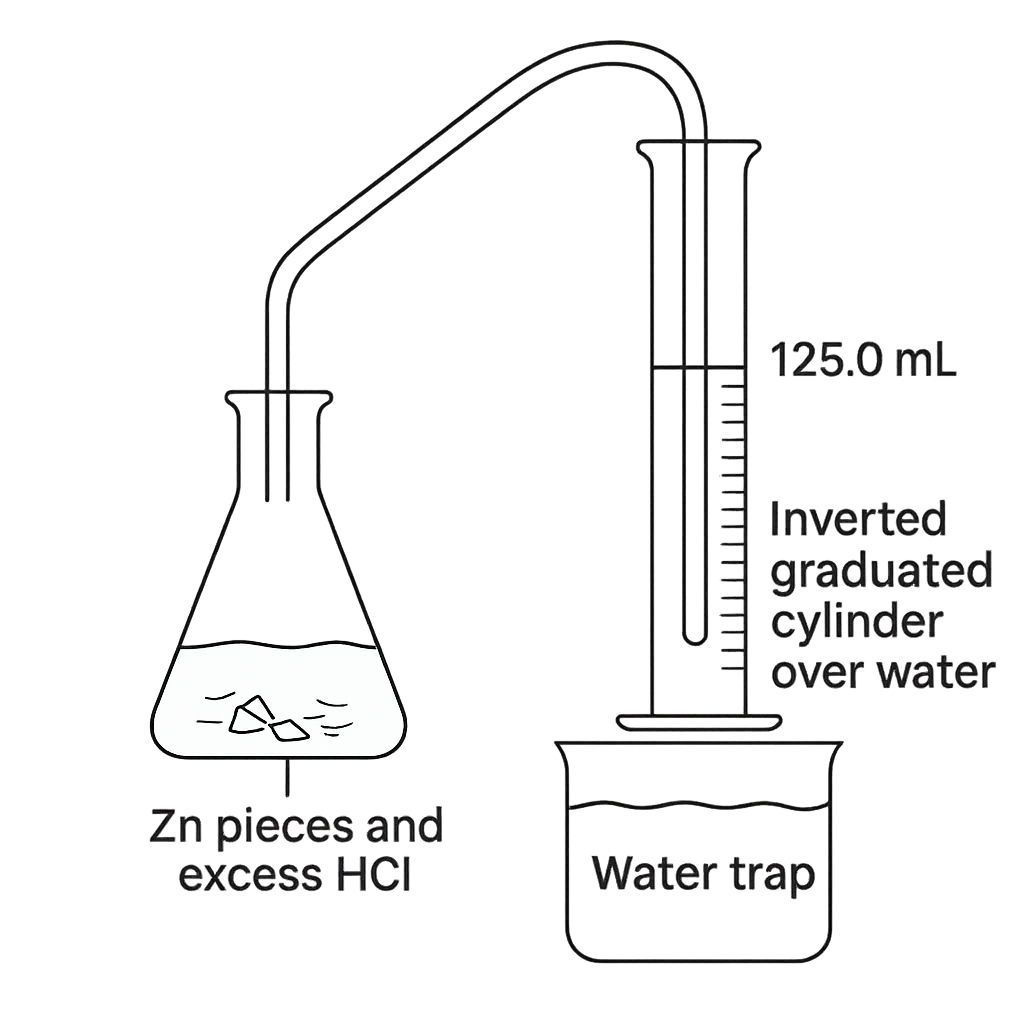
In the laboratory set‑up shown, zinc metal reacts with excess hydrochloric acid to produce hydrogen gas collected over water. The inverted graduated cylinder reads a volume of 125.0 mL of gas at 25 °C. Atmospheric pressure is 760 mmHg and the water vapour pressure at this temperature is 23.8 mmHg. A mass of 0.500 g of zinc was used. Calculate the percent yield of hydrogen gas based on the theoretical amount that could be produced from the zinc.
A. 85%
Correct B. 65%
C. 55%
D. 75%

Correct Answer: B

Want to see the full step-by-step solution? Unlock AI Explanation & Analytics
Question 17 View Details
An unknown element Y forms a +3 cation, has an atomic radius of about 0.125 nm, and belongs to the same period as sulfur. Identify the element.
A. P
Correct B. Al
C. Mg
D. Si

Correct Answer: B

Want to see the full step-by-step solution? Unlock AI Explanation & Analytics
Question 18 View Details
A reaction between benzoic acid (C₇H₆O₂) and ethanol (C₂H₅OH) is carried out. The masses used are 10.0 g of benzoic acid and 5.0 g of ethanol. The reaction is: C₇H₆O₂ + C₂H₅OH → C₉H₁₀O₂ + H₂O. After completion, 6.5 g of ethyl benzoate (C₉H₁₀O₂) is isolated. Determine (a) the limiting reagent, (b) the theoretical mass of ethyl benzoate, (c) the percent yield based on the 6.5 g obtained, and (d) the theoretical mass of water that would be formed.
Correct A. Limiting reagent: benzoic acid; Theoretical mass of ethyl benzoate: 12.3 g; Percent yield: 53 %; Theoretical water mass: 1.48 g
B. Limiting reagent: benzoic acid; Theoretical mass of ethyl benzoate: 13.5 g; Percent yield: 60 %; Theoretical water mass: 1.80 g
C. Limiting reagent: ethanol; Theoretical mass of ethyl benzoate: 12.8 g; Percent yield: 50 %; Theoretical water mass: 1.30 g
D. Limiting reagent: ethanol; Theoretical mass of ethyl benzoate: 11.0 g; Percent yield: 45 %; Theoretical water mass: 1.20 g

Correct Answer: A

Want to see the full step-by-step solution? Unlock AI Explanation & Analytics
Question 19 View Details
A 2.00 g sample of a substance with molar mass 100 g mol⁻¹ is heated from 25 °C to 150 °C. Its melting point is 30 °C (ΔH_fus = 6.0 kJ mol⁻¹) and its boiling point is 120 °C (ΔH_vap = 30 kJ mol⁻¹). The specific heat capacities are: solid 0.5 J g⁻¹ K⁻¹, liquid 0.8 J g⁻¹ K⁻¹, gas 1.0 J g⁻¹ K⁻¹. Calculate the total heat absorbed for the entire heating process.
A. 1.05 kJ
B. 0.78 kJ
C. 1.20 kJ
Correct D. 0.93 kJ

Correct Answer: D

Want to see the full step-by-step solution? Unlock AI Explanation & Analytics
Question 20 View Details
Consider the reaction of solid tetraphosphorus with chlorine gas: P₄(s) + 6 Cl₂(g) → 4 PCl₃(g). The bond dissociation energies are: P-P in P₄ = 200 kJ mol⁻¹ (six such bonds per P₄ molecule), Cl-Cl = 243 kJ mol⁻¹, and P-Cl = 320 kJ mol⁻¹. The enthalpy of vapourisation of P₄(s) to P₄(g) is 30 kJ mol⁻¹. Using these data, calculate the net enthalpy change per mole of PCl₃ formed and state whether the reaction is exothermic or endothermic.
Correct A. -288 kJ·mol⁻¹ (exothermic)
B. -150 kJ·mol⁻¹ (exothermic)
C. +288 kJ·mol⁻¹ (endothermic)
D. -288 kJ·mol⁻¹ (endothermic)

Correct Answer: A

Want to see the full step-by-step solution? Unlock AI Explanation & Analytics
Question 21 View Details
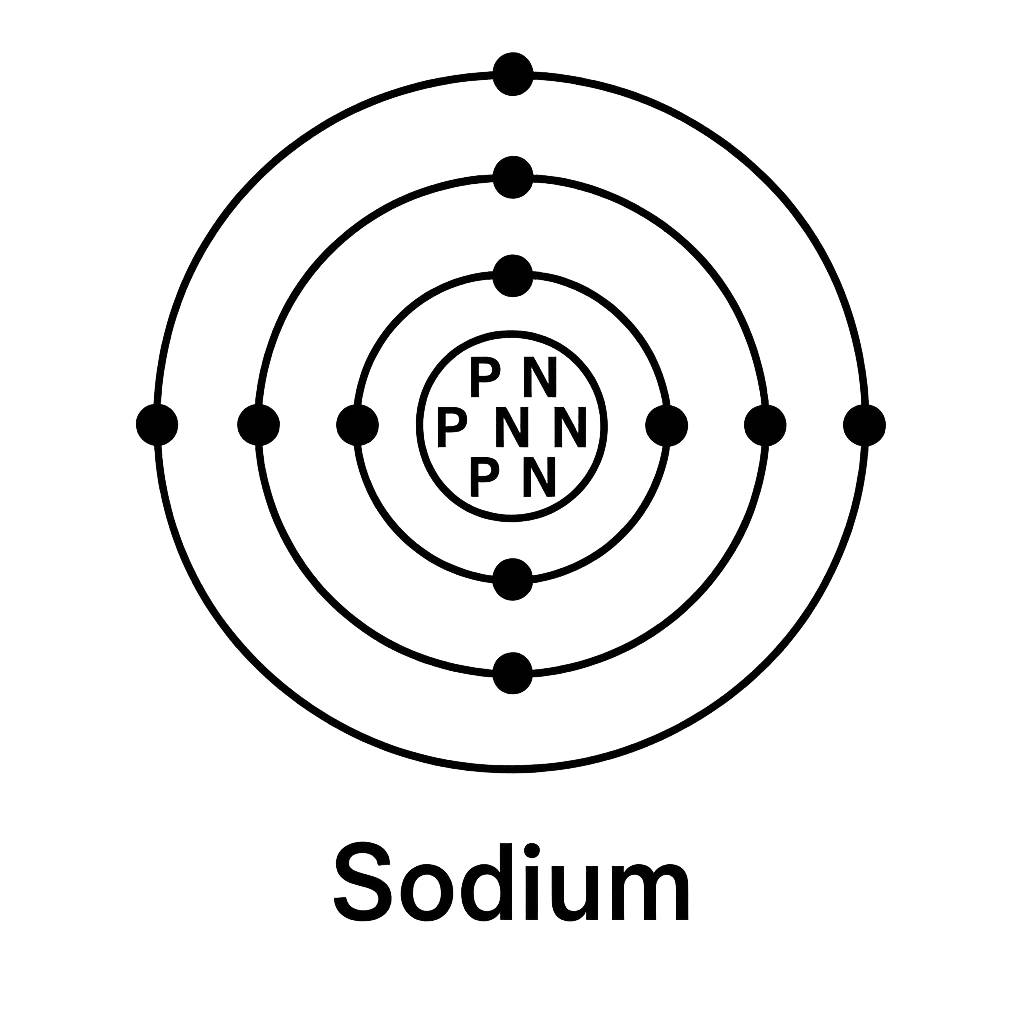
The diagram shows a Bohr model of a neutral atom. The nucleus contains 11 protons and 12 neutrons. The electron shells are labelled K, L and M with 2, 8 and 1 electrons respectively. Based on this information, state the atomic number (Z) and the mass number (A) of the element.
A. 12, 23
B. 11, 24
Correct C. 11, 23
D. 12, 24

Correct Answer: C

Want to see the full step-by-step solution? Unlock AI Explanation & Analytics
Question 22 View Details
A galvanic cell is constructed as follows: Zn(s) | Zn^{2+} (0.010 M) || Cu^{2+} (0.10 M) | Cu(s). The standard reduction potentials are E°(Cu^{2+}/Cu)=+0.34 V and E°(Zn^{2+}/Zn)=‑0.76 V. Calculate the cell potential at 298 K.
A. 1.20 V
Correct B. 1.13 V
C. 1.10 V
D. 0.58 V

Correct Answer: B

Want to see the full step-by-step solution? Unlock AI Explanation & Analytics
Question 23 View Details
A 150 g mixture of octane (C₈H₁₈) and decane (C₁₀H₂₂) is cracked catalytically. Each molecule yields one molecule of ethene (C₂H₄) plus a saturated hydrocarbon containing the remaining carbon atoms. The mass of ethene obtained is 30 g. Determine the mass percentage of octane in the original mixture.
Correct A. 5.8 %
B. 7.3 %
C. 4.2 %
D. 9.1 %

Correct Answer: A

Want to see the full step-by-step solution? Unlock AI Explanation & Analytics
Question 24 View Details
In an electrolytic copper‑plating operation a constant current of 2.5 A is passed for 3.0 h. The current efficiency for copper deposition is 85 %. Calculate the mass of copper deposited on the cathode. (M_{Cu}=63.55 g mol⁻¹, F=96 485 C mol⁻¹)
A. 5.4 g
B. 8.9 g
Correct C. 7.6 g
D. 6.2 g

Correct Answer: C

Want to see the full step-by-step solution? Unlock AI Explanation & Analytics
Question 25 View Details
A sample of polyethylene terephthalate (PET) is prepared by condensation polymerisation of ethylene glycol (C₂H₆O₂, M=62.07 g mol⁻¹) and terephthalic acid (C₈H₆O₄, M=166.13 g mol⁻¹). The polymer contains 0.5 % by mass of residual -OH end groups (from ethylene glycol) and 0.3 % by mass of residual -COOH end groups (from terephthalic acid). Assuming each polymer chain has exactly one -OH end and one -COOH end, determine the number‑average degree of polymerisation (DPₙ) of the PET sample. (M_{repeat}=192.17 g mol⁻¹, M_{‑OH}=45.07 g mol⁻¹, M_{‑COOH}=45.02 g mol⁻¹)
A. 62
B. 73
Correct C. 58
D. 45

Correct Answer: C

Want to see the full step-by-step solution? Unlock AI Explanation & Analytics

Master the Exam!

You've seen a preview, but there are thousands more questions plus AI tutor to break down complex solutions.

Unlock Full Access Available for Android & Windows
Help others prepare! Share this practice hub:
Chat with Support