waec model questions vol1 2017 chemistry | Essay

Prepare for your exams with waec model questions vol1 questions? Reviewing past/model questions is one of the most effective ways to guarantee a high score. This practice hub features authentic 2017 chemistry (Essay) questions designed to simulate the real exam environment.

Practice these randomly selected questions to test your readiness.
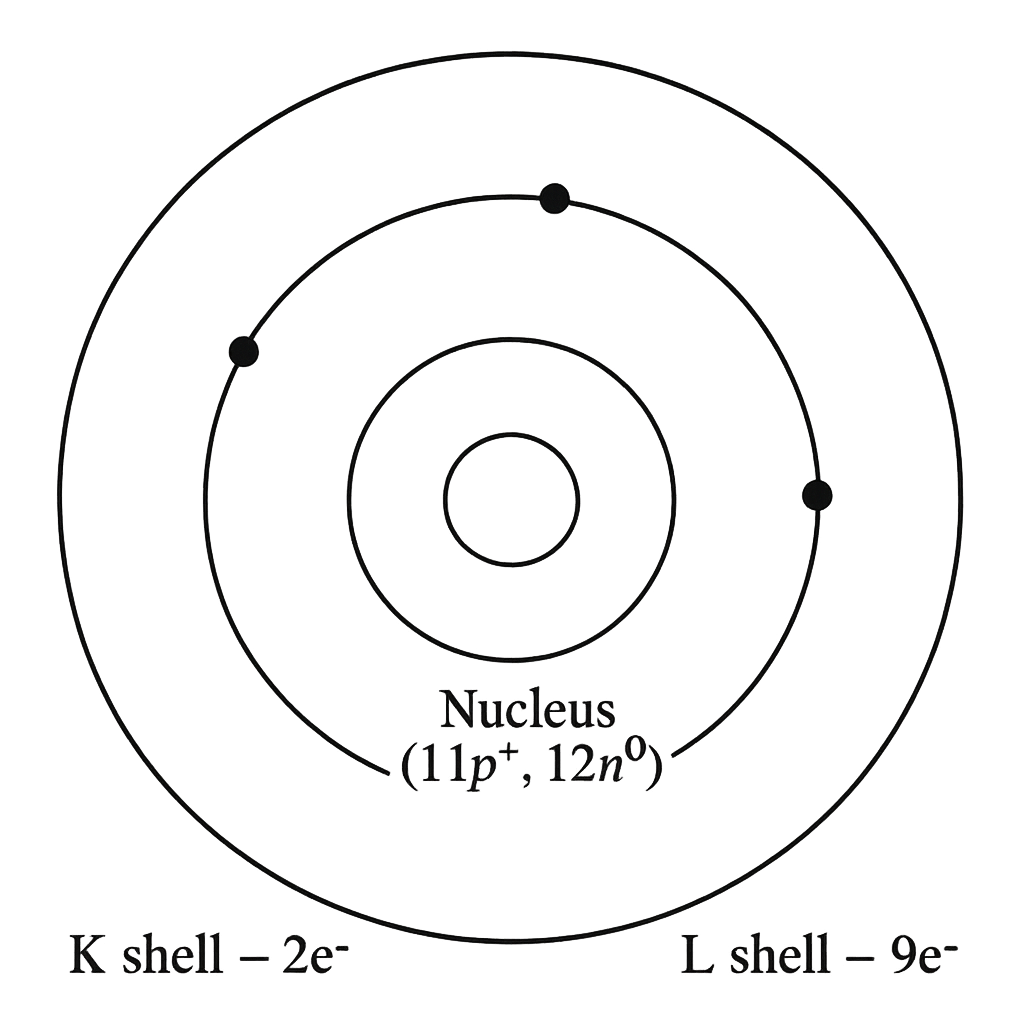
Question 1 View Details
The diagram shows a Bohr model of an atom of an unknown element. The nucleus is labelled with the numbers of protons and neutrons. Two concentric shells are drawn: the inner (K) shell contains 2 electrons and the outer (L) shell contains 9 electrons. No other shells are shown.
Question Parts
(a)
State the atomic number (Z) and the mass number (A) of the element.
(b)
Write the full electron configuration of the element using the principal quantum numbers (n) and the maximum electrons per shell (2n²).
(c)
If one electron is removed from the outermost shell, write the resulting ion symbol and indicate its charge.
Detailed Essay Solution & Marking Scheme Available

Get the step-by-step mathematical proofs, key points required by examiners, and a comprehensive breakdown from our AI Tutor.
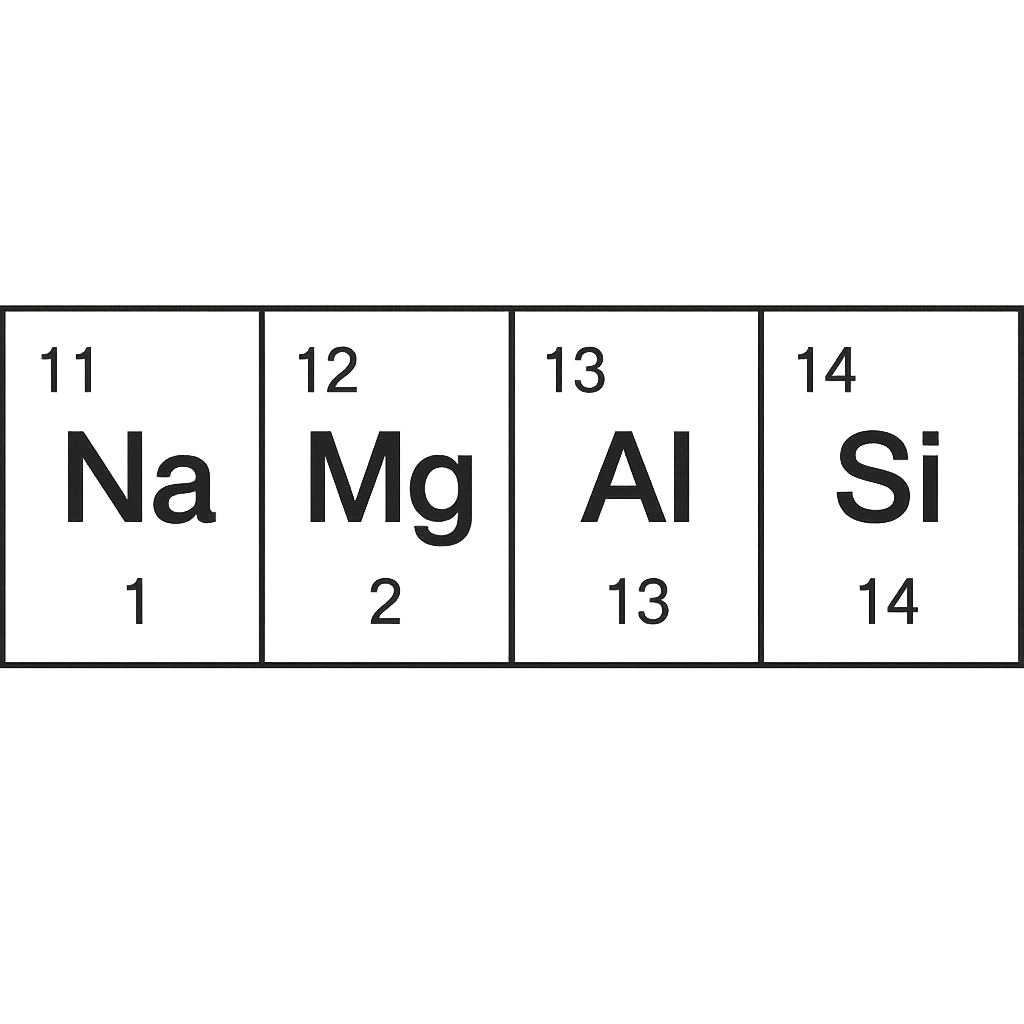
Question 2 View Details
The illustration shows a section of the periodic table containing the elements Na, Mg, Al and Si. Their symbols, atomic numbers and group numbers are displayed. No other information is given.
Question Parts
(a)
State the atomic number and the standard atomic weight (to the nearest whole number) of magnesium (Mg).
(b)
Write the ground‑state electron configuration of aluminium (Al) using the notation 1s² 2s² 2p⁶ … .
(c)
Explain why sodium (Na) and magnesium (Mg) belong to different groups and how this difference influences their most common oxidation states.
Detailed Essay Solution & Marking Scheme Available

Get the step-by-step mathematical proofs, key points required by examiners, and a comprehensive breakdown from our AI Tutor.

Question 3 View Details
Magnesium (Mg) reacts with chlorine (Cl) to form magnesium chloride, MgCl₂. Using this information, answer the following:
Question Parts
(a)
State the type of bond formed between Mg and Cl in MgCl₂ and give a brief justification based on electron transfer.
(b)
Write the ground‑state electron configuration of a neutral Mg atom and a neutral Cl atom. Then show, using the configurations, how the electrons are transferred to give Mg²⁺ and Cl⁻ ions.
(c)
Using the ions obtained above, (i) draw the Lewis dot diagram for MgCl₂ and (ii) explain why MgCl₂ has a high melting point.
Detailed Essay Solution & Marking Scheme Available

Get the step-by-step mathematical proofs, key points required by examiners, and a comprehensive breakdown from our AI Tutor.

Question 4 View Details
Calcium carbonate reacts with hydrochloric acid according to the equation: CaCO₃ + 2 HCl → CaCl₂ + CO₂ + H₂O. In a laboratory experiment, 5.0 g of CaCO₃ is mixed with 3.0 g of HCl. Answer the following questions:
Question Parts
(a)
Calculate the number of moles of CaCO₃ used in the experiment.
(b)
From the amount of CaCO₃ calculated in part (a), determine the mass of CO₂ that can be produced.
(c)
Identify the limiting reagent and calculate the theoretical mass of CaCl₂ that can be formed.
(d)
If the actual mass of CaCl₂ obtained after the reaction is 4.0 g, calculate the percent yield.
Detailed Essay Solution & Marking Scheme Available

Get the step-by-step mathematical proofs, key points required by examiners, and a comprehensive breakdown from our AI Tutor.

Question 5 View Details
The diagram shows the structural formula of an organic compound (named X). The compound contains only carbon, hydrogen, nitrogen and oxygen atoms. Using the diagram, answer the following questions.
Question Parts
(a)
Write the molecular formula of compound X.
(b)
Calculate the molar mass of X (give your answer to two decimal places).
(c)
When X undergoes complete combustion in excess oxygen, the products are carbon dioxide, water and nitrogen gas. Write the balanced chemical equation for this reaction.
Detailed Essay Solution & Marking Scheme Available

Get the step-by-step mathematical proofs, key points required by examiners, and a comprehensive breakdown from our AI Tutor.

Question 6 View Details
A sample of 150.0 g of pure water is initially at 25.0 °C. It is placed in a calorimeter and heated until all the water has been converted to steam at 120.0 °C at a pressure of 1.0 atm.
Question Parts
(a)
Calculate the total amount of heat (in kJ) required for this process. Use cₕ(l) = 4.18 J g⁻¹ K⁻¹, cₕ(g) = 2.01 J g⁻¹ K⁻¹, and assume the molar enthalpy of vaporisation at 120 °C is 38.0 kJ mol⁻¹.
(b)
The calorimeter loses heat to the surroundings at a rate of 5.0 kJ per minute. If the heating process takes 12 minutes, determine the net heat absorbed by the water and discuss how the heat loss would affect the final temperature if the calorimeter were not allowed to reach 120 °C.
(c)
Explain, with reference to intermolecular forces, why the boiling point of water is higher than that of ethanol (C₂H₅OH), even though both have similar molecular weights.
Detailed Essay Solution & Marking Scheme Available

Get the step-by-step mathematical proofs, key points required by examiners, and a comprehensive breakdown from our AI Tutor.

Question 7 View Details
A weak monoprotic acid HA (Ka = 1.8 × 10⁻⁵) is dissolved in water to give a 0.200 mol solution in a 1.00 L flask. Afterwards 0.150 mol of its sodium salt NaA is added to the same solution.
Question Parts
(a)
Calculate the pH of the resulting solution at 25 °C.
(b)
A further 0.050 mol of NaOH is added to the mixture. Calculate the new pH and state whether the buffer now lies on the acidic or basic side of the pKa.
(c)
The dissociation of HA is endothermic with ΔH° = +12 kJ mol⁻¹. Discuss qualitatively how raising the temperature from 25 °C to 35 °C would affect the pH of the original buffer (before NaOH addition).
Detailed Essay Solution & Marking Scheme Available

Get the step-by-step mathematical proofs, key points required by examiners, and a comprehensive breakdown from our AI Tutor.

Question 8 View Details
A sample of an unknown inorganic solid is suspected to contain a mixture of metal ions. The following reagents are added in succession to separate the ions:
Question Parts
(a)
When dilute HCl is added, a white precipitate forms which dissolves on heating. Identify the ion responsible and explain the observed behaviour.
(b)
After filtering, the filtrate is treated with ammonium hydroxide. A blue precipitate appears which is insoluble in excess NH₄OH. Identify the ion and give the chemical equation for its precipitation.
Detailed Essay Solution & Marking Scheme Available

Get the step-by-step mathematical proofs, key points required by examiners, and a comprehensive breakdown from our AI Tutor.

Master the Exam!

You've seen a preview, but there are thousands more questions plus AI tutor to break down complex solutions.

Unlock Full Access Available for Android & Windows
Help others prepare! Share this practice hub:
Chat with Support