waec model questions vol1 2017 biology | Objective

Are you preparing for waec model questions vol1 exams? Reviewing past questions is one of the most effective ways to guarantee a high score. This practice hub features authentic 2017 biology (Objective) questions designed to simulate the real exam environment.

Practice these randomly selected questions to test your readiness.

Question 1 View Details
A fasting blood glucose level is 5 mmol/L. After a meal, glucose enters the bloodstream at a rate of 3 mmol/L per hour for two consecutive hours. Insulin is secreted proportionally to the amount of glucose above 5 mmol/L, with a removal rate of 0.5 mmol/L per hour for each mmol/L above 5. No glucagon action occurs. What is the blood glucose concentration after the two‑hour period?
A. 8.10
B. 5.75
Correct C. 7.25
D. 6.80

Correct Answer: C

Want to see the full step-by-step solution? Unlock AI Explanation & Analytics
Question 2 View Details
A person drinks 2 L of water that contains 0.5 g of urea per litre. The kidneys filter plasma at a glomerular filtration rate (GFR) of 120 mL min⁻¹. Plasma urea concentration is 0.3 g L⁻¹, and 85 % of the filtered urea is re‑absorbed. Assuming the urine volume equals the water intake, calculate (a) the total amount of urea excreted in a day and (b) the concentration of urea in the urine (in g L⁻¹).
A. 7.00 g excreted; 3.50 g/L urine concentration
B. 8.20 g excreted; 4.10 g/L urine concentration
C. 6.50 g excreted; 3.25 g/L urine concentration
Correct D. 7.78 g excreted; 3.89 g/L urine concentration

Correct Answer: D

Want to see the full step-by-step solution? Unlock AI Explanation & Analytics
Question 3 View Details
In a human somatic cell at metaphase of mitosis, how many chromosomes are present?
A. 23
Correct B. 46
C. 48
D. 44

Correct Answer: B

Want to see the full step-by-step solution? Unlock AI Explanation & Analytics
Question 4 View Details
After the completion of meiosis I, each daughter cell contains how many chromosomes compared with the original diploid cell?
A. 46
B. 22
Correct C. 23
D. 24

Correct Answer: C

Want to see the full step-by-step solution? Unlock AI Explanation & Analytics
Question 5 View Details
A simple reflex arc consists of a sensory neuron that conducts an impulse over 0.5 m at 50 m s⁻¹, a single synapse with a delay of 0.5 ms, and a motor neuron that conducts over 0.4 m at 60 m s⁻¹. What is the total time from stimulus to muscle contraction, expressed in milliseconds (rounded to one decimal place)?
A. 18.2
B. 17.7
C. 16.7
Correct D. 17.2

Correct Answer: D

Want to see the full step-by-step solution? Unlock AI Explanation & Analytics
Question 6 View Details
A toxin that specifically inhibits the enzyme ATP synthase is introduced into a eukaryotic cell. As a result, aerobic respiration efficiency drops dramatically. Identify the organelle that contains ATP synthase and explain why inhibition of this enzyme reduces ATP production.
A. Nucleus; inhibition stops the proton‑driven synthesis of ATP by ATP synthase, so ATP production falls dramatically.
B. Chloroplast; inhibition stops the proton‑driven synthesis of ATP by ATP synthase, so ATP production falls dramatically.
Correct C. Mitochondrion; inhibition stops the proton‑driven synthesis of ATP by ATP synthase, so ATP production falls dramatically.
D. Endoplasmic reticulum; inhibition stops the proton‑driven synthesis of ATP by ATP synthase, so ATP production falls dramatically.

Correct Answer: C

Want to see the full step-by-step solution? Unlock AI Explanation & Analytics
Question 7 View Details
In a community of 5,000 individuals, 200 are smokers and 4,800 are non‑smokers. Among smokers, 30 develop lung disease, while among non‑smokers, 20 develop the same disease. Calculate the relative risk of lung disease for smokers compared with non‑smokers and state what the value indicates about the association.
A. 42
B. 0.0042
Correct C. 36
D. 0.15

Correct Answer: C

Want to see the full step-by-step solution? Unlock AI Explanation & Analytics
Question 8 View Details
A 7‑year‑old child presents with growth retardation, swollen ankles, and a diet low in green leafy vegetables. Laboratory results show serum calcium 8.0 mg/dL (normal 9-11), serum phosphate 2.5 mg/dL (normal 3-4.5), and alkaline phosphatase 350 IU/L (normal 30-120). Identify the vitamin deficiency, describe the hormonal regulation that is disturbed, and predict the effect on bone mineralisation.
Correct A. Vitamin D deficiency; reduced calcitriol leads to low calcium absorption and secondary hyperparathyroidism, causing defective bone mineralisation (rickets).
B. Vitamin D deficiency; increased calcitriol leads to high calcium absorption and primary hypoparathyroidism, causing excessive bone mineralisation (osteopetrosis).
C. Vitamin C deficiency; impaired collagen synthesis leads to low calcium absorption and secondary hyperparathyroidism, causing defective bone mineralisation (rickets).
D. Vitamin K deficiency; reduced calcitriol leads to low calcium absorption and secondary hyperparathyroidism, causing defective bone mineralisation (rickets).

Correct Answer: A

Want to see the full step-by-step solution? Unlock AI Explanation & Analytics
Question 9 View Details
In a beetle population of 200 individuals, 150 are green and 50 are brown. After a predation event, 30 green and 40 brown beetles survive. Assuming green colour is dominant (G) over brown (g), calculate the selection coefficient (s) against the green phenotype.
A. 0.2
B. 0.6
Correct C. 0.8
D. 1

Correct Answer: C

Want to see the full step-by-step solution? Unlock AI Explanation & Analytics
Question 10 View Details
During anaphase of mitosis in a human somatic cell, each chromosome consists of how many chromatids? Provide a brief explanation.
Correct A. 1
B. 2
C. 4
D. 3

Correct Answer: A

Want to see the full step-by-step solution? Unlock AI Explanation & Analytics
Question 11 View Details
A diabetic patient's fasting blood glucose is 5 mmol/L. After a meal it rises to 9 mmol/L. Insulin secretion increases glucose uptake at a rate of 0.8 mmol L⁻¹ h⁻¹, while glucagon secretion decreases uptake (i.e., raises glucose) at 0.2 mmol L⁻¹ h⁻¹. A basal metabolic consumption of glucose of 0.1 mmol L⁻¹ h⁻¹ operates at all times. Insulin effect begins 30 min after the meal and glucagon effect begins 1 h after the meal. Assuming the rates remain constant, what is the blood‑glucose concentration (in mmol L⁻¹) 3 h after the meal?
A. 5.9
B. 8.2
C. 6.5
Correct D. 7.1

Correct Answer: D

Want to see the full step-by-step solution? Unlock AI Explanation & Analytics
Question 12 View Details
A fish population in a lake follows the logistic growth model \(\frac{dN}{dt}=rN\left(1-\frac{N}{K}\right)\) with intrinsic rate \(r=0.5\) yr⁻¹ and carrying capacity \(K=20\,000\) fish. A constant harvest of \(H\) fish per year is imposed.\n(a) Determine the maximum sustainable harvest \(H_{max}\) that allows a non‑zero equilibrium.\n(b) If the lake is stocked with \(N_0=8\,000\) fish and the harvest is set at this maximum value, what is the fish population after 5 years? (Give the nearest whole fish.)
A. 8000
Correct B. 7333
C. 6500
D. 9000

Correct Answer: B

Want to see the full step-by-step solution? Unlock AI Explanation & Analytics
Question 13 View Details
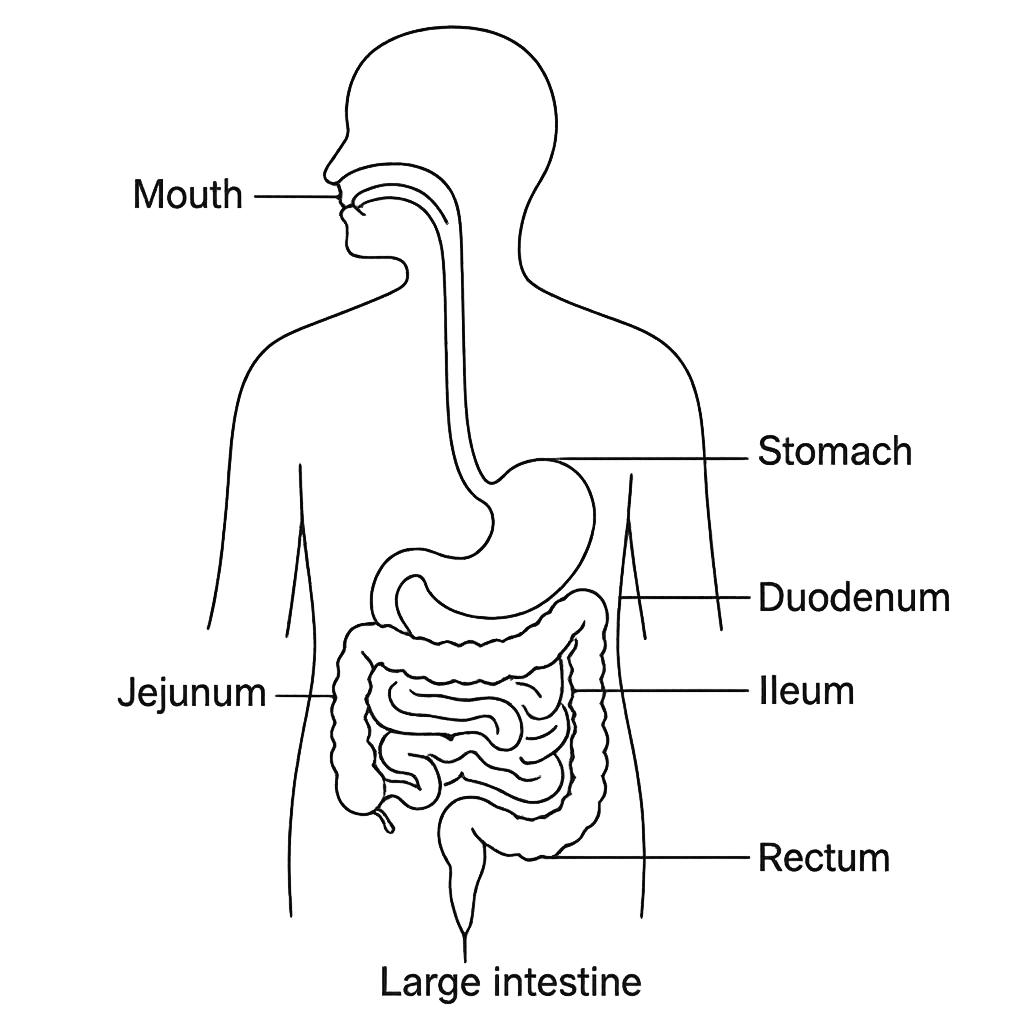
The diagram shows the human digestive system. The jejunum is the principal site for carbohydrate absorption. If a person consumes 200 g of carbohydrate, 90 % of it is absorbed in the jejunum, and 20 % of the carbohydrate absorbed in the jejunum is metabolised by the intestinal cells for their own energy, how many grams of carbohydrate reach the bloodstream from the jejunum?
A. 108
Correct B. 144
C. 126
D. 180

Correct Answer: B

Want to see the full step-by-step solution? Unlock AI Explanation & Analytics
Question 14 View Details
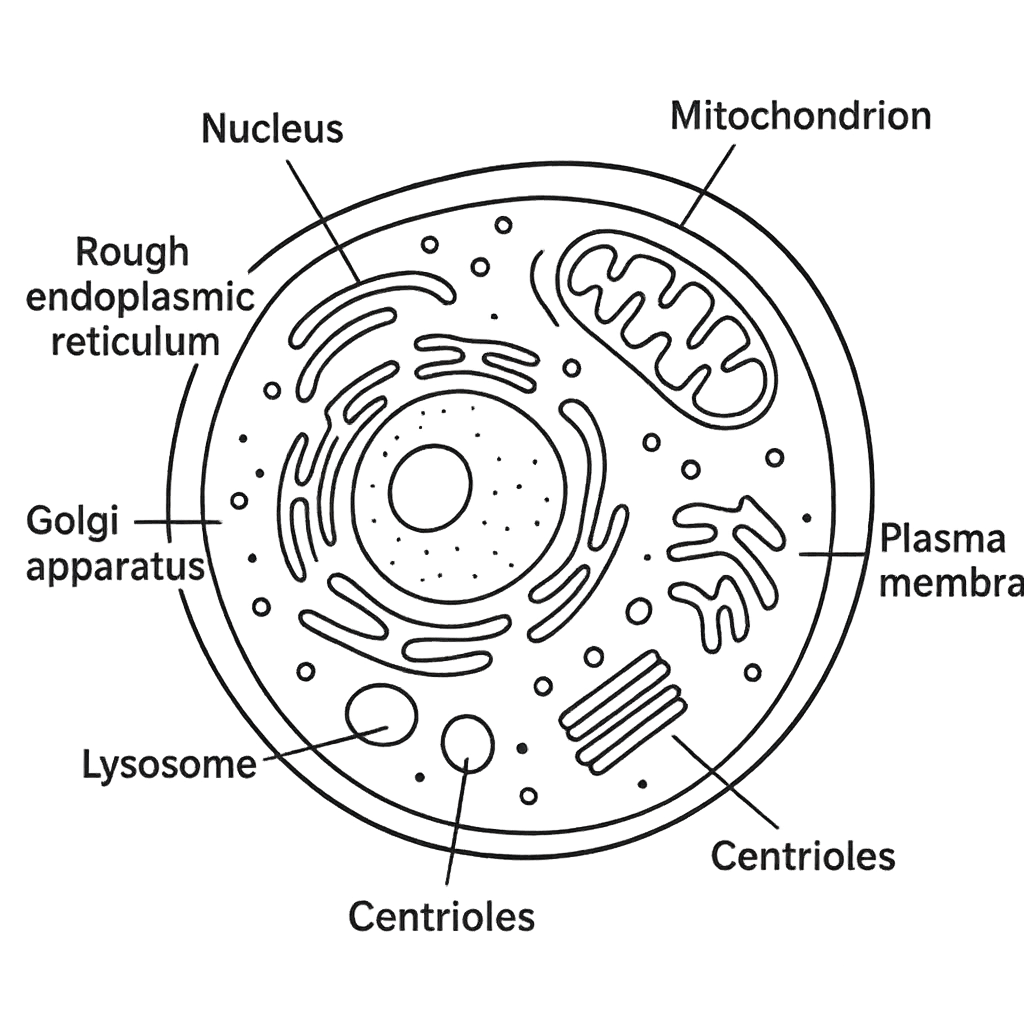
The diagram depicts a typical animal cell with its major organelles labelled. Which labelled structure is primarily responsible for protein synthesis?
A. mitochondrion
B. nucleus
C. golgi apparatus
Correct D. ribosome

Correct Answer: D

Want to see the full step-by-step solution? Unlock AI Explanation & Analytics
Question 15 View Details
A desert shrub employs several adaptations to minimise water loss. Its leaves have a total surface area of 30 cm² and use Crassulacean Acid Metabolism (CAM) so that stomata are open only at night, giving an effective transpiration rate of 1 mL h⁻¹ cm⁻². A comparable C₃ plant has leaves with a total area of 50 cm² and a daytime transpiration rate of 5 mL h⁻¹ cm⁻². Assuming both plants experience 12 h of daylight, calculate the amount of water (in mL) saved per day by the desert shrub compared with the C₃ plant.
Correct A. 2640
B. 2280
C. 3000
D. 360

Correct Answer: A

Want to see the full step-by-step solution? Unlock AI Explanation & Analytics
Question 16 View Details
The glomerular filtration rate (GFR) in a healthy adult is 125 mL min⁻¹. The plasma glucose concentration is 15 mmol L⁻¹ and the renal threshold for glucose reabsorption is 10 mmol L⁻¹. Assume that glucose is reabsorbed completely up to the threshold and any amount above the threshold is excreted unchanged. How many millimoles of glucose are excreted in the urine each minute?
Correct A. 0.625 mmol min⁻¹
B. 1.875 mmol min⁻¹
C. 625 mmol min⁻¹
D. 1.250 mmol min⁻¹

Correct Answer: A

Want to see the full step-by-step solution? Unlock AI Explanation & Analytics
Question 17 View Details
Which organelle is primarily responsible for the production of ATP through oxidative phosphorylation in eukaryotic cells?
A. ribosome
B. nucleus
C. chloroplast
Correct D. mitochondrion

Correct Answer: D

Want to see the full step-by-step solution? Unlock AI Explanation & Analytics
Question 18 View Details
At sea level the atmospheric pressure is 760 mmHg. The partial pressure of water vapour in the alveoli is 47 mmHg and the fraction of inspired oxygen (FiO₂) is 0.21. If the arterial PCO₂ is 40 mmHg and the respiratory quotient (R) is 0.8, calculate the alveolar partial pressure of oxygen (PAO₂) using the alveolar gas equation.
A. 120 mmHg
B. 90 mmHg
Correct C. 100 mmHg
D. 110 mmHg

Correct Answer: C

Want to see the full step-by-step solution? Unlock AI Explanation & Analytics
Question 19 View Details
After a meal a student's blood glucose concentration rises to 180 mg dL⁻¹. Insulin secretion causes glucose uptake by cells at a rate proportional to the excess glucose above the normal fasting level of 100 mg dL⁻¹, with a proportionality constant of 0.5 min⁻¹. Glucagon secretion is suppressed, so endogenous glucose production is negligible. Assuming the rate of decrease of glucose concentration follows the differential equation dG/dt = -0.5 (G - 100), how many minutes will it take for the glucose concentration to fall to 110 mg dL⁻¹?
A. 6.3 minutes (to one decimal place)
B. 3.5 minutes (to one decimal place)
C. 5.0 minutes (to one decimal place)
Correct D. 4.2 minutes (to one decimal place)

Correct Answer: D

Want to see the full step-by-step solution? Unlock AI Explanation & Analytics
Question 20 View Details
A solute diffuses across a biological membrane that is 0.02 cm thick. The membrane surface area is 2.0 cm², the diffusion coefficient of the solute in the membrane is 1.5 × 10⁻⁵ cm² s⁻¹, and the concentration difference across the membrane is 0.5 mol cm⁻³. Using Fick's first law of diffusion (Rate = D × A × ΔC / Δx), calculate the rate of diffusion of the solute in mol s⁻¹.
A. 1.5 × 10⁻⁴ mol s⁻¹
Correct B. 7.5 × 10⁻⁴ mol s⁻¹
C. 7.5 × 10⁻⁵ mol s⁻¹
D. 7.5 × 10⁻³ mol s⁻¹

Correct Answer: B

Want to see the full step-by-step solution? Unlock AI Explanation & Analytics
Question 21 View Details
In a diet, 30% of the total calories come from protein, 55% from carbohydrate and the remaining calories from fat. If the diet provides 180 g of protein per day, how many grams of fat are supplied by the diet?
Correct A. 40
B. 30
C. 50
D. 45

Correct Answer: A

Want to see the full step-by-step solution? Unlock AI Explanation & Analytics
Question 22 View Details
A woman has a regular menstrual cycle of 34 days. Ovulation occurs 14 days before the start of the next period. The fertile window consists of the five days ending on the day of ovulation, and the probability of conception from a single act of intercourse on any fertile day is 0.25 (zero on other days). She has unprotected intercourse on day 18 and again on day 20 of her cycle. What is the probability (to two decimal places) that she will conceive from at least one of these acts?
A. 0.38
B. 0.50
Correct C. 0.44
D. 0.25

Correct Answer: C

Want to see the full step-by-step solution? Unlock AI Explanation & Analytics
Question 23 View Details
A teenage girl has a basal metabolic rate (BMR) of 1400 kcal per day. She walks briskly for 60 minutes each day, burning 5 kcal per kilogram of body weight per hour. Her weight is 55 kg and she consumes a diet providing 2500 kcal per day. Assuming no other physical activity, estimate the weight gain (in kilograms) after 4 weeks, given that a surplus of 7700 kcal corresponds to a gain of 1 kg of body mass.
A. 4
B. 2
Correct C. 3
D. 5

Correct Answer: C

Want to see the full step-by-step solution? Unlock AI Explanation & Analytics
Question 24 View Details
A bacterial culture starts with 2 × 10³ cells. It undergoes a lag phase of 2 hours (no growth) followed by exponential growth with a generation time of 30 minutes. After a total of 6 hours of incubation, an antibiotic is added that instantly kills 90 % of the cells. The culture then continues exponential growth with the same generation time for another 4 hours. What is the final number of cells (expressed in scientific notation to two significant figures) after the total 10 hours?
A. 1.2×10^8
Correct B. 1.3×10^7
C. 1.3×10^8
D. 2.1×10^8

Correct Answer: B

Want to see the full step-by-step solution? Unlock AI Explanation & Analytics
Question 25 View Details
In peas, two genes are linked on the same chromosome: gene A (tall T dominant over dwarf t) and gene B (yellow Y dominant over green y). The recombination frequency between them is 10 %. A plant heterozygous for both genes (TtYy) is test‑crossed with a homozygous recessive plant (ttyy). What is the probability (as a percentage) that an offspring will be tall and green (phenotype T y)?
A. 20
Correct B. 5
C. 10
D. 15

Correct Answer: B

Want to see the full step-by-step solution? Unlock AI Explanation & Analytics

Master the Exam!

You've seen a preview, but there are thousands more questions plus AI tutor to break down complex solutions.

Unlock Full Access Available for Android & Windows
Help others prepare! Share this practice hub:
Chat with Support