waec model questions vol1 2017 agricultural_science | Objective

Prepare for your exams with waec model questions vol1 questions? Reviewing past/model questions is one of the most effective ways to guarantee a high score. This practice hub features authentic 2017 agricultural_science (Objective) questions designed to simulate the real exam environment.

Practice these randomly selected questions to test your readiness.

Question 1 View Details
A farmer rears two batches of broiler chickens. Batch A is fed a diet that costs ₦150 per kilogram and each bird consumes 2.4 kg of this feed over the rearing period, gaining an average of 1.8 kg live weight. Batch B is fed a diet that costs ₦120 per kilogram; each bird consumes 2.7 kg of this feed and gains an average of 1.5 kg live weight. Which batch provides the lower feed cost per kilogram of weight gain and what is that cost?
A. Batch B - 180 Naira per kg
B. Batch A - 250 Naira per kg
Correct C. Batch A - 200 Naira per kg
D. Batch B - 210 Naira per kg

Correct Answer: C

Want to see the full step-by-step solution? Unlock AI Explanation & Analytics
Question 2 View Details
A farmer harvests 500 kg of fresh cassava roots containing 60 % moisture (wet basis). The roots must be dried to 12 % moisture for safe storage. The drying process is carried out in two stages: Stage 1: The kiln operates at 30 °C and 40 % relative humidity. Under these conditions the equilibrium moisture content (EMC) of cassava is 20 % (wet basis) and the drying constant k₁ = 0.5 % h⁻¹. The farmer dries the roots until the moisture content reaches 25 %. Stage 2: The roots are then transferred to a second dryer operating at 45 °C and 20 % relative humidity, where EMC = 10 % and k₂ = 0.8 % h⁻¹. Drying continues until the moisture content reaches the target 12 %. Assuming the moisture loss follows the exponential model M(t) = EMC + (M₀ - EMC)·e^{‑k t}, where M is moisture content (wet basis) and t is time in hours, calculate the total drying time required to reach 12 % moisture. Give your answer to one decimal place in hours.
Correct A. 6.7
B. 8.2
C. 7.4
D. 5.9

Correct Answer: A

Want to see the full step-by-step solution? Unlock AI Explanation & Analytics
Question 3 View Details
A tractor with a rated engine power of 50 kW operates at 1800 rpm while pulling a moldboard plough. The draft force required to pull the plough is given by D = a + b·M, where M is the soil moisture content (%), a = 2000 N and b = 50 N · %⁻¹. The field being cultivated has an average moisture content of 12 %. The tractor moves at a forward speed of 5 km h⁻¹. The tractor's fuel consumption rate is 0.25 L kW⁻¹ h⁻¹ of mechanical power output. Calculate the amount of fuel (in litres) the tractor will consume during a 2‑hour operation under these conditions. Give your answer to one decimal place.
Correct A. 1.8
B. 2.5
C. 3.0
D. 1.2

Correct Answer: A

Want to see the full step-by-step solution? Unlock AI Explanation & Analytics
Question 4 View Details
A maize farmer expects a yield of 4 t ha⁻¹ (4000 kg ha⁻¹) and sells maize at ₦150 per kilogram. The Fall Armyworm causes a yield loss of 0.5 % for each larva present on a plant. The farmer can apply a biopesticide at a cost of ₦12 000 ha⁻¹; the product reduces the larval population by 80 %. Determine the minimum larval density (larvae per plant) at which applying the biopesticide becomes economically justified (i.e., the value of the loss avoided exceeds the control cost).
A. 8
B. 10
C. 4
Correct D. 6

Correct Answer: D

Want to see the full step-by-step solution? Unlock AI Explanation & Analytics
Question 5 View Details
A soil test of the top 15 cm of a field shows an available phosphorus (P) concentration of 12 mg kg⁻¹. The target P level for optimum maize production is 30 mg kg⁻¹. The soil bulk density is 1.3 g cm⁻³. The farmer intends to apply triple superphosphate (TSP) which contains 46 % P₂O₅ (equivalent to 20 % elemental P). Only 70 % of the applied P becomes available to the crop. How many kilograms of TSP per hectare should be applied to raise the soil P to the target level? Round your answer to the nearest kilogram.
A. 109
B. 167
Correct C. 251
D. 176

Correct Answer: C

Want to see the full step-by-step solution? Unlock AI Explanation & Analytics
Question 6 View Details
A farmer intends to grow maize on a 1‑hectare field. The expected yield (in tonnes per hectare) as a function of the amount of nitrogen fertilizer applied (F kg ha⁻¹) is Y = 2 + 0.5F - 0.05F², where 0 ≤ F ≤ 10. The market price of maize is ₦800 per tonne. Variable cost of fertilizer is ₦30 per kg and the fixed production cost is ₦2,000 per hectare. What amount of fertilizer (to the nearest 0.1 kg ha⁻¹) should be applied to maximise profit per hectare?
Correct A. 4.6
B. 6.0
C. 5.8
D. 3.2

Correct Answer: A

Want to see the full step-by-step solution? Unlock AI Explanation & Analytics
Question 7 View Details
In a forest plantation the timber volume (m³ ha⁻¹) after t years of growth is V(t) = 0.8t² - 0.05t³ (0 ≤ t ≤ 30). Timber sells for ₦1,500 per m³. Planting cost is ₦2,000 per ha (incurred at year 0) and annual management cost is ₦100 per ha. Using a discount rate of 10 % per annum, the present value of one rotation harvested at age t is: PV(t) = [₦1,500·V(t)]/(1.1)^{t} - ₦2,000 - 100·[1‑(1.1)^{‑t}]/0.10. Determine the rotation age (in whole years) that gives the highest present value.
A. 7
Correct B. 9
C. 15
D. 12

Correct Answer: B

Want to see the full step-by-step solution? Unlock AI Explanation & Analytics
Question 8 View Details
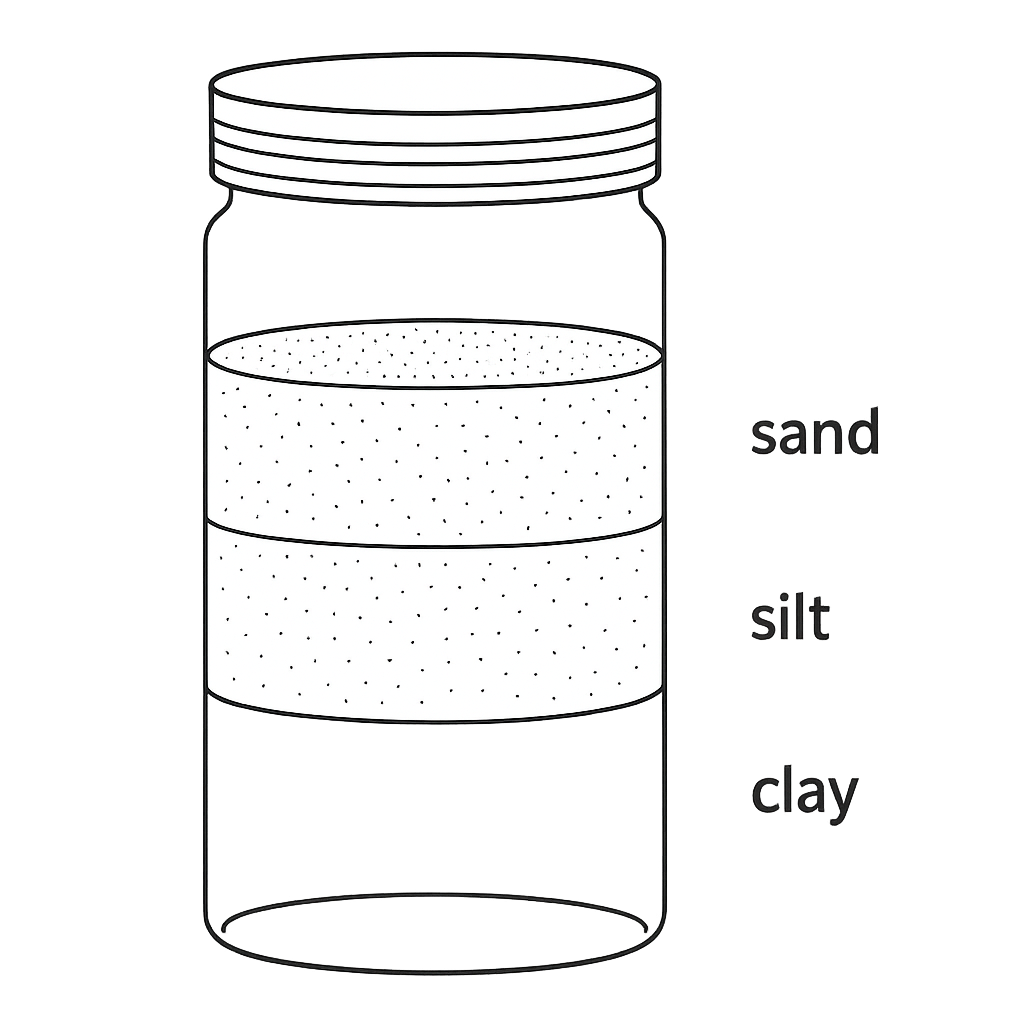
A soil‑texture separation apparatus consists of a clear cylindrical jar (height 30 cm) filled with a soil sample that, after shaking and settling, forms three distinct layers: sand (top), silt (middle) and clay (bottom). The sand layer occupies 13.5 cm of the total settled height. What is the percentage of sand in the sample?
Correct A. 45
B. 55
C. 60
D. 30

Correct Answer: A

Want to see the full step-by-step solution? Unlock AI Explanation & Analytics
Question 9 View Details
During a field survey of a maize farm, 200 plants were inspected. Thirty plants showed symptoms of leaf blight. Of these, 12 plants had severe lesions covering more than 50 % of the leaf area, while the remaining 18 plants had moderate lesions (severity score 50). The disease incidence is defined as (number of diseased plants ÷ total inspected) × 100. The disease severity index is calculated as (sum of severity scores ÷ (number of diseased plants × 100)) × 100. Determine the disease incidence (in %) and the disease severity index (in %).
A. Incidence: 15%; Severity index: 60%
Correct B. Incidence: 15%; Severity index: 70%
C. Incidence: 10%; Severity index: 50%
D. Incidence: 20%; Severity index: 70%

Correct Answer: B

Want to see the full step-by-step solution? Unlock AI Explanation & Analytics
Question 10 View Details
A mixed farm produces 5 tonnes of cassava (price ₦400 per kg) and rears 20 pigs (sale price ₦80,000 each). Fixed costs amount to ₦3,000,000 per year. Variable cost per tonne of cassava is ₦120,000 and variable cost per pig is ₦30,000. Calculate the farm's net profit (or loss). If the farm is operating at a loss, state the additional revenue required to break even.
A. Loss of ₦500,000; needs ₦500,000 additional revenue to break even
B. Loss of ₦600,000; needs ₦700,000 additional revenue to break even
Correct C. Loss of ₦600,000; needs ₦600,000 additional revenue to break even
D. Profit of ₦200,000; no additional revenue needed

Correct Answer: C

Want to see the full step-by-step solution? Unlock AI Explanation & Analytics
Question 11 View Details
A farmer intends to lime a 2‑hectare field. The recommended lime rate for soils with pH 5.0 is 2.5 tonnes per hectare. The field's soil pH is 5.2, which requires only 80 % of the full lime rate. How many tonnes of lime should be applied to the whole field?
A. 5
B. 3
Correct C. 4
D. 6

Correct Answer: C

Want to see the full step-by-step solution? Unlock AI Explanation & Analytics
Question 12 View Details
A mango orchard has 1 500 trees. Initially 12 % of the trees show symptoms of a fungal disease. After the first fungicide application, the number of diseased trees is reduced by 40 % of the original diseased count. A second treatment later reduces the remaining diseased trees by 25 % of that remaining count. How many trees are still diseased after both treatments?
A. 108
B. 63
Correct C. 81
D. 90

Correct Answer: C

Want to see the full step-by-step solution? Unlock AI Explanation & Analytics
Question 13 View Details
A pond is stocked with 4 000 catfish. Each month the population grows by 6 % (compounded). At the end of every month a harvest is made. Under Plan X, 250 fish are harvested each month. Under Plan Y, 300 fish are harvested each month, but if the population after growth is less than 300, only the available fish are taken. After 5 months, which plan leaves more fish in the pond and by how many fish?
Correct A. Plan X leaves more fish by about 292
B. Plan Y leaves more fish by about 310
C. Plan X leaves more fish by about 150
D. Plan Y leaves more fish by about 45

Correct Answer: A

Want to see the full step-by-step solution? Unlock AI Explanation & Analytics
Question 14 View Details
A flock of 200 chickens is threatened by Newcastle disease. The disease causes a 30 % mortality within four days if the birds are unprotected. A vaccine costing ₦250 per bird provides 90 % protection against the disease. If the farmer vaccinates the entire flock before an outbreak, how many chickens are expected to survive the disease?
A. 188
Correct B. 194
C. 186
D. 200

Correct Answer: B

Want to see the full step-by-step solution? Unlock AI Explanation & Analytics
Question 15 View Details
A 3‑hectare maize field is infested with stem borer larvae at a density of 120 larvae per hectare. The larval population doubles every 7 days if untreated. A pesticide applied on day 0 reduces the larval population by 75 % instantly, and its effect lasts exactly 14 days, after which the population resumes its original doubling rate. The farmer applies the pesticide again on day 14. How many larvae are present in the whole field on day 28?
A. 90
Correct B. 360
C. 720
D. 180

Correct Answer: B

Want to see the full step-by-step solution? Unlock AI Explanation & Analytics
Question 16 View Details
A pest species in a field doubles its population every 4 days. If the initial population is 30 insects, what is the minimum number of days required for the population to reach at least 500 insects?
A. 24
Correct B. 20
C. 28
D. 16

Correct Answer: B

Want to see the full step-by-step solution? Unlock AI Explanation & Analytics
Question 17 View Details
A farmer intends to cultivate 5 ha of maize. Fixed costs (land rent, machinery depreciation) total ₦150,000. Variable cost per hectare (seed, fertilizer, labour) is ₦45,000. Expected yield is 3.2 tonnes per hectare. The farmer desires a profit of ₦120,000. What minimum selling price per kilogram of maize must be obtained to achieve this profit?
A. 26.75
B. 28.50
Correct C. 30.94
D. 33.10

Correct Answer: C

Want to see the full step-by-step solution? Unlock AI Explanation & Analytics
Question 18 View Details
A teak forest stand contains 120 trees per hectare. The average diameter at breast height (DBH) is 30 cm and the average height is 22 m. The form factor for this species is 0.55, where the volume of a single tree is V = form × π × (DBH/2)² × height. The forest manager wishes to harvest no more than 25 % of the standing volume in a year while retaining at least 80 trees per hectare after harvest. Determine (a) the maximum number of trees that can be harvested per hectare without breaching the minimum tree density, and (b) the total volume (in m³) that can be harvested per hectare under this constraint.
A. 25 trees per ha; 22.3 m³
Correct B. 30 trees per ha; 25.7 m³
C. 30 trees per ha; 30.0 m³
D. 35 trees per ha; 28.9 m³

Correct Answer: B

Want to see the full step-by-step solution? Unlock AI Explanation & Analytics
Question 19 View Details
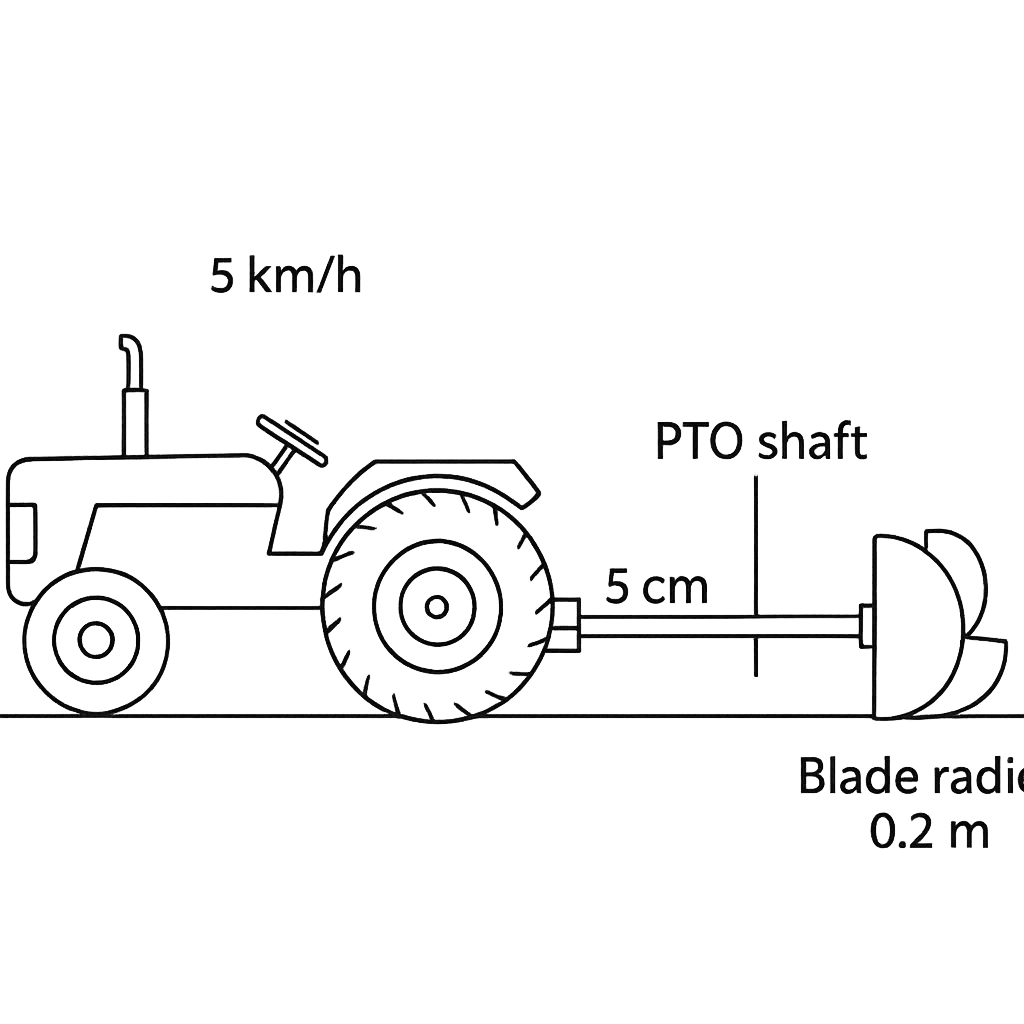
In the diagram, a tractor moves at a ground speed of 5 km h⁻¹. Its power‑take‑off (PTO) shaft rotates at 540 rpm and has a diameter of 5 cm. The PTO drives a belt that turns the tiller shaft, whose diameter is 10 cm. The tiller shaft is directly connected to a rotating tiller blade of radius 0.20 m. Assuming no slip, calculate the linear speed of the blade tip in metres per second.
A. 6.2
B. 4.8
Correct C. 5.65
D. 5.0

Correct Answer: C

Want to see the full step-by-step solution? Unlock AI Explanation & Analytics
Question 20 View Details
During scouting of a 3.5‑ha maize field, a farmer finds 12 stem‑borer larvae in a 20 m² quadrat. The economic threshold is 5 larvae per 10 m². The recommended pesticide is to be applied at a rate of 1.8 L per hectare for a 0.025 % (w/v) solution. If the farmer mixes the spray in a 200‑L tank, how many millilitres of pure concentrate must be added to achieve the recommended concentration?
A. 25
B. 100
Correct C. 50
D. 75

Correct Answer: C

Want to see the full step-by-step solution? Unlock AI Explanation & Analytics
Question 21 View Details
A centrifugal pump has a impeller diameter of 300 mm and operates at 1450 rpm, delivering a flow of 20 m³/h at a head of 30 m. Using the pump affinity laws, determine the impeller diameter (to the nearest millimetre) and the new operating speed (to the nearest rpm) required to deliver a flow of 30 m³/h while maintaining the same head of 30 m.
A. Diameter = 300 mm, Speed = 2175 rpm
B. Diameter = 450 mm, Speed = 1450 rpm
Correct C. Diameter = 367 mm, Speed = 1184 rpm
D. Diameter = 367 mm, Speed = 967 rpm

Correct Answer: C

Want to see the full step-by-step solution? Unlock AI Explanation & Analytics
Question 22 View Details
A diesel tractor engine is rated at 50 kW. Its fuel consumption is 0.25 L kWh⁻¹ at full load and 0.20 L kWh⁻¹ at half load. The tractor is operated for 1500 h per year, 60 % of the time at full load and the remaining 40 % at half load. If diesel costs ₦180 per litre, calculate the total annual fuel consumption (in litres) and the corresponding fuel cost (in naira).
Correct A. Fuel consumption = 14 250 L; Fuel cost = ₦2 565 000
B. Fuel consumption = 15 000 L; Fuel cost = ₦2 700 000
C. Fuel consumption = 17 250 L; Fuel cost = ₦3 105 000
D. Fuel consumption = 18 750 L; Fuel cost = ₦3 375 000

Correct Answer: A

Want to see the full step-by-step solution? Unlock AI Explanation & Analytics
Question 23 View Details
A farmer intends to plant maize at a seed rate of 25 kg ha⁻¹. The average seed weight is 0.30 g. Germination percentage is 85 % and emergence of the germinated seeds is 90 %. Each established plant yields an average of 0.25 kg of grain. After harvest, 15 % of the grain is lost to pests and a further 10 % is lost to shattering. Calculate the expected net grain yield per hectare (in tonnes).
A. ≈ 9.8 tonnes per hectare
B. ≈ 10.5 tonnes per hectare
C. ≈ 14.0 tonnes per hectare
Correct D. ≈ 12.2 tonnes per hectare

Correct Answer: D

Want to see the full step-by-step solution? Unlock AI Explanation & Analytics
Question 24 View Details
The diagram shows a simple lever used to lift a heavy stone. The effort arm (distance from the fulcrum to the point where the effort is applied) is 0.8 m and the load arm (distance from the fulcrum to the centre of the stone) is 0.2 m. The stone weighs 200 N. Assuming an ideal (frictionless) lever, determine the minimum effort force required to lift the stone and state the mechanical advantage of the lever.
A. Effort = 40 N; Mechanical advantage = 5
B. Effort = 66.7 N; Mechanical advantage = 3
Correct C. Effort = 50 N; Mechanical advantage = 4
D. Effort = 60 N; Mechanical advantage = 4

Correct Answer: C

Want to see the full step-by-step solution? Unlock AI Explanation & Analytics
Question 25 View Details
A farmer plans to grow soybeans. Fixed costs for the enterprise are ₦150 000. Variable cost is ₦45 000 per hectare. Expected yield is 2.5 t ha⁻¹ and the market price is ₦120 000 per tonne. (a) Determine the minimum area (in hectares, to two decimal places) that must be cultivated to break even. (b) If the farmer cultivates 5 ha, calculate the expected profit.
Correct A. Break‑even area = 0.59 ha; Profit for 5 ha = ₦1 125 000
B. Break‑even area = 0.45 ha; Profit for 5 ha = ₦1 050 000
C. Break‑even area = 0.62 ha; Profit for 5 ha = ₦1 080 000
D. Break‑even area = 0.71 ha; Profit for 5 ha = ₦1 200 000

Correct Answer: A

Want to see the full step-by-step solution? Unlock AI Explanation & Analytics

Master the Exam!

You've seen a preview, but there are thousands more questions plus AI tutor to break down complex solutions.

Unlock Full Access Available for Android & Windows
Help others prepare! Share this practice hub:
Chat with Support