waec model questions vol1 2017 agricultural_science | Essay

Prepare for your exams with waec model questions vol1 questions? Reviewing past/model questions is one of the most effective ways to guarantee a high score. This practice hub features authentic 2017 agricultural_science (Essay) questions designed to simulate the real exam environment.

Practice these randomly selected questions to test your readiness.

Question 1 View Details
A mixed farming system is being introduced in a semi‑arid region of Nigeria. The system integrates crop production, livestock rearing and agro‑forestry. Discuss:
Question Parts
(a)
The major biotic and abiotic components of the farming ecosystem and how they interact.
(b)
The flow of energy through the system, indicating the primary producers, primary consumers and higher trophic levels.
(c)
Two possible adverse effects of excessive pesticide use on the biodiversity of this mixed farming ecosystem and suggest one management practice to mitigate each effect.
Detailed Essay Solution & Marking Scheme Available

Get the step-by-step mathematical proofs, key points required by examiners, and a comprehensive breakdown from our AI Tutor.
Question 2 View Details
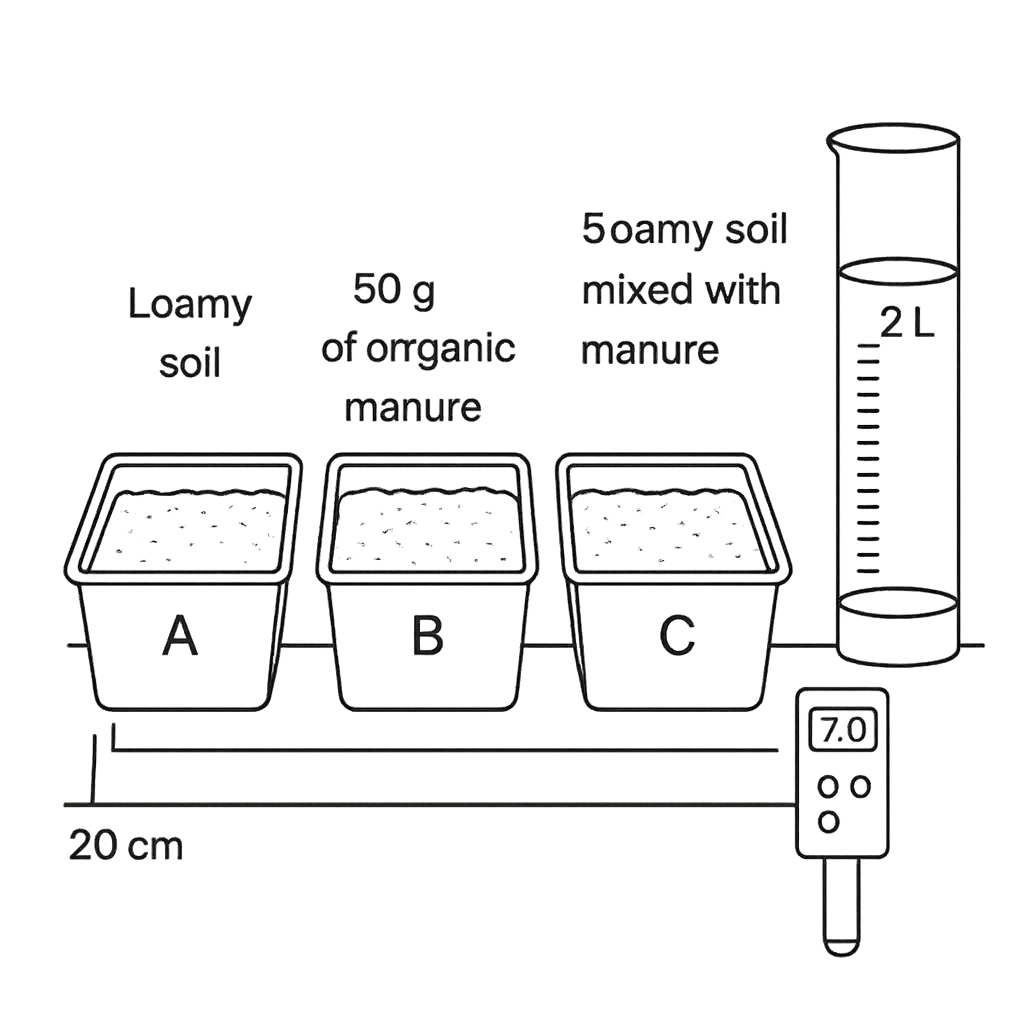
A soil‑science practical is set up to investigate the effect of organic manure on soil pH over a four‑week period. The experimental arrangement consists of three identical pots (A, B and C) placed on a bench. Each pot is filled with the same amount of loamy soil. Pot A receives no manure, Pot B receives 50 g of well‑decomposed organic manure, and Pot C receives 100 g of the same manure. Each pot will be watered with 2 L of distilled water at the start of the experiment. A digital pH meter is positioned beside the pots for weekly pH readings. Answer the following:
Question Parts
(a)
State a clear hypothesis for this experiment.
(b)
Identify the independent variable, the dependent variable and one controlled variable.
(c)
Using the diagram, calculate the total volume of water required for the three pots at the start of the experiment.
(d)
Describe the procedure for recording the pH changes over the four‑week period, ensuring reliability of the data.
Detailed Essay Solution & Marking Scheme Available

Get the step-by-step mathematical proofs, key points required by examiners, and a comprehensive breakdown from our AI Tutor.
Question 3 View Details
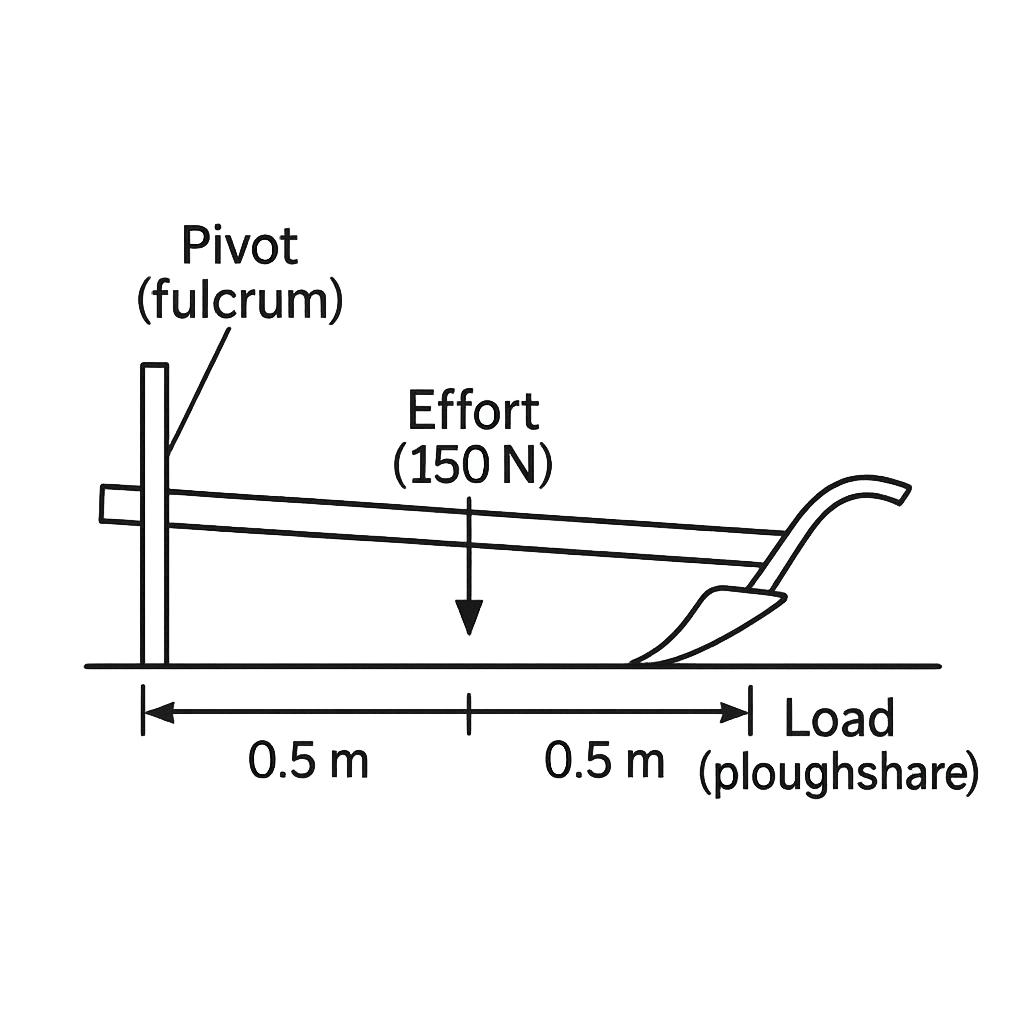
A farmer is demonstrating the use of a traditional wooden lever‑type plough. The setup consists of a sturdy wooden beam 2.0 m long pivoted at one end on a fixed stake. The ploughshare is attached at the opposite end of the beam. The farmer applies a downward force of 150 N at a point 0.5 m from the pivot on the beam.
Question Parts
(a)
Explain, with reference to the law of the lever, how the farmer is able to increase the effective force on the ploughshare.
(b)
Calculate the magnitude of the force exerted on the ploughshare, assuming the beam is in static equilibrium.
(c)
Discuss two safety precautions the farmer should observe while using this lever‑type plough.
(d)
Suggest two maintenance practices that will prolong the service life of the wooden beam and the ploughshare.
Detailed Essay Solution & Marking Scheme Available

Get the step-by-step mathematical proofs, key points required by examiners, and a comprehensive breakdown from our AI Tutor.

Question 4 View Details
A smallholder farmer plans to purchase a 20‑horsepower (hp) diesel‑powered tractor to mechanise his 5‑hectare farm. The tractor consumes diesel at a rate of 4.5 L per hour when operating at full load. Diesel costs ₦250 per litre. The farmer expects to run the tractor for 6 hours each day during the cropping season, which lasts 120 days.
Question Parts
(a)
Calculate the total volume of diesel (in litres) required for the entire cropping season.
(b)
Estimate the total fuel cost for the season.
(c)
If the tractor can plough at a rate of 0.4 ha per hour, determine how many days are needed to plough the whole 5 ha farm, assuming the tractor works 6 hours each day.
(d)
Discuss two advantages and two disadvantages of using a diesel tractor compared with animal traction for this farm.
Detailed Essay Solution & Marking Scheme Available

Get the step-by-step mathematical proofs, key points required by examiners, and a comprehensive breakdown from our AI Tutor.

Question 5 View Details
A farmer intends to cultivate maize on a 2.0‑hectare field that has a soil test indicating available nitrogen (N) of 15 kg ha⁻¹, phosphorus (P) of 8 kg ha⁻¹ and potassium (K) of 12 kg ha⁻¹. The recommended nutrient rates for optimum maize yield are 120 kg N, 60 kg P₂O₅ and 80 kg K₂O per hectare. The seed rate recommended for the variety is 25 kg ha⁻¹. The farmer expects a rainfall of 450 mm, while the crop water requirement for optimum yield is 550 mm. The expected yield under optimum moisture is 6 t ha⁻¹, and each 10 mm shortfall in water reduces yield by 0.3 t ha⁻¹.
Question Parts
(a)
Determine the amount of N, P₂O₅ and K₂O fertilizer that must be applied per hectare to meet the recommended rates.
(b)
Calculate the total seed requirement for the 2‑ha field.
(c)
Estimate the expected yield from the field after adjusting for the anticipated rainfall deficit, and state the total grain production in tonnes.
Detailed Essay Solution & Marking Scheme Available

Get the step-by-step mathematical proofs, key points required by examiners, and a comprehensive breakdown from our AI Tutor.

Question 6 View Details
A dairy farmer keeps a herd of 20 lactating cows. Each cow averages a daily milk yield of 22 L and a lactation length of 305 days per year. The cows are fed a total mixed ration (TMR) containing 12 % crude protein (CP) and 2.5 Mcal ME kg⁻¹. The maintenance energy requirement for a 500 kg cow is 0.45 Mcal ME day⁻¹, and the energy needed for milk production is 0.42 Mcal ME L⁻¹. The cost of the TMR is ₦150 per kilogram.
Question Parts
(a)
Determine the daily metabolizable energy (ME) requirement per cow (maintenance + milk production).
(b)
Calculate the amount of TMR (kg) that must be fed per cow each day to meet the energy requirement.
(c)
Compute the annual feed cost for the whole herd.
(d)
The farmer wishes to improve the protein content of the ration to 14 % CP without changing the total diet weight. Discuss two nutritional advantages of increasing CP level for lactating cows, and one potential drawback.
Detailed Essay Solution & Marking Scheme Available

Get the step-by-step mathematical proofs, key points required by examiners, and a comprehensive breakdown from our AI Tutor.

Question 7 View Details
A farmer in the savanna zone cultivates maize on a 2.5 ha field. The major pest observed is the stem borer (Busseola fusca). Each infested plant yields on average 0.4 kg less grain than a healthy plant. The field contains 30,000 maize plants. The farmer intends to use an organophosphate insecticide (dimethoate) that is to be applied at a rate of 1.5 L per hectare of a 0.025% (w/v) solution. The insecticide is sold in 500 mL bottles containing 20% (w/v) dimethoate and costs ₦1,200 per bottle.
Question Parts
(a)
Estimate the total potential loss in kilograms of grain if the pest is not controlled.
(b)
Determine the number of bottles required to treat the whole field at the recommended rate.
(c)
Calculate the total cost of the pesticide application.
(d)
Discuss two cultural, two biological and two chemical control methods for stem borer, and evaluate the advantages and disadvantages of integrating chemical control with at least one non‑chemical method in the context of sustainable agriculture.
Detailed Essay Solution & Marking Scheme Available

Get the step-by-step mathematical proofs, key points required by examiners, and a comprehensive breakdown from our AI Tutor.

Question 8 View Details
A farmer observes leaf spots on tomato plants in a 1.2 ha farm. The disease is early blight caused by Alternaria solani. Disease incidence is 25% of the plants and each diseased plant yields 30% less fruit weight than a healthy plant. The average fruit yield per healthy plant is 5 kg. The farmer planted the tomatoes at a density of 16,667 plants per hectare, giving a total of 20,000 plants on the farm. The farmer wants to implement a disease‑management programme using resistant varieties, crop rotation and a fungicide spray. The recommended fungicide (copper oxychloride) is to be applied at 2.0 kg per hectare of a 50% (w/w) formulation. The formulation is sold in 25‑kg bags at ₦3,500 per bag.
Question Parts
(a)
Calculate the total expected loss in kilograms of tomato fruit if the disease is left unmanaged.
(b)
Determine the amount (kg) of the 50% formulation needed for the whole farm and the number of 25‑kg bags required.
(c)
Compute the total cost of the fungicide.
(d)
Explain how crop rotation with a non‑solanaceous crop and the use of resistant varieties can reduce disease incidence, and discuss any two limitations of relying solely on chemical control for early blight.
Detailed Essay Solution & Marking Scheme Available

Get the step-by-step mathematical proofs, key points required by examiners, and a comprehensive breakdown from our AI Tutor.

Master the Exam!

You've seen a preview, but there are thousands more questions plus AI tutor to break down complex solutions.

Unlock Full Access Available for Android & Windows
Help others prepare! Share this practice hub:
Chat with Support