WAEC 2023 Physics | Practical

Prepare for your exams with WAEC questions? Reviewing past/model questions is one of the most effective ways to guarantee a high score. This practice hub features authentic 2023 Physics (Practical) questions designed to simulate the real exam environment.

Practice these randomly selected questions to test your readiness.
Question 1 View Details
Question Parts
(a)
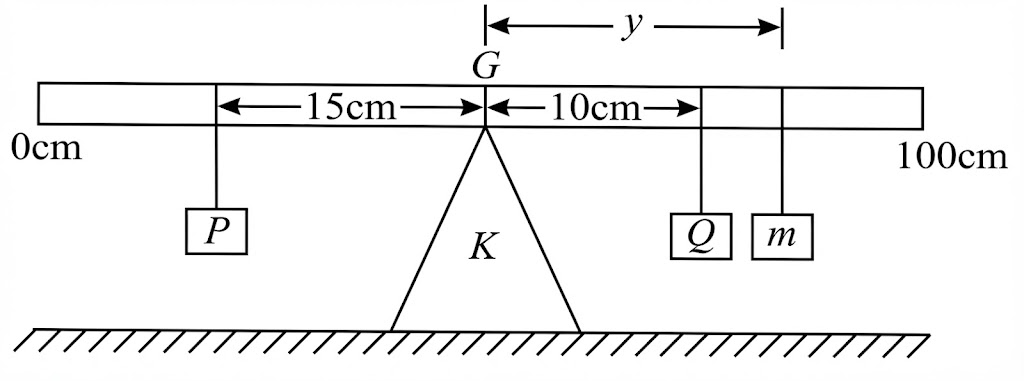
You are provided with a metre rule, two loads, P and Q, a knife, K, a set of masses, m and a piece of string. Use the diagram above as a guide to perform the experiment. (i) With no loads hanging on the metre rule, balance the metre rule horizontally on the knife edge. Record the position, G, of the knife edge on the balance metre rule. (ii) Suspend P securely at 15 cm from G, and Q securely at 10 cm from G. The positions of G, P and Q should not be altered throughout the experiment. (iii) Using a mass, m=40 g, balance the metre rule horizontally. Measure and record the distance, y, of m from G. (iv) Evaluate m^{-1}. (v) Repeat the procedure for m=50 g, 60 g, 70 g and 80 g. In each case, record the distance, y, and evaluate m^{-1}. (vi) Tabulate the results. (vii) Plot a graph with m^{-1} as ordinate and y as abscissa. (viii) Determine the slope, s, of the graph. (ix) Determine the value of m_{p} given that 15 m_{p}=s^{-1}+200. (x) From the graph, deduce the mass, m, that would produce a balance distance, y=27.5 cm. (xi) State two precautions taken to ensure good results.
(b)
(i) State two conditions necessary for a body to be in equilibrium. (ii) Two forces 4 N and 3 N act at right angles to each other, calculate the equilibrium of the system of forces.
Detailed Essay Solution & Marking Scheme Available

Get the step-by-step mathematical proofs, key points required by examiners, and a comprehensive breakdown from our AI Tutor.
Question 2 View Details
Question Parts
(a)
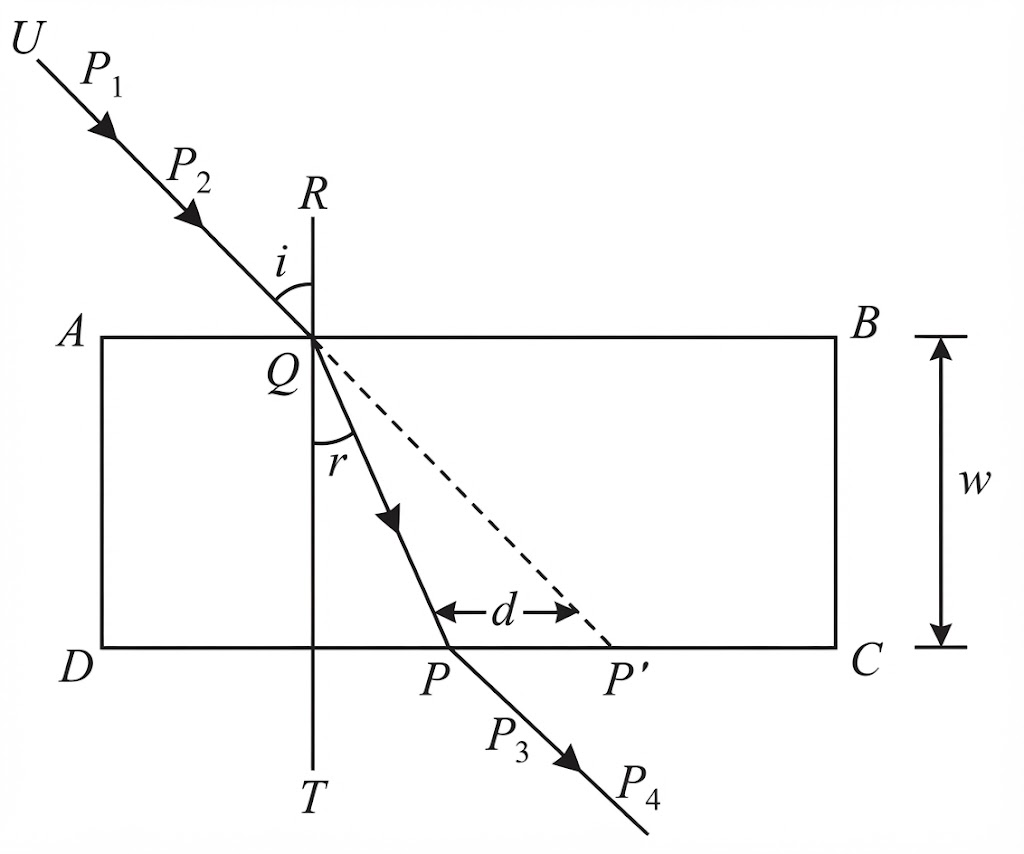
You are provided with a rectangular block, a drawing board, drawing sheets, four optical pins and other necessary materials. Use the diagram above as a guide to perform the experiment. (i) Measure and record the width of the block. (ii) Draw the outline ABCD of the block on a drawing sheet. Mark a point, Q on AB such that AQ=1.5 cm. Draw the normal RQT as shown in the diagram above. (iii) Draw a line UQ making an angle =10^{ extcirc} with the normal RQT. (iv) Insert pins P_{1} and P_{2} on the UQ. Look through the side DC of the block and insert two other pins, P_{3} and P_{4} which appear to be in a straight line with the images of P_{1} and P_{2}. (v) Remove the block and mark the positions of P_{3} and P_{4}. Draw a straight line joining P_{3} and P_{4} and extend it to meet DC at E. (vi) Produce a line UQ to meet DC at the point F. Draw a straight line EQ. (vii) Measure and record the angle, r, length, EF=D, and evaluate an i, an r and V=( an i- an r). (viii) Using different outlines of the block, repeat the procedure for i=20^{ extcirc}, 30^{ extcirc}, 40^{ extcirc} and 50^{ extcirc}. In each case, measure and record r, d and evaluate an I, an r and V. (ix) Tabulate the results. (x) Plot a graph with d on the vertical axis and V on the horizontal axis. (xi) Determine the slope, s, of the graph. (xii) State two precautions taken to ensure good results.
(b)
(i) State the condition for the occurrence of total internal reflection at air-glass interface. (ii) State Snell's law.
Detailed Essay Solution & Marking Scheme Available

Get the step-by-step mathematical proofs, key points required by examiners, and a comprehensive breakdown from our AI Tutor.
Question 3 View Details
Question Parts
(a)
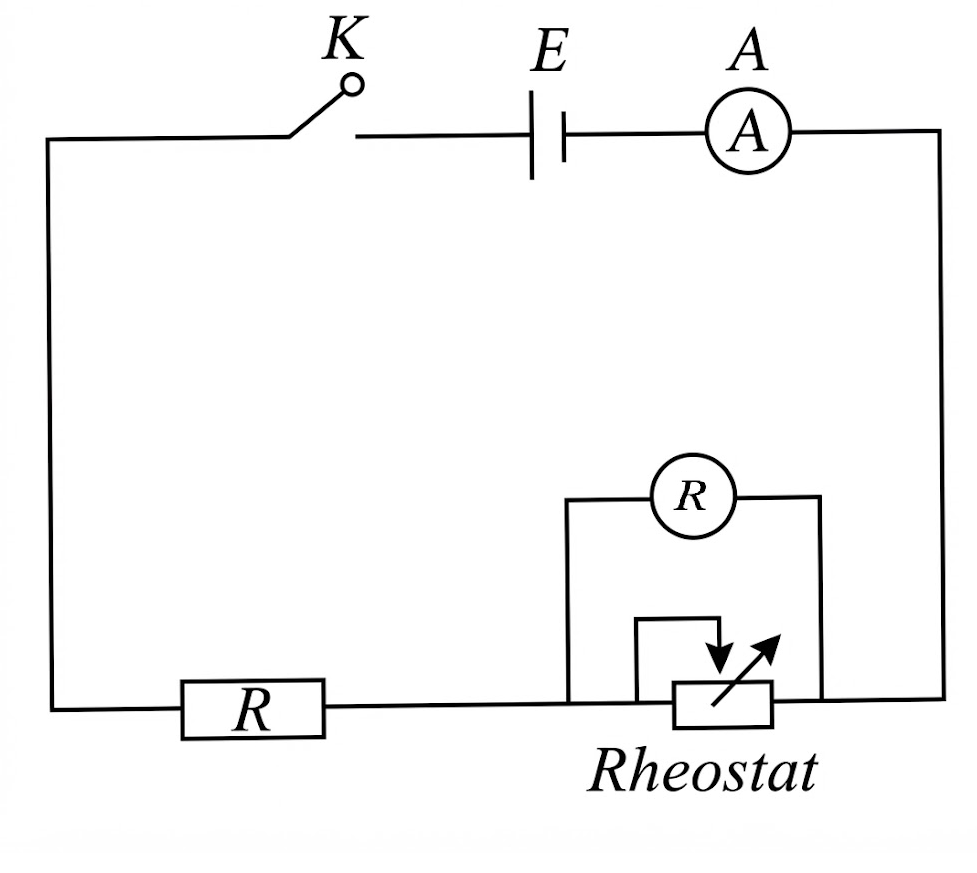
You are provided with a rheostat, an ammeter, a voltmeter, a 1 standard resistor, a key, a source of electricity of emf E and connecting wires. (i) Use the electrical components provided to connect the circuit as shown in the diagram leaving the circuit open. (ii) Connect the voltmeter to the terminals of the battery and record the voltmeter reading, V_{T}. (iii) Close the key and adjust the rheostat so that the ammeter reads I=0.3 A. Record the corresponding voltmeter reading V. (iv) Evaluate I^{-1} and G=1 / L. (v) Repeat the experiment for four other values of I=0.5 A, 0.7 A, 0.9 A and 1.1 A. In each case, record the corresponding value of V and evaluate I^{-1} and G. (vi) Tabulate the result. (vii) Plot a graph with I^{-1} on the vertical axis and G on the horizontal axis. (viii) Determine the slope, s, of the graph. (ix) Using the graph, determine the value of V for G=2.5. (x) State two precautions taken to ensure good results.
(b)
(i) A battery of emf 4.5K has a voltmeter connected to its terminals. If the combination is connected in series with a standard resistor and a key. It is observed that the voltmeter reading is less than 4.5 V when the key is closed. Explain the observation. (ii) An electric device draws 0.50 A in a 120 V circuit. Calculate the cost of using the device for 24 hours if the rate is $0.25 per KWh.
Detailed Essay Solution & Marking Scheme Available

Get the step-by-step mathematical proofs, key points required by examiners, and a comprehensive breakdown from our AI Tutor.

Master the Exam!

You've seen a preview, but there are thousands more questions plus AI tutor to break down complex solutions.

Unlock Full Access Available for Android & Windows
Help others prepare! Share this practice hub:
Chat with Support