UTME 2025 Biology | Objective

Practice these randomly selected questions to test your readiness.

Question 1
Salts and water are absorbed in the roots and transported to the leaves by
A. diffusion through the xylem tissues
B. osmosis through the phloem tissues
C. diffusion through the phloem tissues
D. osmosis through the xylem tissues.
Question 2
In his theory of evolution, Darwin implied that
A. the struggle for existence among living organisms is sporadic
B. the most successful organisms are those that best adapt to their environment
C. organs of the body which are not regularly used by an organism will disappear.
D. any traits acquired by an organism during its lifetime can be passed on to its offspring.
Question 3
The main waste products formed in plants are
A. alkaloids, tannins and resins
B. water, alkaloids and carbon dioxide
C. oxygen, carbon dioxide and alkaloids
D. water, carbon dioxide and oxygen
Question 4
If a plant, homozygous for round and yellow (RR;YY), is crossed with a wrinkled green type (rryy), all of the resulting seeds will be
A. blue and wrinkled
B. round and yellow
C. wrinkled and yellow
D. round and greenish-yellow
Question 5
Peripheral arrangement of vascular tissues in dicots is a characteristic of the internal structure of the
A. leaf
B. petiole
C. stem
D. root.
Question 6
A noticeable adaptation of the animal to its aquatic habitat is the possession of
A. a wide mouth
B. large eyes
C. webbed digits
D. fore limbs
Question 7
A caterpillar and an aphid living in different parts of the same plant can be said to
A. occupy the same ecological niche
B. be in different habitats
C. occupy different ecological niches
D. be in similar microhabitats
Question 8
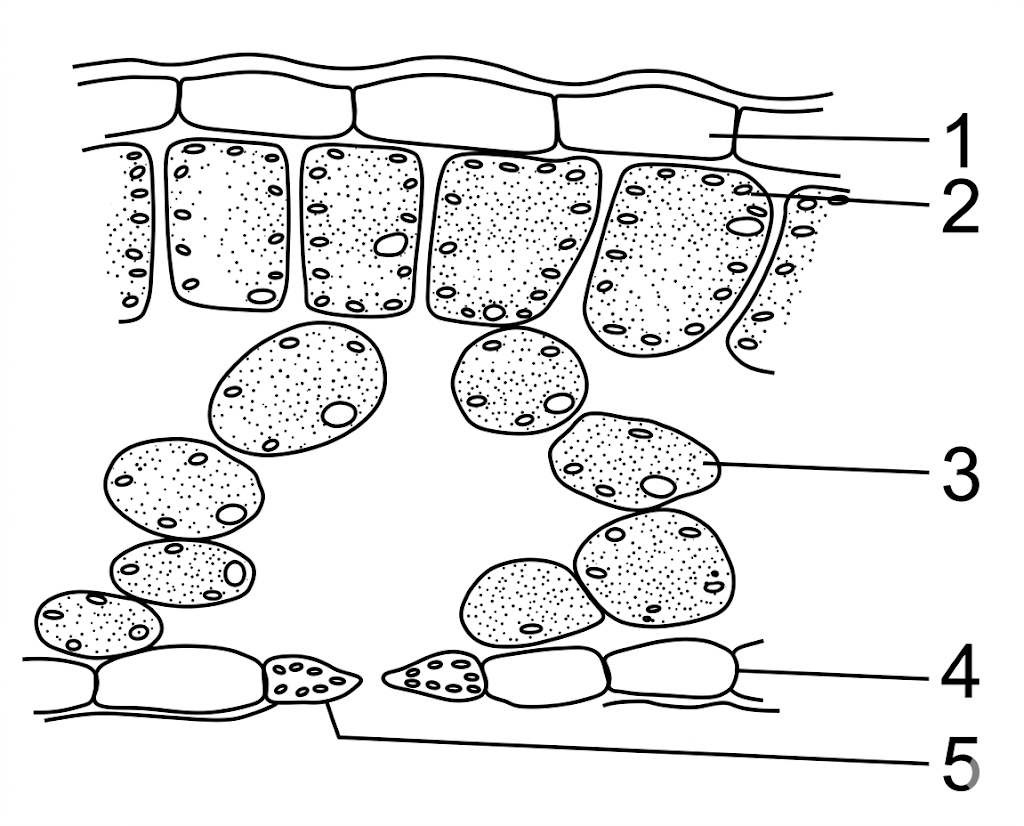
In the above diagram the cell which controls the opening and closing of stomatal pore is
A. 1
B. 2
C. 3
D. 4
E. 5
Question 9
A plant which grows on another plant without apparent harm to the host plant is called
A. a parasite
B. an epiphyte
C. a saprophyte
D. a predator
E. a hermaphrodite
Question 10
The sheet of muscle that separates the thoracic and the abdominal cavities is the
A. intercostal muscle
B. pleural membrane
C. pericardium
D. diaphragm.
Question 11
In a dicotyledonous stem, each companion cell is found beside the
A. endodermal cell
B. xylem vessel
C. sieve tube
D. pericyclic fibre
Question 12
The sequence of the biomes in Nigeria from Port Harcourt to Damaturu is
A. estuarine → rain forest → Guinea savannah → Sahel savannah
B. rain forest → Guinea savannah → estuarine → desert
C. estuarine → Guinea savannah → rain forest → Sahel savannah
D. rain forest → estuarine → Guinea savannah → desert
Question 13
A characteristic feature of tropical rainforest is that it
A. contains trees with narrow leaves.
B. contains large number of plant species.
C. contains fewer number of plants species.
D. has total annual rainfall of less than 50 cm .
Question 14
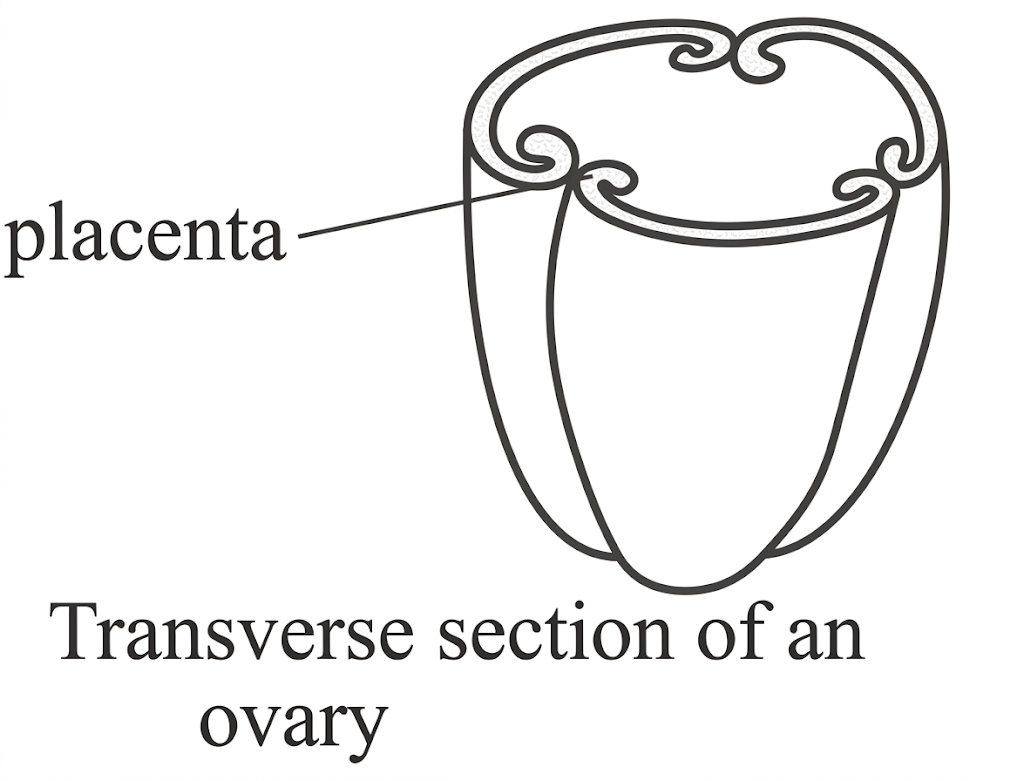
The type of placentation shown in the figure above is
A. parietal
B. marginal
C. axile
D. free-central
Question 15
The type of protective adaptation exhibited by the animal is
A. disruptive colouration
B. flash colouration
C. countershading colouration
D. warning colouration.

Master the Exam!

You've seen a preview, but there are thousands more questions plus AI tutor to break down complex solutions.

Unlock Full Access Available for Android & Windows
Help others prepare! Share this practice hub: