UTME 2023 Biology | Objective

Practice these randomly selected questions to test your readiness.

Question 1
The filaments of Spirogyra were put into equal volumes of sugar solutions X and Y. After 5 minutes, filaments from solution X had their cell contents rounded up while those from Y were unaffected. The experiment shows that
A. solution X was stronger than Y
B. solution Y was stronger than X.
C. Spirogyra used up the sugar in solution X
D. solution X is good for stimulating sexual reproduction in Spirogyra.
Question 2
A potometer with a leafy shoot weighed 18.9 g initially and 17.9 g after 1 hour. From this it follows that
A. the shoot absorbed 1 g of water per hour
B. 1 g of water per hour evaporates from the potometer
C. the shoot lost 1 g of water per hour
D. the potometer water receded at the rate of 1 g per hour.
Question 3
Which of the following characters is NOT sex-linked?
A. River blindness
B. Baldness
C. Haemophilia
D. Colour blindness.
Question 4
Which of the following is likely to encourage inbreeding in plants?
A. Doccious
B. Protandrous
C. Monoecious
D. Hermaphrodite.
Question 5
Yellowing of leaves is a symptom associated with deficiency of
A. iron, calcium and magnesium
B. nitrogen, sulphur and potassium
C. sulphur, phosphorus and iron
D. magnesium, nitrogen and iron.
Question 6
The removal of a man's pancreas by surgical operation can affect only the digestion of
A. starch
B. starch, protein and fats
C. oils and fats
D. proteins.
Question 7
A fundamental similarity between nervous and hormonal system is that both
A. involve chemical transmission
B. have widespread effects
C. shed chemicals into the blood stream
D. evoke rapid responses.
Question 8
In a population study using the transect method, a student is likely to record the highest number of species in
A. a tropical rain forest
B. a guinea savanna
C. a sahel savanna
D. an estuarine swamp.
Question 9
When the adults have reached a certain degree of weakness, the process of binary fission is replaced by conjugation in
A. Paramecium.
B. Euglena.
C. Amoeba.
D. Plasmodium.
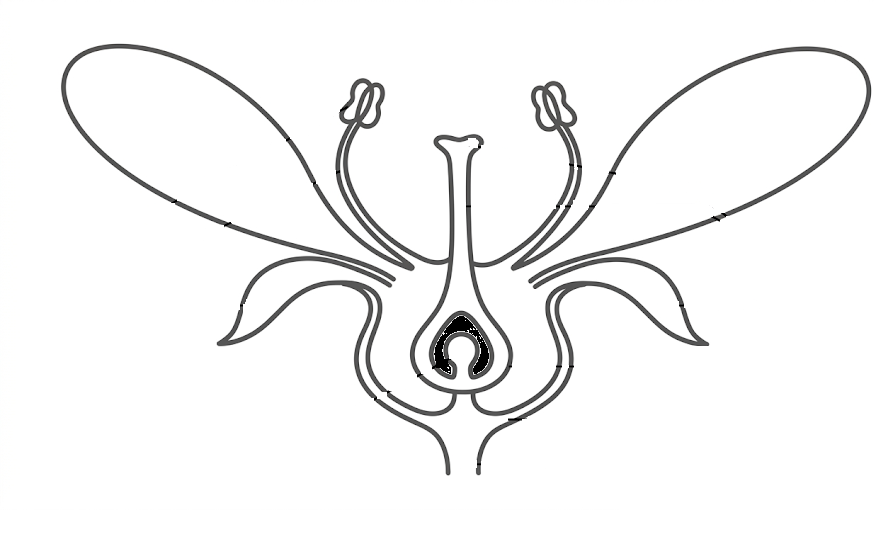
Question 10
The flower shown above is
A. complete, regular, hermaphroditic with superior ovary
B. incomplete, regular, hermaphroditic with inferior ovary
C. complete, regular, hermaphroditic with inferior ovary
D. incomplete, irregular, pistillate with superior ovary.
Question 11
Which of the following is used to test for the presence of lime in a soil sample?
A. \( \mathrm{H}_{2} \mathrm{SO}_{4(\mathrm{aq})} \)
B. \( \mathrm{NaOH}_{(\mathrm{aq})} \)
C. \( \mathrm{HCl}_{(\mathrm{aq})} \)
D. \( \mathrm{HNO}_{3(\mathrm{aq})} \)
Question 12
A certain savanna grasshopper changes colour from green during the rainy season to brown during the dry season and black after the dry season bush fires. The reason for these colour changes is that the
A. grasshopper is getting older
B. environmental temperature is changing
C. grasshopper is avoiding predation
D. grasshopper is frequently moulting.
Question 13
One example of fossil fuels is
A. limestone
B. coral
C. coal
D. firewood.
Question 14
The reproductive system of a male mammal is made up of
A. claspers, prostrate gland, sperm duct and vas deferens
B. testis, prostrate gland, sperm duct and vas deferens
C. oviduct, urethra, testis and sperm duct
D. testis, uterus, prostrate gland and sperm duct.
Question 15
A major difference between platyhelminthes and coelenterates is that platyhelminthes
A. are multicellular
B. have developed a mesoderm
C. reproduce sexually
D. reproduce asexually.

Master the Exam!

You've seen a preview, but there are thousands more questions plus AI tutor to break down complex solutions.

Unlock Full Access Available for Android & Windows
Help others prepare! Share this practice hub: