UTME 2021 Physics | Objective

Practice these randomly selected questions to test your readiness.
Question 1
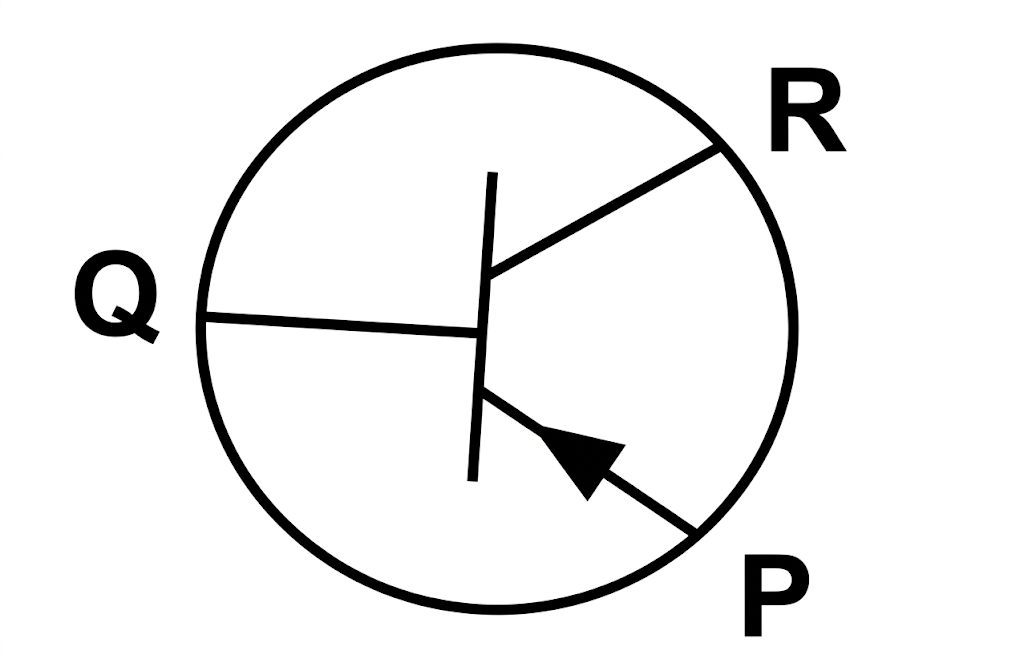
When cold water is poured on a can containing hot water, the can collapses because the
A. steam condenses and occupies the partial vacuum in the can.
B. external air pressure counterbalances the pressure within the can.
C. external pressure becomes greater than the pressure within the can.
D. steam expands to occupy the vacuum remaining in the can.
Question 2
Calculate the e.m.f. of the cell in the above circuit if its internal resistance is negligible.
A. 12 V .
B. 8 V .
C. 2 V .
D. 36 V .
Question 3
During the nuclear reactions described by \[ { }_{92}^{235} \mathrm{~W} \rightarrow{ }_{93}^{235} \mathrm{X} \rightarrow{ }_{91}^{231} \mathrm{Y} \] the particles emitted are respectively
A. \( \beta \) and \( \beta \).
B. \( \beta \) and \( \alpha \).
C. \( \alpha \) and \( \beta \).
D. \( \alpha \) and \( \alpha \).
Question 4
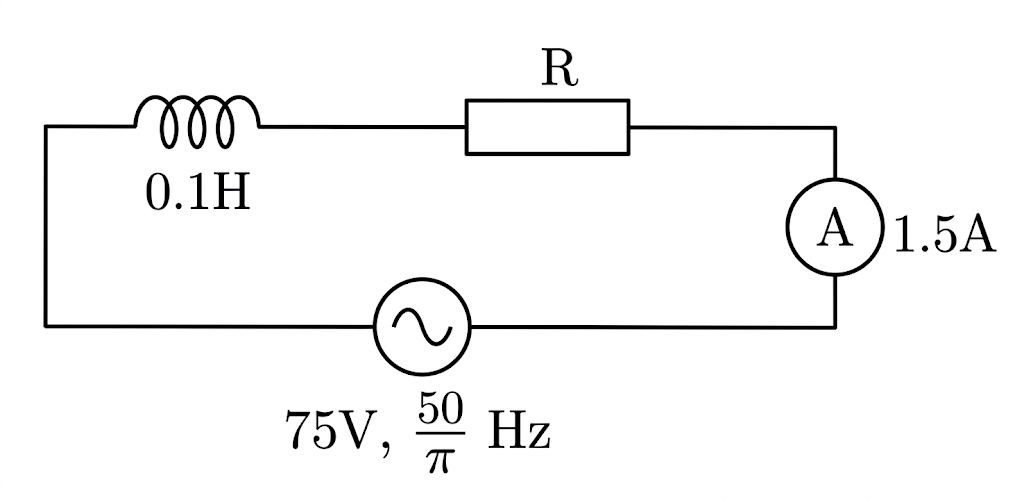
From the diagram above, the inductive reactance and the resistance R are respectively
A. \( 10 \Omega \) and \( 50 \Omega. \)
B. \( 20 \Omega \) and \( 50 \Omega .\)
C. \( 25 \Omega \) and \( 51 \Omega \).
D. \( 50 \Omega \) and \( 45 \Omega \).
Question 5
The diagram above shows a velocity-time graph. The statement that is true about this motion is that, the car
A. decelerates between points F and H.
B. accelerates between points F and G.
C. has a constant speed between points E and F .
D. has no acceleration between point F and G .
Question 6
In the diagram above, a 200 W bulb is lighted by a 240 V a.c mains supply. If 1 kWh is sold at \( N 40 \), the cost of keeping the bulb lighted for a day is
A. N 192.00
B. N 1.92 .
C. N 19.20 .
D. N 1920.00.
Question 7
The process through which free electrons leave the surface of hot metals is known as
A. electron emission
B. ionic emission
C. photon emission
D. thermionic emission
Question 8
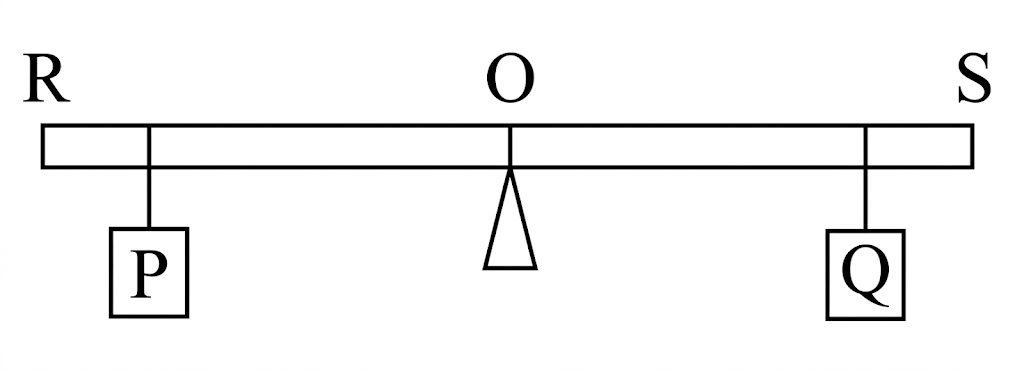
The diagram above shows plank \( \mathbf{R S} \) pivoted at its centre of gravity \( \mathbf{O} \) and is in equilibrium with the weights \( \mathbf{P} \) and \( \mathbf{Q} \). If a weight \( 2 \mathbf{P} \) is added to \( \mathbf{P} \), the plank will be in equilibrium again by
A. moving \( \mathbf{Q} \) nearer to \( \mathbf{O} \).
B. moving \( \mathbf{P} \) nearer to \( \mathbf{O} \).
C. adding a weight \( \mathbf{Q} \) to \( \mathbf{Q} \).
D. moving \( \mathbf{P} \) further away from \( \mathbf{O} \).
Question 9
When the human eye loses its power of accommodation, the defect is known as
A. astigmatism
B. long-sightedness
C. presbyopia.
D. short-sightedness
Question 10
The thermometer whose reading is indicated by a change in colour of its thermometric property is the
A. bi-metallic strip thermometer.
B. thermocouple.
C. platinum resistance thermometer.
D. optical pyrometer.
Question 11
The accurate measurement of the relative density of a substance in its powdered form is done with a beam balance and
A. an eureka can.
B. a density bottle.
C. a pipette.
D. a burette.
Question 12
If a load of mass 10 N stretches a cord by 1.2 cm . what is the total work done?
A. \( 6.0 \times 10^{-2} \mathrm{~J} \)
B. \( 7.6 \times 10^{-2} \mathrm{~J} \)
C. \( 1.8 \times 10^{-2} \mathrm{~J} \)
D. \( 6.6 \times 10^{-2} \mathrm{~J} \)
Question 13
The production of pure spectrum could easily be achieved using a
A. triangular prism.
B. triangular prism with two concave lenses.
C. triangular prism with two convex lenses.
D. glass prism with a pin.
Question 14
If a body of mass 5 kg is thrown vertically upwards with velocity $ u $, at what height will the potential energy equal to the kinetic energy?
A. \( h=\frac{u^{2}}{g} \)
B. \( h=\frac{u^{2}}{4 g} \)
C. \( h=\frac{2 u^{2}}{g} \)
D. \( h=\frac{u^{2}}{2 g} \)
Question 15
The pair of physical quantities consisting of vectors only are
A. acceleration and speed.
B. velocity and distance.
C. displacement and torque.
D. momentum and power.

Master the Exam!

You've seen a preview, but there are thousands more questions plus AI tutor to break down complex solutions.

Unlock Full Access Available for Android & Windows
Help others prepare! Share this practice hub: