UTME 2019 Chemistry | Objective

Practice these randomly selected questions to test your readiness.

Question 1
How many grams of H 2 SO 4 are necessary for the preparation of 0.175 dm 3 of 6.00 MH 2 SO 4 ? \( [\mathrm{S}=32.06 . \mathrm{O}=16.00 . \mathrm{H}=1.001 ] \)
A. 206.0 g
B. 103.0 g
C. 98.1 g
D. 51.5g
Question 2
\( \text{Alkanes} \xrightarrow{400^\circ\text{C} - 700^\circ\text{C}} \) \( \text{ alkanes + hydrogen.} \) \( \\ \text{The above reaction is known as} \)
A. photolysis
B. cracking
C. isomerization
D. reforming.
Question 3
Deliquescent substances are also
A. efflorescent
B. anhydrous
C. hygroscopic
D. insoluble.
Question 4
Calculate the mass in kilograms, of magnesium produced by the electrolysis of magnesium (II) chloride in a cell operating for 24 hours at 500 amperes.
A. 2.7
B. 5.4
C. 10.8
D. 21.7
Question 5
Which of the following is formed when maltose reacts with concentrated tetraoxosulphate (IV) acid?
A. Carbon (IV) oxide
B. Coal tar
C. Charcoal
D. Toxic fumes.
Question 6
The substance ZnO dissolves in sodium hydroxide solution and mineral acid solution to give soluble products in each case. ZnO is therefore referred to as
A. an allotropic oxide
B. an amphoteric oxide
C. a peroxide
D. a dioxide.
Question 7
In the reaction \( \\ 2(\text{C}_{6}\text{H}_{10}\text{O}_{5})_{n} + n\text{H}_{2}\text{O} \xrightarrow{\text{diastase}/60^\circ\text{C}} n\text{C}_{12}\text{H}_{22}\text{O}_{11}, \\ \) diastase is functioning as
A. a dehydrating agent
B. reducing agent
C. an oxidizing agent
D. a catalyst.
Question 8
The carbon atoms on ethane are
A. sp2 hybridized
B. sp3 hybridized
C. sp4 hybridized
D. sp hybridized
Question 9
Alkanoic acids have low volatility compared with alkanols because they
A. are more polar than alkanols
B. have two oxygen atoms while alkanols have one
C. form hydrogen bonds while alkanols do not
D. form two hydrogen bonds while alkanols form one
Question 10
Calculate the volume of carbon(IV) oxide measured at s.t.p. produced when 1 kg of potassium hydrogen trioxocarbonate(IV) is totally decomposed by heat.
A. \( 28dm^3 \)
B. \( 56 dm^3 \)
C. \( 112 dm^3 \)
D. \( 196 dm^3 \)
Question 11
When plastics and packaging materials made from chloroethene are burnt in the open, the mixture of gases released into the atmosphere is most likely to contain
A. ethane
B. chlorine
C. hydrogen chloride
D. ethene.
Question 12
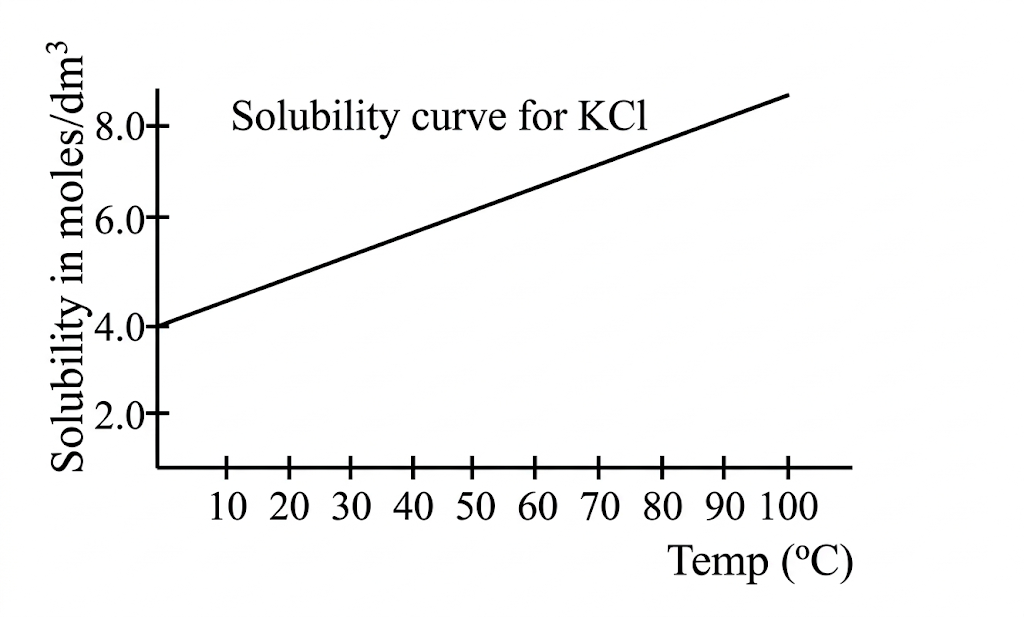
In general, an increase in temperature increases the solubility of a solute in water because
A. more solute molecules collide with each other
B. most solutes dissolve with the evolution of heat
C. more solute molecules dissociate at higher temperature
D. most solutes dissolve with absorption of heat.
Question 13
Which of the following physical properties decreases across the Periodic Table?
A. Ionization potential
B. Electron affinity
C. Electronegativity
D. Atomic radius.
Question 14
The four classes of hydrocarbons are
A. ethane, ethene, ethyne and benzene
B. alkanes, alkenes, alkynes and aromatics
C. alkanes, alkenes, alkynes and benzene
D. methane, ethane, propane and butane.
Question 15
The synthetic rubber obtained by the polymerization of chlorobutadiene in the presence of sodium is called
A. teflon
B. Isoprene
C. Polythene
D. Neoprene

Master the Exam!

You've seen a preview, but there are thousands more questions plus AI tutor to break down complex solutions.

Unlock Full Access Available for Android & Windows
Help others prepare! Share this practice hub: