UTME 2018 Physics | Objective

Practice these randomly selected questions to test your readiness.

Question 1
Which of the following does NOT describe the image formed by a plane mirror?
A. Erect
B. Laterally inverted
C. Same distance from mirror as object
D. Magnified
Question 2
One of the features of the fission process is that
A. it leads to chain reaction
B. its products are not radioactive
C. neutrons are not released
D. the sum of the masses of the reactants equals the sum of the masses of the products.
Question 3
Natural radioactivity consists of the emission of
A. \( \alpha \) -particles and \( \beta \) -rays
B. \( \alpha \) -particles and \( X-rays \)
C. \( \alpha \) -particles,\( \beta \) -rays and \( \gamma \)-rays
D. \( \gamma \) -rays and \( X \)-rays
Question 4
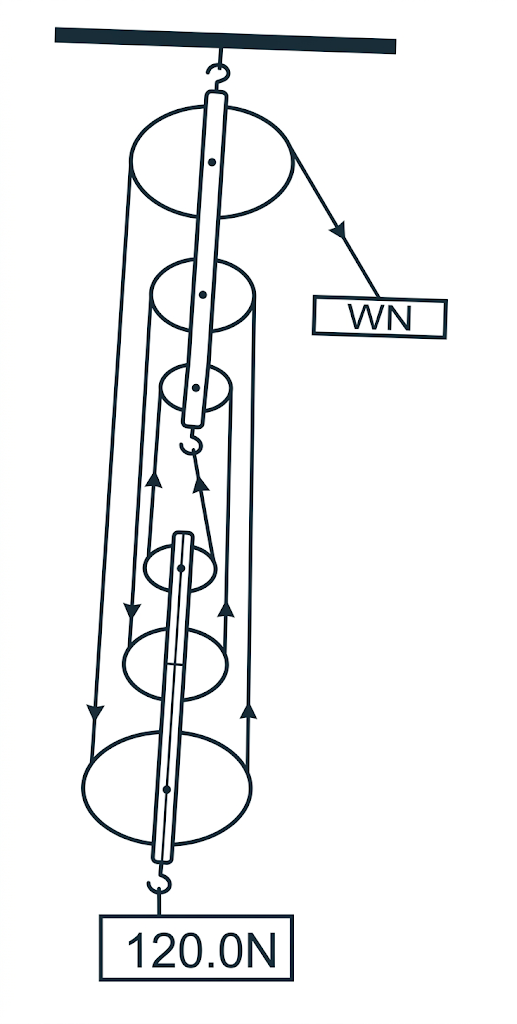
The figure above represents a block-and-tackle pulley system on which an effort of W Newtons supports a load of 120.0 N. If the efficiency of the machine is 40%, then the value of W is
A. 28.0 N
B. 48.0 N
C. 288.0 N
D. 50.0 N
Question 5
In homes, electrical appliances and lamps are connected in parallel because:
A. less current will be used
B. less voltage will be used
C. parallel connection does not heat up the wires
D. series connection uses high voltage.
Question 6
The linear expansivity of brass is 2 \( \times 10^{-5} \mathrm{C}^{-1} \). If the volume of a piece of brass is 15.00 \( \mathrm{~cm}^{3} \) at \( 0^{\circ} \mathrm{C} \), what is the volume at \( 100^{\circ} \mathrm{C} \)?
A. \( 16.03 \mathrm{~cm}^{3} \)
B. \( 15.09 \mathrm{~cm}^{3} \)
C. \( 16.00 \mathrm{~cm}^{3} \)
D. \( 15.03 \mathrm{~cm}^{3} \)
Question 7
What type of reaction is represented by the following scheme? \[_{1}^{2}X + _{1}^{2}Y \rightarrow _{2}^{3}Z + _{0}^{1}n + \text{ energy}\]
A. Fusion reaction
B. Fission reaction
C. Chain reaction
D. Radioactive decay.
Question 8
Convex mirrors are used as driving mirrors because images formed are:
A. erect, virtual and diminished
B. erect, real and diminished.
C. erect, virtual and magnified.
D. inverted, virtual and diminished.
Question 9
Calculate the effective capacitance of the circuit above:
A. \( 4 \mu \mathrm{f} \)
B. \( 3 \mu \mathrm{f} \)
C. \( 2 \mu \mathrm{f} \)
D. \( 1 \mu \mathrm{f} \)
Question 10
The pitch of an acoustic device can be increased by
A. decreasing the loudness
B. increasing the amplitude
C. increasing the frequency
D. decreasing the intensity.
Question 11
In a series R-I-C circuit at resonance, the voltages across the resistor and the inductor are 30 V and 40 V respectively. What is the voltage across the capacitor?
A. 30 V
B. 70 V
C. 50 V
D. 40 V
Question 12
A lead bullet of mass 0.05 kg is fired with a velocity of \( 200 \mathrm{~ms}^{-1} \) into a lead block of mass 0.95 kg. Given that the lead block can move freely, the final kinetic energy after impact is:
A. 150 J
B. 100 J
C. \( \frac{50}{J^{-131}} \)
D. 200 J
Question 13
The process whereby a liquid turns spontaneously into vapour is called:
A. regelation.
B. evaporation.
C. boiling.
D. sublimation.
Question 14
Shadows and eclipses result from the
A. refraction of light
B. reflection of light
C. defraction of light
D. rectilinear propagation of light
Question 15
The density of 400 cm³ of palm oil was 0.9 g cm⁻³ before frying. If the density of the oil was 0.6 g cm⁻³ after frying, assuming no loss of oil due to spilling, its new volume was
A. 360 cm³
B. 600 cm³
C. 240 cm³
D. 800 cm³

Master the Exam!

You've seen a preview, but there are thousands more questions plus AI tutor to break down complex solutions.

Unlock Full Access Available for Android & Windows
Help others prepare! Share this practice hub: