POST UTME UNIPORT 2024 Chemistry | Objective

Practice these randomly selected questions to test your readiness.

Question 1
A 0.1 M solution of CuSO4 is mixed with a 0.1 M solution of NaOH. The resulting precipitate is filtered and dried. What is the molar mass of the precipitate?
A. 159 g/mol
B. 159.7 g/mol
C. 160 g/mol
D. 160.5 g/mol
Question 2
A 2.5 g sample of a non-metallic oxide is dissolved in 50 cm³ of water. If the resulting solution has a pH of 3.5, what is the molar mass of the oxide?
A. 100 g/mol
B. 200 g/mol
C. 300 g/mol
D. 400 g/mol
Question 3
A diagram of a chromatography setup is shown below. What is the purpose of the chromatography column in this setup?
A. To separate the components of a mixture
B. To identify the components of a mixture
C. To measure the concentration of a component
D. To measure the volume of a component
Question 4
What is the major product of the reaction between 2-methylpropane and HCl?
A. 2-chloro-2-methylpropane
B. 2-methyl-2-chloropropane
C. 2-methyl-1-chloropropane
D. 2-methyl-2-chloropropane
Question 5
The s\tandard enthalpy of formation of CO(g) is -110.5 kJ/mol. Calculate the s\tandard enthalpy of formation of C(s) + 1/2 O2(g) → CO(g).
A. -110.5 kJ/mol
B. 0 kJ/mol
C. 110.5 kJ/mol
D. 0 kJ/mol
Question 6
The s\tandard enthalpy of formation of H2O(l) is -285.8 kJ/mol. Calculate the s\tandard enthalpy of formation of H2(g) + 1/2 O2(g) → H2O(l).
A. -285.8 kJ/mol
B. 0 kJ/mol
C. 285.8 kJ/mol
D. 0 kJ/mol
Question 7
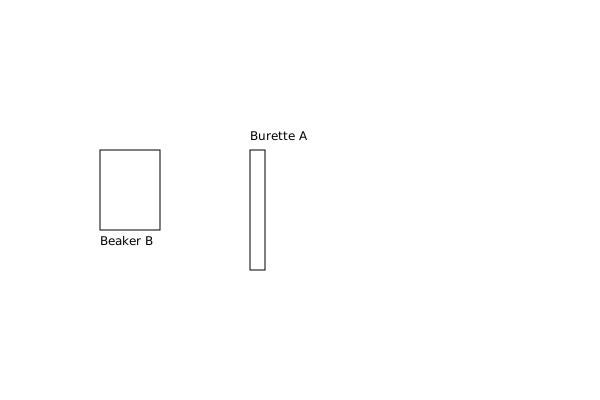
A diagram of a titration setup is shown below. What is the purpose of the burette?
A. To measure the volume of the solution
B. To measure the pH of the solution
C. To measure the temperature of the solution
D. To measure the density of the solution
Question 8
The s\tandard electrode potential of the reaction Zn(s) + 2Ag+(aq) → Zn2+(aq) + 2Ag(s) is 1.56 V. Calculate the s\tandard electrode potential of the reaction Zn(s) + 2Cu2+(aq) → Zn2+(aq) + 2Cu+(aq).
A. 0.34 V
B. 1.56 V
C. 2.10 V
D. 0.34 V
Question 9
A solution of sodium hydroxide (NaOH) is prepared by dissolving 10 g of NaOH in 100 cm³ of water. What is the concentration of the solution in moles per liter?
A. 0.1 M
B. 0.5 M
C. 1 M
D. 2 M
Question 10
A sample of a non-metallic element, sulfur, is heated in a crucible. The resulting gas is collected over water and found to have a volume of 2.50 L at 25°C and 1.00 atm. What is the molar mass of sulfur?
A. 32.1 g/mol
B. 40.1 g/mol
C. 48.1 g/mol
D. 56.1 g/mol
Question 11
A solution of 0.5 M HCl is titrated with a solution of 0.5 M NaOH. What is the pH of the solution after the addition of 25 mL of NaOH?
A. 1
B. 2
C. 3
D. 4
Question 12
A 2.5 M solution of H2SO4 is titrated with 1.0 M NaOH. Calculate the pH of the solution after 25 mL of NaOH has been added. The dissociation cons\tant for H2SO4 is 1.2 × 10^-2.
A. 1.2
B. 1.5
C. 1.8
D. 2.1
Question 13
A diagram of a colloid is shown below. What is the nature of the particles in this colloid?
A. Solid particles dispersed in a liquid
B. Liquid particles dispersed in a gas
C. Gas particles dispersed in a liquid
D. Solid particles dispersed in a gas
Question 14
A diagram of a titration setup is shown below. What is the purpose of the burette in this setup?
A. To measure the volume of the titrant
B. To measure the volume of the analyte
C. To mix the titrant and analyte
D. To separate the titrant and analyte
Question 15
Determine the number of moles of carbon dioxide produced when 2.5 g of calcium carbonate is heated in a crucible.
A. 0.05 mol
B. 0.10 mol
C. 0.15 mol
D. 0.20 mol

Master the Exam!

You've seen a preview, but there are thousands more questions plus AI tutor to break down complex solutions.

Unlock Full Access Available for Android & Windows
Help others prepare! Share this practice hub: