POST UTME UNILAG 2022 Chemistry | Objective

Practice these randomly selected questions to test your readiness.

Question 1
A solution contains 0.5 M NaCl and 0.2 M CaCl2. What is the total concentration of chloride ions in the solution?
A. 0.5 M
B. 0.7 M
C. 0.9 M
D. 1.1 M
Question 2
Determine the molar mass of a gas that occupies 2.5 L at 273 K and 1 atm. Use the ideal gas law to calculate the number of moles.
A. \( 0.0224 , \text{mol} \)
B. \( 0.0448 , \text{mol} \)
C. \( 0.0672 , \text{mol} \)
D. \( 0.0896 , \text{mol} \)
Question 3
A solution of 5 g of glu\cose (C6H12O6) in 100 g of water has a freezing point depression of 1.5°C. Calculate the molar mass of glu\cose.
A. 180 g/mol
B. 200 g/mol
C. 220 g/mol
D. 240 g/mol
Question 4
A solution contains 2.5 g of NaCl in 100 mL of water. What is the molarity of the solution?
A. 0.1 M
B. 0.2 M
C. 0.3 M
D. 0.4 M
Question 5
A 25 mL sample of a 0.2 M solution of CuSO4 is mixed with 25 mL of a 0.2 M solution of NaOH. Determine the concentration of Cu(OH)2 formed in the resulting solution.
A. 0.02 M
B. 0.04 M
C. 0.06 M
D. 0.08 M
Question 6
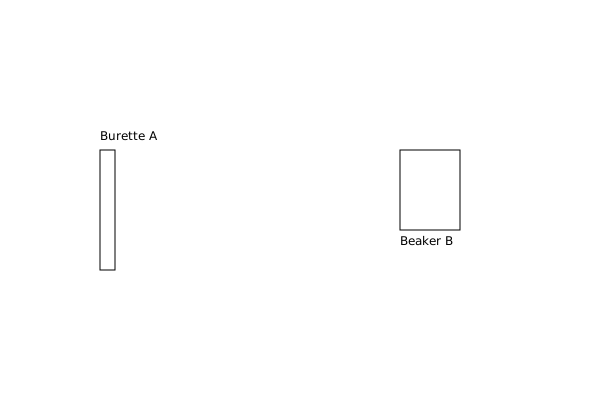
The diagram below shows a titration setup. What is the purpose of the burette?
A. To measure the volume of the acid
B. To measure the volume of the base
C. To mix the acid and base
D. To measure the pH of the solution
Question 7
A 0.1 M solution of NaOH is titrated with 0.1 M HCl. If 20 mL of HCl is required to reach the equivalence point, what is the volume of NaOH required to reach the equivalence point?
A. 10 mL
B. 20 mL
C. 30 mL
D. 40 mL
Question 8
A metal (X) reacts with HCl to produce a gas (Y) and a salt (Z). The reaction is as follows: X + 2HCl → Y + Z. If 2.5 g of X reacts with 10 mL of 0.5 M HCl, determine the molar mass of X.
A. 50 g/mol
B. 75 g/mol
C. 100 g/mol
D. 125 g/mol
Question 9
The rate cons\tant (k) of a first-order reaction is related to the half-life \( t_\( 1/2 \ \)) by the equation: k = ln(2) / t_\( 1/2 \). If the half-life of a reaction is 10 minutes, what is the rate cons\tant (k) in min^\( -1 \)?
A. 0.0693 min^\( -1 \)
B. 0.693 min^\( -1 \)
C. 6.93 min^\( -1 \)
D. 69.3 min^\( -1 \)
Question 10
A hydrocarbon with the molecular formula C4H10 is classified as an alkane. Which of the following is a possible structure for this hydrocarbon?
A. CH3CH2CH2CH3
B. CH3CH2CH2CH2CH3
C. CH3CH2CH(CH3)2
D. CH3CH(CH3)CH2CH3
Question 11
A sample of a non-ideal gas has a molar volume of 25 L/mol at 25°C and 1 atm. What is the molar volume of the gas at 50°C and 2 atm?
A. 20 L/mol
B. 25 L/mol
C. 30 L/mol
D. 35 L/mol
Question 12
At 298 K, the s\tandard Gibbs free energy change (ΔG°) for the reaction 2NO(g) + O2(g) → 2NO2(g) is -111.3 kJ/mol. Calculate the equilibrium cons\tant (K) for this reaction.
A. 1.0 × 10^12
B. 1.0 × 10^6
C. 1.0 × 10^3
D. 1.0 × 10^0
Question 13
A solution of 10 g of NaCl in 100 g of water has a boiling point elevation of 0.5°C. Calculate the molality of the solution.
A. 0.1 m
B. 0.2 m
C. 0.3 m
D. 0.4 m
Question 14
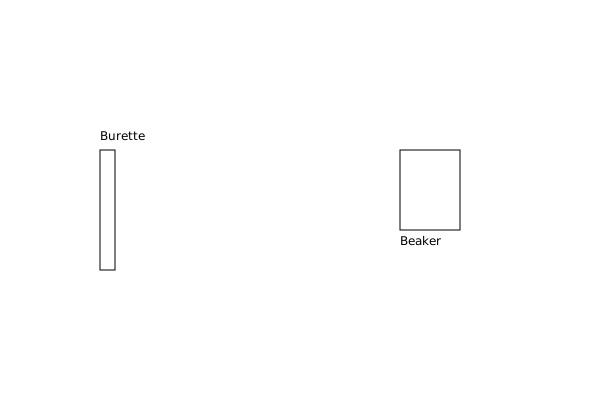
The diagram below shows a titration setup. If 25 mL of 0.1 M NaOH is added to the burette, what is the pH of the solution?
A. 7
B. 8
C. 9
D. 10
Question 15
Determine the pH of a 0.1 M solution of HCl.
A. 1
B. 2
C. 3
D. 4

Master the Exam!

You've seen a preview, but there are thousands more questions plus AI tutor to break down complex solutions.

Unlock Full Access Available for Android & Windows
Help others prepare! Share this practice hub: