POST UTME UNILAG 2017 Chemistry | Objective

Practice these randomly selected questions to test your readiness.

Question 1
A 2.5 g sample of a metal carbonate is heated to produce a metal oxide and carbon dioxide gas. If the mass of the metal oxide produced is 2.1 g, calculate the percentage yield of the metal oxide.
A. 65%
B. 70%
C. 75%
D. 80%
Question 2
A 2.50 L flask contains 0.500 mol of an ideal gas at 27°C. What is the pressure of the gas?
A. 1.01 × 10^5 Pa
B. 1.02 × 10^5 Pa
C. 1.03 × 10^5 Pa
D. 1.04 × 10^5 Pa
Question 3
A sample of benzene (C6H6) has a mass of 12.0 g. Calculate the number of moles of benzene present in the sample.
A. 0.154 mol
B. 0.1545 mol
C. 0.1541 mol
D. 0.1549 mol
Question 4
A 2.5 g sample of a metal carbonate is heated to produce a metal oxide and carbon dioxide gas. If the mass of the metal oxide produced is 2.1 g, calculate the percentage yield of the metal oxide.
A. 65%
B. 70%
C. 75%
D. 80%
Question 5
A redox reaction involves the transfer of electrons from one species to another. What is the driving force behind this transfer?
A. The driving force behind the transfer of electrons is the difference in electronegativity between the two species.
B. The driving force behind the transfer of electrons is the difference in oxidation states between the two species.
C. The driving force behind the transfer of electrons is the difference in reduction potentials between the two species.
D. The driving force behind the transfer of electrons is the difference in atomic radii between the two species.
Question 6
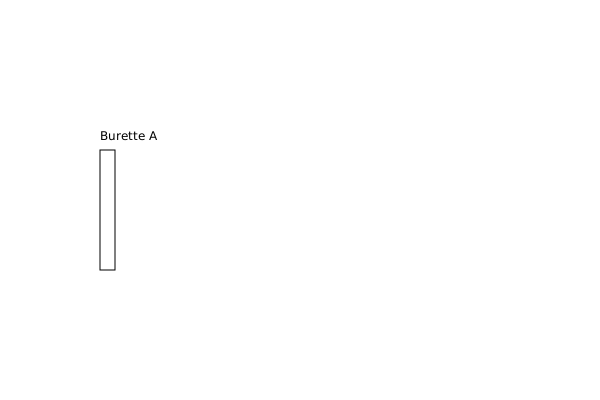
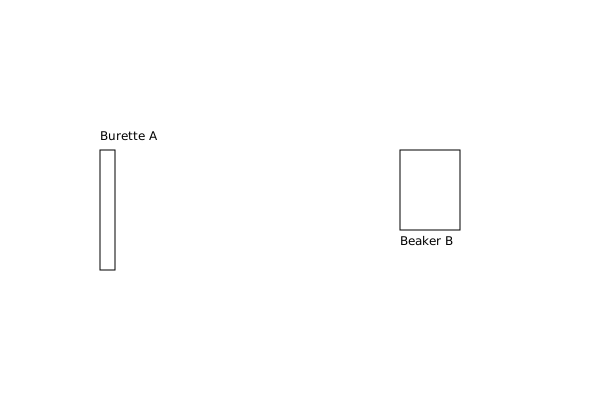
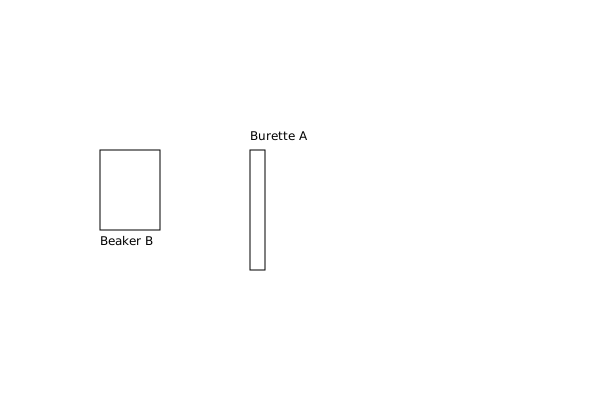
A diagram of a titration setup is shown below. What is the purpose of the burette in this setup?
A. To measure the volume of the solution being added.
B. To measure the volume of the solution being titrated.
C. To mix the solutions together.
D. To separate the solutions.
Question 7
At 273 K, the volume of 1 mole of an ideal gas is 22.4 L. If the temperature is increased to 373 K, what is the new volume of the gas?
A. 44.8 L
B. 22.4 L
C. 11.2 L
D. 5.6 L
Question 8
A 2.0 L flask contains 1.0 mol of an ideal gas at 298 K. What is the pressure of the gas?
A. 101.3 kPa
B. 202.6 kPa
C. 303.9 kPa
D. 405.2 kPa
Question 9
A solution of 0.1 M HCl is titrated with a solution of 0.1 M NaOH. What is the pH of the solution after the reaction is complete?
A. 7
B. 8
C. 9
D. 10
Question 10
A solution containing 0.1 M NaCl is electrolyzed u\sing a platinum electrode. If the current is 2 A, what is the mass of Cl2 produced after 10 minutes?
A. 0.1 g
B. 0.2 g
C. 0.3 g
D. 0.4 g
Question 11
A redox reaction involves the transfer of 2 electrons. If the s\tandard reduction potential of the oxidizing agent is +0.5 V, what is the s\tandard reduction potential of the reducing agent?
A. -0.5 V
B. -0.6 V
C. -0.7 V
D. -0.8 V
Question 12
The diagram below shows a titration setup. What is the purpose of the burette?
A. To measure the volume of the solution
B. To measure the volume of the solid
C. To measure the volume of the gas
D. To measure the volume of the liquid
Question 13
A 10.0 g sample of a metal is heated in air to produce a metal oxide. The mass of the metal oxide produced is 12.0 g. What is the percentage yield of the reaction?
A. 80%
B. 90%
C. 92%
D. 96%
Question 14
A 2.5 g sample of a polymer is dissolved in 50 mL of a solvent. If the density of the solution is 1.2 g/mL, what is the molarity of the solution?
A. 0.1 M
B. 0.2 M
C. 0.3 M
D. 0.4 M
Question 15
A 1.0 M solution of H2SO4 is mixed with 1.0 M solution of NaOH. What is the pH of the resulting solution?
A. 1
B. 2
C. 3
D. 4

Master the Exam!

You've seen a preview, but there are thousands more questions plus AI tutor to break down complex solutions.

Unlock Full Access Available for Android & Windows
Help others prepare! Share this practice hub: