POST UTME UNILAG 2017 Biology | Objective

Practice these randomly selected questions to test your readiness.

Question 1
The process by which microorganisms, such as bacteria, become resis\tant to antibiotics is known as?
A. Horizontal gene transfer
B. Vertical gene transfer
C. Mutation
D. Gene recombination
Question 2
In a eukaryotic cell, the Golgi apparatus is responsible for which of the following functions?
A. Protein synthesis
B. Lipid synthesis
C. Protein modification and transport
D. Cell signaling
Question 3
The Hardy-Weinberg principle states that allele and genotype frequencies in a population will remain cons\tant from generation to generation in the absence of other evolutionary influences. Which of the following is a necessary condition for the Hardy-Weinberg principle to hold?
A. Random mating
B. No mutation
C. No gene flow
D. No natural selection
Question 4
A population of bacteria is growing exponentially. If the initial population is 100 and the growth rate is 20% per hour, what will be the population after 3 hours?
A. 1000
B. 2000
C. 4000
D. 8000
Question 5
The process of mitosis is divided into four stages: prophase, metaphase, anaphase, and
A. Telophase
B. Cytokinesis
C. Interphase
D. Meiosis
Question 6
The diagram below represents the structure of the human heart. Which part of the heart pumps blood to the lungs?
A. Left Ventricle
B. Right Ventricle
C. Tricuspid Valve
D. Mitral Valve
Question 7
A researcher is studying the effect of antibiotics on bacterial growth. Which of the following is a characteristic of antibiotic resis\tance?
A. The bacteria are killed by the antibiotic.
B. The bacteria are inhibited by the antibiotic.
C. The bacteria are resis\tant to the antibiotic.
D. The bacteria are unaffected by the antibiotic.
Question 8
The diagram below represents the structure of the human cell. Which part of the cell is responsible for protein synthesis?
A. Nucleus
B. Mitochondria
C. Ribosomes
D. Lysosomes
Question 9
The diagram below represents the structure of the human blood vessel. Which part of the blood vessel is responsible for regulating blood pressure?
A. Artery
B. Vein
C. Capillary
D. Venules
Question 10
In the context of eco\logical succession, what is the primary mechanism driving the transition from a pioneer community to a climax community?
A. Niche partitioning
B. Predation and competition
C. Mutualism and symbiosis
D. Environmental disturbance
Question 11
The diagram below shows the structure of a plant cell. Which part is responsible for photosynthesis?
A. The cell wall
B. The vacuole
C. The chloroplast
D. The cytoplasm
Question 12
A plant has a genotype of BBRR. What is the probability that it will produce a seed with the genotype RR?
A. 0.5
B. 0.25
C. 0.75
D. 0.9
Question 13
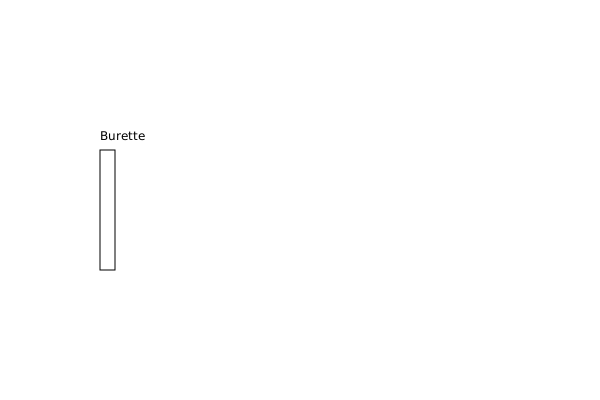
A diagram of a titration setup is shown below. What is the purpose of the burette?
A. To measure the volume of the acid
B. To measure the volume of the base
C. To mix the acid and base
D. To measure the pH of the solution
Question 14
The process of classification of living things involves the grouping of organisms based on their characteristics. What is the primary criterion used in the classification of living things?
A. Morpho\logy
B. Physio\logy
C. Biochemistry
D. Genetics
Question 15
The process of osmoregulation in humans involves the regulation of the concentration of solutes in the body fluids. What is the primary mechanism by which the kidneys regulate the concentration of solutes in the urine?
A. By adjusting the amount of water reabsorbed
B. By adjusting the amount of solutes reabsorbed
C. By adjusting the amount of ions reabsorbed
D. By adjusting the amount of glu\cose reabsorbed

Master the Exam!

You've seen a preview, but there are thousands more questions plus AI tutor to break down complex solutions.

Unlock Full Access Available for Android & Windows
Help others prepare! Share this practice hub: