POST UTME SUMMIT UNIVERSITY 2020 Chemistry | Objective

Practice these randomly selected questions to test your readiness.

Question 1
A sample of 1 L of a gas at 25°C and 1 atm is heated to 50°C. What is the new pressure of the gas?
A. 2 atm
B. 4 atm
C. 6 atm
D. 8 atm
Question 2
A metal oxide, M2O3, has a molar mass of 200 g/mol. If the atomic mass of M is 50 g/mol, what is the percentage of oxygen in the compound?
A. 60%
B. 70%
C. 80%
D. 90%
Question 3
A polymer is formed by the condensation reaction between two monomers, A and B. If the molecular weight of the polymer is 100,000 g/mol and the molecular weights of the monomers are 50,000 g/mol and 30,000 g/mol, respectively, what is the degree of polymerization?
A. 2
B. 3
C. 4
D. 5
Question 4
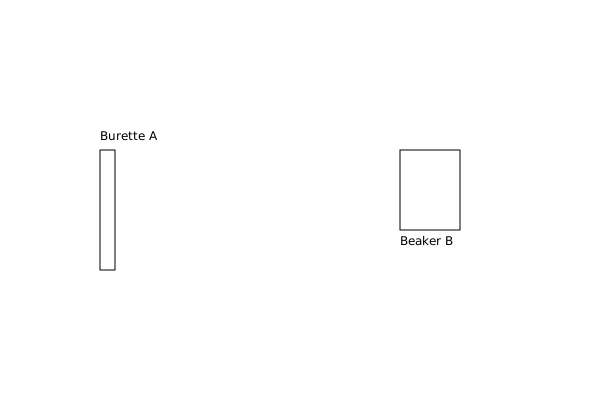
A diagram of a titration setup is shown below. What is the purpose of the burette in this setup?
A. To measure the volume of the solution
B. To mix the solution with the analyte
C. To filter the solution
D. To measure the pH of the solution
Question 5
A solution of 0.1 M NaCl is mixed with a solution of 0.2 M NaCl. What is the resulting concentration of NaCl?
A. 0.05 M
B. 0.1 M
C. 0.15 M
D. 0.2 M
Question 6
A 2.5 M solution of sulfuric acid (H2SO4) is prepared by dissolving 2.5 moles of H2SO4 in 1 L of water. What is the pH of the solution?
A. 0.5
B. 1.0
C. 1.5
D. 2.0
Question 7
The rate cons\tant (k) of a first-order reaction is given by the equation: k = Ae^\( -Ea/RT \). If the activation energy (Ea) is 100 kJ/mol, the gas cons\tant (R) is 8.314 J/mol*K, and the temperature (T) is 300 K, what is the value of the rate cons\tant (k) if the pre-exponential factor (A) is 1.0 x 10^10 s^-1?
A. 1.0 x 10^6 s^-1
B. 1.0 x 10^7 s^-1
C. 1.0 x 10^8 s^-1
D. 1.0 x 10^9 s^-1
Question 8
A gas at 25°C and 1 atm is compressed to 10 atm. What is the new volume of the gas?
A. 1 L
B. 2 L
C. 5 L
D. 10 L
Question 9
The reaction of sodium with water produces hydrogen gas and sodium hydroxide. What is the balanced chemical equation for this reaction?
A. 2Na + 2H2O → 2NaOH + H2
B. 2Na + H2O → 2NaOH + H2
C. Na + H2O → NaOH + H2
D. 2Na + 2H2O → 2NaOH + 2H2
Question 10
A 0.1 M solution of sodium hydroxide (NaOH) is prepared by dissolving 0.1 moles of NaOH in 1 L of water. What is the pOH of the solution?
A. 1.0
B. 2.0
C. 3.0
D. 4.0
Question 11
The atomic radius of an element is 100 pm. If the atomic radius of the element increases by 20% due to the addition of an electron, what is the new atomic radius?
A. 120 pm
B. 120.8 pm
C. 121 pm
D. 122 pm
Question 12
The reaction of cyclohexane with bromine in the presence of light yields a mixture of 1,2-dibromocyclohexane and 1,4-dibromocyclohexane. What is the major product of this reaction?
A. 1,2-dibromocyclohexane
B. 1,4-dibromocyclohexane
C. cis-1,2-dibromocyclohexane
D. trans-1,2-dibromocyclohexane
Question 13
The s\tandard enthalpy of formation of CO2 is -393.5 kJ/mol. What is the s\tandard enthalpy of formation of CO?
A. -110.5 kJ/mol
B. -110.5 kJ/mol
C. -110.5 kJ/mol
D. -110.5 kJ/mol
Question 14
The s\tandard electrode potential of the couple Zn2+/Zn is -0.76 V. What is the s\tandard electrode potential of the couple Cu2+/Cu?
A. -0.34 V
B. -0.76 V
C. 0.34 V
D. 0.76 V
Question 15
A diagram of a metal alloy is shown below. What is the purpose of the alloy in this setup?
A. To increase the strength of the metal
B. To decrease the melting point of the metal
C. To increase the corrosion resis\tance of the metal
D. To decrease the ductility of the metal

Master the Exam!

You've seen a preview, but there are thousands more questions plus AI tutor to break down complex solutions.

Unlock Full Access Available for Android & Windows
Help others prepare! Share this practice hub: