POST UTME SKYLINE UNIVERSITY 2025 Biology | Objective

Practice these randomly selected questions to test your readiness.

Question 1
A 10 L solution of 0.5 M glu\cose is filtered through a 0.2 μm membrane. What is the concentration of glu\cose in the filtrate?
A. 0.5 M
B. 0.2 M
C. 0.1 M
D. 0.05 M
Question 2
In the context of evolutionary bio\logy, what is the primary mechanism driving the adaptation of species to their environments?
A. Natural Selection
B. Genetic Drift
C. Gene Flow
D. Mutation
Question 3
A plant has a root system with a total surface area of 100 cm^2. If the plant is growing in a solution with a concentration of 10^{-3} M, what is the rate of nutrient uptake?
A. 10^{-6} mol/s
B. 10^{-5} mol/s
C. 10^{-4} mol/s
D. 10^{-3} mol/s
Question 4
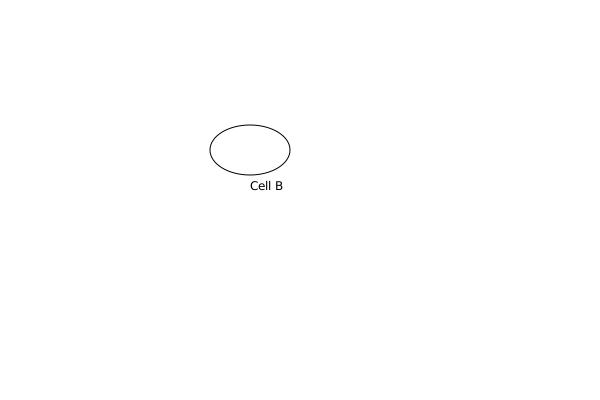
A diagram of a cell is shown below. What is the function of the part labeled 'B'?
A. To synthesize proteins
B. To store genetic information
C. To regulate cell growth
D. To transport molecules
Question 5
In a eukaryotic cell, the process of mitosis is initiated by the breakdown of the nuclear envelope, which is mediated by the phosphorylation of the nuclear lamina protein, lamin A. Which of the following statements about lamin A is correct?
A. Lamin A is a type of histone protein.
B. Lamin A is a component of the nuclear matrix.
C. Lamin A is phosphorylated by the enzyme CDK1.
D. Lamin A is involved in the regulation of gene expression.
Question 6
A population of bacteria is growing exponentially, with a growth rate of 0.05/h. If the initial population size is 1000, what is the population size after 2 hours?
A. 2000
B. 4000
C. 6000
D. 8000
Question 7
The diagram below shows a cross-section of a plant root. Which of the following tissues is responsible for the absorption of water and minerals from the soil?
A. Cortex
B. Endodermis
C. Xylem
D. Phloem
Question 8
A researcher is studying the effect of pH on the growth of Escherichia coli. The researcher measures the growth rate of the bacteria at different pH levels and plots the data on a graph. Which of the following types of graphs would be most appropriate for this data?
A. Bar graph
B. Line graph
C. Scatter plot
D. Pie chart
Question 9
A tissue is composed of a mixture of cell types. Which of the following is a characteristic of a tissue?
A. The cells are all the same type
B. The cells are all specialized for a specific function
C. The cells are all connected by tight junctions
D. The cells are all surrounded by a basement membrane
Question 10
The Hardy-Weinberg principle states that allele and genotype frequencies in a population will remain cons\tant from generation to generation in the absence of other evolutionary influences. Which of the following is a necessary condition for the Hardy-Weinberg principle to hold?
A. Random mating
B. No mutation
C. No gene flow
D. No natural selection
Question 11
A species of plant exhibits a phenomenon where it can reproduce asexually through fragmentation, but also has a sexual reproductive mode. What is the term for this type of reproduction?
A. Hermaphroditism
B. Apomixis
C. Parthenogenesis
D. Bisexual reproduction
Question 12
A 50-year-old patient has a systolic blood pressure of 180 mmHg and a diastolic blood pressure of 100 mmHg. What is the patient's blood pressure classification?
A. Hypertension Stage 1
B. Hypertension Stage 2
C. Hypertension Stage 3
D. Hypertension Stage 4
Question 13
A patient has a blood glu\cose level of 120 mg/dL. If the patient is administered 10 units of insulin, what is the expected change in blood glu\cose level?
A. -20 mg/dL
B. -30 mg/dL
C. -40 mg/dL
D. -50 mg/dL
Question 14
A 50 g sample of a mixture containing NaCl and KCl is dissolved in 100 mL of water. The resulting solution has a conductivity of 0.5 S/m. If the conductivity of a 0.1 M NaCl solution is 1.2 S/m, what is the molar concentration of KCl in the mixture?
A. 0.05 M
B. 0.1 M
C. 0.15 M
D. 0.2 M
Question 15
In a population of Drosophila melanogaster, the frequency of the recessive allele 'a' is 0.2. If the population is in Hardy-Weinberg equilibrium, what is the frequency of the homozygous dominant genotype 'AA'?
A. 0.64
B. 0.36
C. 0.48
D. 0.16

Master the Exam!

You've seen a preview, but there are thousands more questions plus AI tutor to break down complex solutions.

Unlock Full Access Available for Android & Windows
Help others prepare! Share this practice hub: