POST UTME SKYLINE UNIVERSITY 2017 Chemistry | Objective
Practice these randomly selected questions to test your readiness.
Question 1
A sample of a metal is analyzed and found to have a mass of 20 g. If the metal has a density of 8 g/cm^3, what is the volume of the sample?
Question 2
A solution of sodium hydroxide is prepared by dissolving 25.0 g of NaOH in 100 mL of water. Calculate the molarity of the solution.
Question 3
The reaction between nitrogen dioxide and water is given by the equation: 3NO2 + H2O → 2HNO3 + NO. If 2.5 moles of NO2 react with excess water, what is the limiting reac\tant?
Question 4
A 0.1 M solution of HCl is titrated with 0.1 M NaOH. Calculate the pH of the solution after 20 mL of NaOH has been added to 20 mL of the HCl solution. Assume the volume of the resulting solution is 40 mL.
Question 5
Determine the s\tandard electrode potential (E°) of the reaction: MnO4- + 8H+ + 5e- → Mn2+ + 4H2O. Given that the s\tandard electrode potential of the reduction of MnO4- is -1.23 V.
Question 6
A 1.0 M solution of NaOH is mixed with a 1.0 M solution of HCl. If the reaction is allowed to proceed to completion, calculate the concentration of the resulting solution.
Question 7
A solution contains 3.0 g of potassium nitrate (KNO3) per 100 mL of solution. What is the molarity of the solution?
Question 8
The reaction of zinc metal with copper(II) sulfate solution is represented by the equation: Zn(s) + CuSO4(aq) → ZnSO4(aq) + Cu(s). What is the oxidation state of zinc in the product ZnSO4?
Question 9
Determine the pH of a 0.1 M solution of HCl after 20 mL of 0.1 M NaOH has been added to 20 mL of the HCl solution. Assume the volume of the resulting solution is 40 mL.
Question 10
A 1.0 M solution of hydrochloric acid (HCl) is prepared by dissolving 36.5 g of HCl in water to make 1.0 L of solution. What is the molarity of the solution?
Question 11
A 1.5 g sample of a metal carbonate is heated to produce a metal oxide. Calculate the mass of the metal oxide produced if the metal carbonate has a molar mass of 100 g/mol and the metal oxide has a molar mass of 50 g/mol.
Question 12
The electrolysis of water produces hydrogen gas at the cathode and oxygen gas at the anode. If 2.0 g of hydrogen gas is collected at the cathode, calculate the number of moles of hydrogen gas produced.
Question 13
The reaction between zinc metal and hydrochloric acid is represented by the equation: Zn(s) + 2HCl(aq) → ZnCl2(aq) + H2(g). If 2.50 g of zinc metal is added to 100 mL of 2.00 M HCl, calculate the number of moles of hydrogen gas produced.
Question 14
A gas occupies a volume of 5.0 L at a pressure of 2.0 atm. What is the pressure of the gas at a volume of 10.0 L, assuming the temperature remains cons\tant?
Question 15
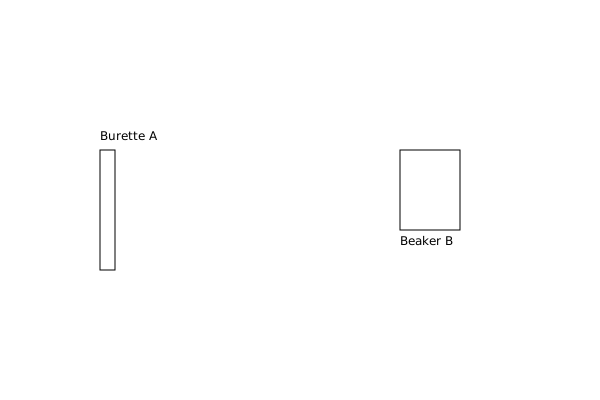
The diagram below shows a setup for electrolysis of a solution of CuSO4.
Master the Exam!
You've seen a preview, but there are thousands more questions plus AI tutor to break down complex solutions.
Unlock Full Access
Available for Android & Windows