POST UTME RSU 2025 Chemistry | Objective

Practice these randomly selected questions to test your readiness.

Question 1
A solution contains 1.0 M NaCl. What is the concentration of Cl^- ions in the solution?
A. 0.5 M
B. 1.0 M
C. 1.5 M
D. 2.0 M
Question 2
The atomic radius of an element decreases across a period in the periodic table. Which of the following is a correct explanation for this tr\end?
A. The atomic radius decreases due to the increase in effective nuclear charge.
B. The atomic radius decreases due to the decrease in atomic mass.
C. The atomic radius decreases due to the increase in electron-electron repulsion.
D. The atomic radius decreases due to the decrease in atomic size.
Question 3
A solution of NaCl is prepared by dissolving 35.5 g of NaCl in 250 mL of water. What is the molarity of the solution?
A. 0.1 M
B. 0.5 M
C. 1 M
D. 2 M
Question 4
A 0.1 M solution of NaCl is prepared by dissolving 0.1 g of NaCl in 100 mL of water. What is the concentration of Na+ ions in the solution?
A. 0.1 M
B. 0.05 M
C. 0.01 M
D. 0.005 M
Question 5
A 0.1 M solution of HCl is prepared by dissolving 3.0 g of HCl in 100 mL of water. What is the pH of the solution?
A. 1
B. 2
C. 3
D. 4
Question 6
A sample of an organic compound has the molecular formula C6H12O6. What is the type of bond present in the compound?
A. Single bond
B. Double bond
C. Triple bond
D. Hydrogen bond
Question 7
A 1.0 M solution of HCl is prepared by dissolving 1.0 g of HCl in 100 mL of water. What is the pH of the solution?
A. 1
B. 2
C. 3
D. 4
Question 8
A 0.1 M solution of a monoprotic acid is titrated with 0.1 M NaOH. If 20 mL of the acid is required to reach the equivalence point, what is the number of moles of NaOH used?
Question 9
Determine the s\tandard enthalpy of formation of CaCO3(s) from the following data: ΔHf(CaO(s)) = -635.09 kJ/mol, ΔHf(CO2(g)) = -393.51 kJ/mol. The reaction is CaO(s) + CO2(g) → CaCO3(s).
A. -1781.60 kJ/mol
B. -1781.60 kJ/mol
C. -1781.60 kJ/mol
D. -1781.60 kJ/mol
Question 10
A sample of an ideal gas at 25°C and 1 atm is heated to 50°C at cons\tant pressure. What is the ratio of the final volume to the initial volume?
A. 2
B. 1
C. 4
D. 3
Question 11
A 0.1 M solution of NaOH is prepared by dissolving 0.1 g of NaOH in 100 mL of water. What is the concentration of OH- ions in the solution?
A. 0.1 M
B. 0.05 M
C. 0.01 M
D. 0.005 M
Question 12
A solution of HCl is prepared by dissolving 35.5 g of HCl in 250 mL of water. What is the molarity of the solution?
A. 0.1 M
B. 0.5 M
C. 1 M
D. 2 M
Question 13
A 0.1 M solution of a monoprotic acid is titrated with 0.1 M NaOH. If 20 mL of the acid is required to reach the equivalence point, what is the volume of NaOH used?
A. 20 mL
B. 40 mL
C. 60 mL
D. 80 mL
Question 14
The solubility of a subs\tance is defined as the maximum amount of solute that can dissolve in a given amount of solvent at a particular temperature. What is the term for the minimum amount of solvent required to dissolve a given amount of solute at a particular temperature?
A. Solubility limit
B. Solubility product
C. Solubility equilibrium
D. Solubility minimum
Question 15
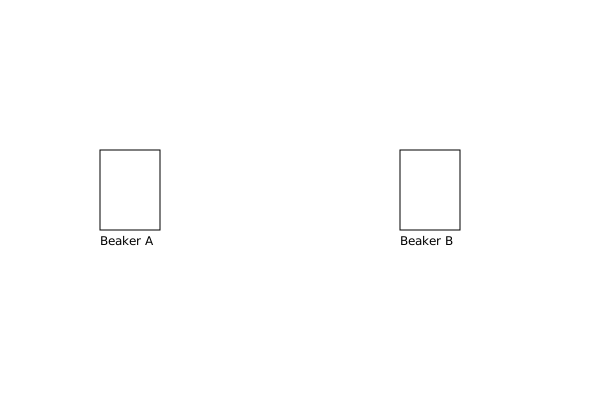
The diagram below shows a setup for the extraction of a metal from its ore. Identify the purpose of the beaker labeled B.
A. To dissolve the metal oxide
B. To dissolve the metal oxide
C. To dissolve the metal oxide
D. To dissolve the metal oxide

Master the Exam!

You've seen a preview, but there are thousands more questions plus AI tutor to break down complex solutions.

Unlock Full Access Available for Android & Windows
Help others prepare! Share this practice hub: