POST UTME RSU 2017 Geography | Objective

Practice these randomly selected questions to test your readiness.

Question 1
The process of soil erosion involves the removal of soil particles from one location to another. Which of the following is a major cause of soil erosion?
A. Water
B. Wind
C. Ice
D. Gravity
Question 2
The Earth's climate is influenced by several factors. What is the primary factor that influences the Earth's climate?
A. The amount of solar radiation the Earth receives
B. The amount of greenhouse gases in the Earth's atmosphere
C. The Earth's distance from the Sun
D. The Earth's rotation rate
Question 3
The diagram below shows a cross-section of a mountain range. Which of the following landforms is typically found in this type of terrain?
A. Mountain pass
B. U-shaped valley
C. Plateau
D. Foothill
Question 4
The diagram below shows a graph of the relationship between population density and urbanization. Which of the following conclusions can be drawn from the graph?
Question 5
The diagram below shows a simple diagram of a river's course. What is the term for the area where the river widens and slows down?
A. Delta
B. Estuary
C. Floodplain
D. River mouth
Question 6
The Niger Delta is a region of high population density and rapid urbanization. What is the primary reason for the high population density in this region?
A. High agricultural productivity
B. Abundant natural resources
C. Proximity to major cities
D. Access to transportation networks
Question 7
The process of weathering that involves the breakdown of rocks into smaller fragments due to the expansion and contraction of water within the rock's pores is known as:
A. Mechanical weathering
B. Chemical weathering
C. Physical weathering
D. Biological weathering
Question 8
The Niger River is the longest river in West Africa and flows through several countries. What is the primary reason for the Niger River's course?
A. The Niger River flows through a zone of high tectonic activity.
B. The Niger River flows through a low-lying area with a high water table.
C. The Niger River flows through a region of high rainfall and runoff.
D. The Niger River flows through a zone of coastal erosion.
Question 9
The diagram below shows a simple circuit. What is the value of the current (I) in the circuit?
A. 2A
B. 4A
C. 6A
D. 8A
Question 10
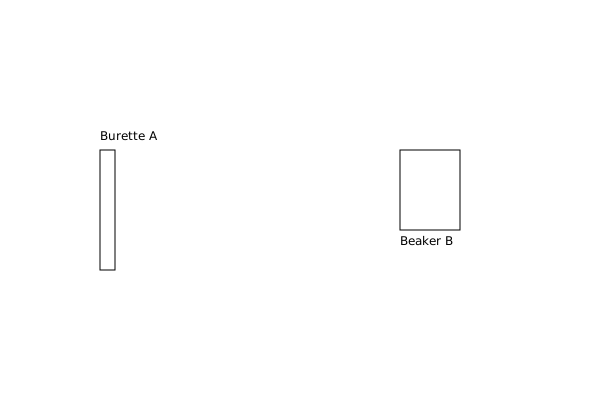
The diagram below shows a simple titration setup. What is the purpose of the burette in this setup?
A. To measure the volume of the solution
B. To add the titrant to the solution
C. To mix the solution and the titrant
D. To measure the pH of the solution
Question 11
The Earth's rotation causes the planet to bulge at the equator. What is the term for this phenomenon?
A. Equatorial bulge
B. Polar bulge
C. Elliptical shape
D. Spherical shape
Question 12
A population of 10,000 people is growing at a rate of 5% per annum. If the population is currently distributed evenly across a 100 km x 100 km area, what is the population density in people per square kilometer?
A. 100 people/km^2
B. 125 people/km^2
C. 150 people/km^2
D. 175 people/km^2
Question 13
The savannas of West Africa are characterized by a distinct vegetation belt, which is influenced by the presence of a particular type of tree. Identify the tree species that is most commonly associated with this vegetation belt.
A. Baobab tree
B. Acacia tree
C. Moringa tree
D. Sapotaceae tree
Question 14
A rock sample is composed of 60% quartz, 20% feldspar, and 20% mica. What is the percentage of mica in the rock sample?
A. 10%
B. 20%
C. 30%
D. 40%
Question 15
The diagram below illustrates the structure of the Earth's atmosphere. Which of the following is a characteristic of the stratosphere?
A. High levels of atmospheric pressure
B. High levels of ozone
C. High levels of water vapor
D. High levels of temperature

Master the Exam!

You've seen a preview, but there are thousands more questions plus AI tutor to break down complex solutions.

Unlock Full Access Available for Android & Windows
Help others prepare! Share this practice hub: