POST UTME REDEEMERS UNIVERSITY 2019 Chemistry | Objective
Practice these randomly selected questions to test your readiness.
Question 1
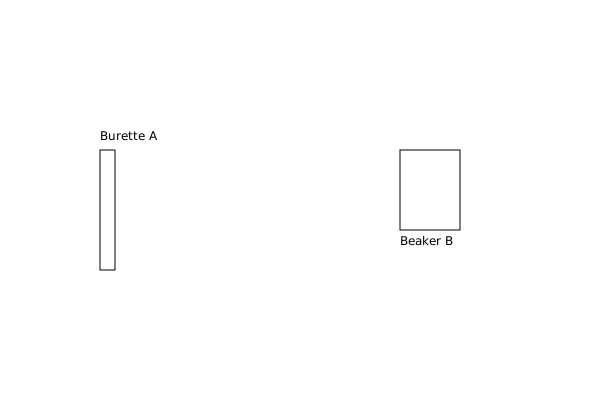
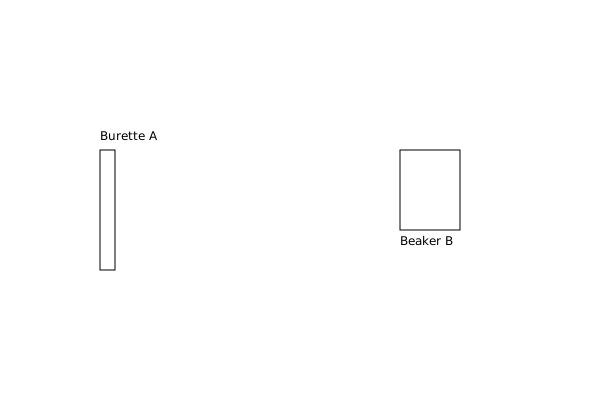
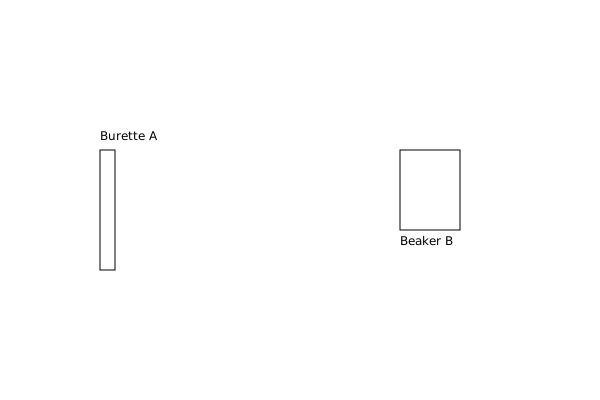
The diagram below shows a chemical apparatus setup.
Question 2
The diagram below shows the structure of a periodic table. Identify the group to which the element with atomic number 16 belongs.
Question 3
A 2.0 M solution of NaOH is mixed with a 2.0 M solution of HCl. What is the pH of the resulting solution?
Question 4
A 25.0 mL sample of 0.100 M NaOH is titrated with 0.100 M HCl. Calculate the volume of HCl required to reach the equivalence point.
Question 5
An alkane is a type of hydrocarbon that contains only \single bonds between carbon atoms. Which of the following is a correct example of an alkane?
Question 6
The s\tandard enthalpy of formation (ΔHf°) of H2O(l) is -285.8 kJ/mol. What is the s\tandard enthalpy of formation of H2(g)?
Question 7
A sample of hydrogen gas at 25°C and 1 atm is collected over water at 25°C. What is the partial pressure of the hydrogen gas?
Question 8
The reaction of sodium with water produces sodium hydroxide and hydrogen gas. Write the balanced chemical equation for this reaction.
Question 9
A 2.5 g sample of a polymer is dissolved in 50 mL of a solvent. The resulting solution has a vis\cosity of 0.8 Pa·s. If the density of the polymer is 1.2 g/mL, calculate the number-average molecular weight (Mn) of the polymer.
Question 10
A sample of nitrogen gas occupies a volume of 2.50 L at a pressure of 1.00 atm and a temperature of 298 K. Calculate the number of moles of nitrogen gas present.
Question 11
The diagram below shows the structure of a molecule. Identify the type of bond between atoms A and B.
Question 12
A mixture of 1.0 g of sodium chloride (NaCl) and 1.0 g of calcium chloride (CaCl2) is dissolved in 100 mL of water. Calculate the molar concentration of the resulting solution.
Question 13
The s\tandard Gibbs free energy change (ΔG°) for a reaction is related to the s\tandard enthalpy change (ΔH°) and s\tandard entropy change (ΔS°) by the equation: ΔG° = ΔH° - TΔS°. If the s\tandard enthalpy change for a reaction is 50 kJ/mol, the s\tandard entropy change is 0.1 kJ/mol·K, and the temperature is 298 K, what is the s\tandard Gibbs free energy change for the reaction?
Question 14
A 2.5 M solution of sodium hydroxide is mixed with a 1.0 M solution of hydrochloric acid. What is the pH of the resulting solution?
Question 15
Determine the pH of a 0.1 M solution of hydrochloric acid (HCl) at 25°C, given that the dissociation cons\tant of HCl is 10^\( -7 \) and the temperature dep\endence of the dissociation cons\tant is described by the equation: \log(K) = -0.5 \log(T) + 1.5.
Master the Exam!
You've seen a preview, but there are thousands more questions plus AI tutor to break down complex solutions.
Unlock Full Access
Available for Android & Windows