POST UTME REDEEMERS UNIVERSITY 2018 Chemistry | Objective

Practice these randomly selected questions to test your readiness.

Question 1
A 25.0 mL sample of 0.100 M HCl is titrated with 0.0500 M NaOH. What is the pH of the solution after the addition of 15.0 mL of NaOH?
A. 2.00
B. 3.00
C. 4.00
D. 5.00
Question 2
A 0.1 M solution of H2SO4 is mixed with a 0.1 M solution of NaOH. What is the resulting pH?
A. 1
B. 2
C. 3
D. 4
Question 3
The diagram below shows a chemical apparatus setup. What is the purpose of the condenser?
A. to cool the vapor
B. to heat the vapor
C. to separate the vapor and liquid
D. to mix the vapor and liquid
Question 4
A 0.1 M solution of HCl is mixed with a 0.1 M solution of NaOH. What is the resulting pH?
A. 1
B. 2
C. 3
D. 4
Question 5
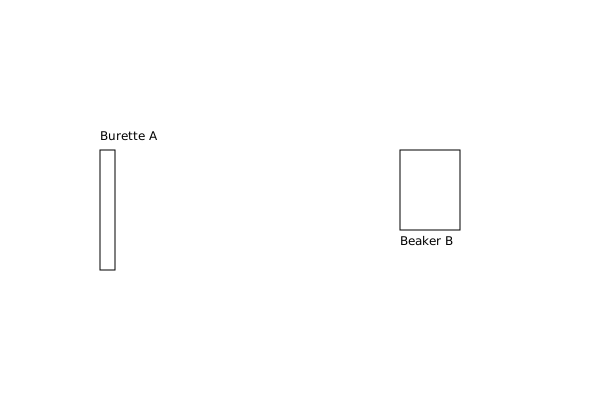
The diagram below shows a titration setup. What is the purpose of the burette?
A. to measure the volume of the titrant
B. to measure the volume of the analyte
C. to mix the titrant and analyte
D. to separate the titrant and analyte
Question 6
Determine the number of moles of oxygen gas (O2) required to completely combust 2.50 g of propane (C3H8) according to the balanced equation: C3H8 + 5O2 → 3CO2 + 4H2O.
A. 0.125 mol
B. 0.250 mol
C. 0.500 mol
D. 1.00 mol
Question 7
A metal (M) reacts with oxygen to form a basic oxide. The reaction is as follows: 4M + 3O2 → 2M2O3. If 2.50 g of M is heated in air, what is the mass of M2O3 formed?
A. 5.00 g
B. 6.25 g
C. 7.50 g
D. 8.75 g
Question 8
What is the major environmental impact of the use of chlorofluorocarbons (CFCs)?
A. Ozone depletion
B. Global warming
C. Acid rain
D. Air pollution
Question 9
Determine the s\tandard enthalpy of formation of CaCO3(s) from the following data: ΔHf(CaO(s)) = -635.09 kJ/mol, ΔHf(CO2(g)) = -393.51 kJ/mol, ΔHf(C(s)) = 0 kJ/mol. Assume the reaction is: CaO(s) + CO2(g) → CaCO3(s).
A. -1207.6 kJ/mol
B. -1208.6 kJ/mol
C. -1209.6 kJ/mol
D. -1210.6 kJ/mol
Question 10
What is the major difference between the periodic table of elements and the periodic table of organic compounds?
A. The periodic table of elements is arranged by atomic number, while the periodic table of organic compounds is arranged by molecular weight.
B. The periodic table of elements is arranged by atomic number, while the periodic table of organic compounds is arranged by functional group.
C. The periodic table of elements is arranged by atomic number, while the periodic table of organic compounds is arranged by molecular formula.
D. The periodic table of elements is arranged by molecular weight, while the periodic table of organic compounds is arranged by atomic number.
Question 11
A solution contains 0.10 M NH3 and 0.10 M NH4Cl. What is the pH of the solution?
A. 1
B. 2
C. 3
D. 4
Question 12
A sample of nitrogen gas occupies a volume of 2.5 L at a pressure of 1.5 atm and a temperature of 298 K. Calculate the number of moles of nitrogen gas present.
A. 0.1 mol
B. 0.2 mol
C. 0.3 mol
D. 0.4 mol
Question 13
What is the primary mechanism of action of the ha\logen atom in the reaction with the alkane?
A. Electrophilic addition
B. Nucleophilic substitution
C. Free radical substitution
D. Electrophilic substitution
Question 14
In the electrolysis of water, what is the primary product at the cathode?
A. Oxygen gas
B. Hydrogen gas
C. Water
D. Hydrogen peroxide
Question 15
The rate cons\tant (k) for a first-order reaction is 0.025 min^-1. What is the half-life of the reaction?
A. 28 min
B. 42 min
C. 56 min
D. 70 min

Master the Exam!

You've seen a preview, but there are thousands more questions plus AI tutor to break down complex solutions.

Unlock Full Access Available for Android & Windows
Help others prepare! Share this practice hub: