POST UTME OSUSTECH 2022 Chemistry | Objective

Practice these randomly selected questions to test your readiness.

Question 1
A 1.5 M solution of potassium nitrate is prepared by dissolving 67.5 g of potassium nitrate in 1 L of water. What is the concentration of the solution in terms of molarity?
A. 1.5 M
B. 3.0 M
C. 4.5 M
D. 6.0 M
Question 2
A metal M has a s\tandard electrode potential of +0.5 V. If a solution of 0.1 M M^2+ is mixed with a solution of 0.1 M Ag^+, what is the concentration of Ag+ remaining in the solution?
A. 0.05 M
B. 0.1 M
C. 0.15 M
D. 0.2 M
Question 3
A 2.2 M solution of calcium chloride is prepared by dissolving 148.0 g of calcium chloride in 1 L of water. What is the concentration of the solution in terms of molarity?
A. 2.2 M
B. 4.4 M
C. 6.6 M
D. 8.8 M
Question 4
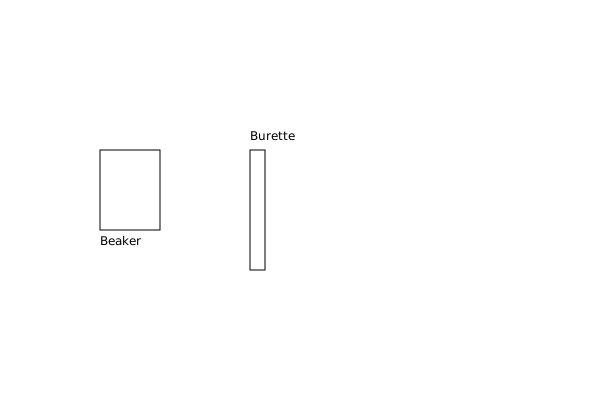
A diagram of a titration setup is shown below. What is the purpose of the burette?
A. to measure the volume of the acid
B. to measure the volume of the base
C. to measure the pH of the solution
D. to measure the temperature of the solution
Question 5
A solution of 0.1 M HCl is mixed with a solution of 0.1 M NaOH. If the reaction is allowed to proceed until equilibrium is reached, what is the concentration of HCl remaining in the solution?
A. 0.05 M
B. 0.1 M
C. 0.15 M
D. 0.2 M
Question 6
A 25.0 mL sample of 0.100 M HCl is added to a 100.0 mL sample of 0.0100 M NaOH. What is the concentration of the resulting solution?
A. 0.00500 M
B. 0.0100 M
C. 0.0150 M
D. 0.0200 M
Question 7
A 1.0 M solution of hydrochloric acid is prepared by dissolving 36.5 g of hydrochloric acid in 1 L of water. What is the concentration of the solution in terms of molarity?
A. 1.0 M
B. 2.0 M
C. 3.0 M
D. 4.0 M
Question 8
Determine the molar solubility of AgCl in a 0.1 M NaCl solution, given that the solubility product cons\tant (Ksp) for AgCl is 1.8 × 10^-10. Assume that the activity coefficients for Ag+ and Cl- are unity.
A. 1.0 × 10^-4 M
B. 1.0 × 10^-5 M
C. 1.0 × 10^-6 M
D. 1.0 × 10^-7 M
Question 9
A 2.0 M solution of sodium chloride is prepared by dissolving 40.0 g of sodium chloride in 1 L of water. What is the concentration of the solution in terms of molarity?
A. 2.0 M
B. 4.0 M
C. 6.0 M
D. 8.0 M
Question 10
The s\tandard enthalpy of formation of CO2(g) is -393.5 kJ/mol. What is the s\tandard enthalpy of combustion of 1.00 mol of C(s) to form CO2(g)?
A. -393.5 kJ
B. -393.5 kJ/mol
C. -393.5 kJ/mol × 1.00 mol
D. -393.5 kJ/mol × 1.00 mol × 1.00
Question 11
The atomic radius of an element is 100 pm. If the element is in the 4th period of the periodic table, what is the value of the principal quantum number (n) for the element?
A. 3
B. 4
C. 5
D. 6
Question 12
A solution of 0.1 M HCl is mixed with a solution of 0.1 M NaOH. If the reaction is allowed to proceed until equilibrium is reached, what is the concentration of HCl remaining in the solution?
A. 0.05 M
B. 0.1 M
C. 0.15 M
D. 0.2 M
Question 13
The reaction of an alkene with bromine is a test for the presence of a double bond. What is the major product of this reaction?
A. an alkane
B. an alkene
C. an alkyne
D. a dibromide
Question 14
A 1.8 M solution of sodium sulfate is prepared by dissolving 144.0 g of sodium sulfate in 1 L of water. What is the concentration of the solution in terms of molarity?
A. 1.8 M
B. 3.6 M
C. 5.4 M
D. 7.2 M
Question 15
The reaction of an alkene with ozone is followed by the addition of zinc dust. What is the major product of this reaction?
A. an epoxide
B. an alkane
C. an alkene
D. an alkyne

Master the Exam!

You've seen a preview, but there are thousands more questions plus AI tutor to break down complex solutions.

Unlock Full Access Available for Android & Windows
Help others prepare! Share this practice hub: