POST UTME NILE UNIVERSITY 2025 Chemistry | Objective

Practice these randomly selected questions to test your readiness.

Question 1
A 0.500 M solution of HCl(aq) is titrated with 0.500 M NaOH(aq). If 25.0 mL of NaOH(aq) is required to reach the equivalence point, what is the pH of the resulting solution?
A. 1.00
B. 2.00
C. 3.00
D. 4.00
Question 2
A solution contains 0.1 M NaCl and 0.2 M NaOH. Calculate the pH of the solution u\sing the equation: pH = -\log[H+].
A. 1
B. 2
C. 3
D. 4
Question 3
The reaction of cyclohexane with bromine in the presence of light produces a mixture of 1,2-dibromocyclohexane and 1,4-dibromocyclohexane. What is the major product of this reaction?
A. 1,2-dibromocyclohexane
B. 1,4-dibromocyclohexane
C. cis-1,2-dibromocyclohexane
D. trans-1,2-dibromocyclohexane
Question 4
A sample of air contains 20% O2, 70% N2, and 10% CO2 by volume. What is the partial pressure of CO2 in a sample of air at 1 atm total pressure?
A. 0.1 atm
B. 0.2 atm
C. 0.3 atm
D. 0.4 atm
Question 5
A 1.0 M solution of potassium chloride is mixed with a 1.0 M solution of sodium hydroxide. What is the resulting solution?
A. NaCl(aq) + KCl(aq)
B. NaOH(aq) + KCl(aq)
C. NaCl(aq) + KCl(aq)
D. NaOH(aq) + KCl(aq)
Question 6
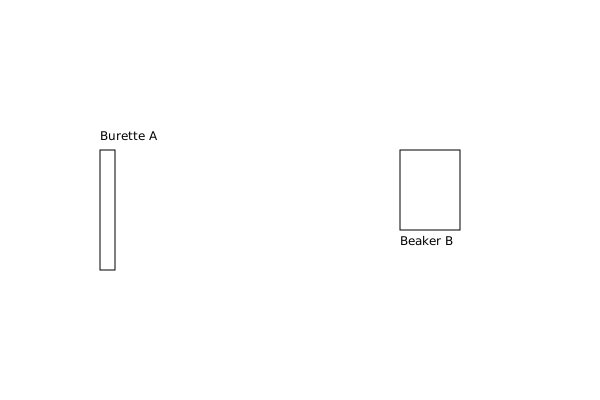
The diagram below shows a titration setup. What is the purpose of the burette in this setup?
A. To measure the volume of the titrant
B. To measure the volume of the analyte
C. To mix the titrant and analyte
D. To separate the titrant and analyte
Question 7
A 0.5 M solution of HCl is titrated with 0.5 M NaOH. If 25 mL of HCl is required to reach the equivalence point, what is the volume of NaOH required to reach the equivalence point?
A. 12.5 mL
B. 25 mL
C. 37.5 mL
D. 50 mL
Question 8
The polymerization of styrene in the presence of benzoyl peroxide as an initiator yields a polymer with a degree of polymerization (DP) of 1000. If the number-average molecular weight (Mn) of the polymer is 50000 g/mol, what is the weight-average molecular weight (Mw)?
A. 250000 g/mol
B. 50000 g/mol
C. 100000 g/mol
D. 200000 g/mol
Question 9
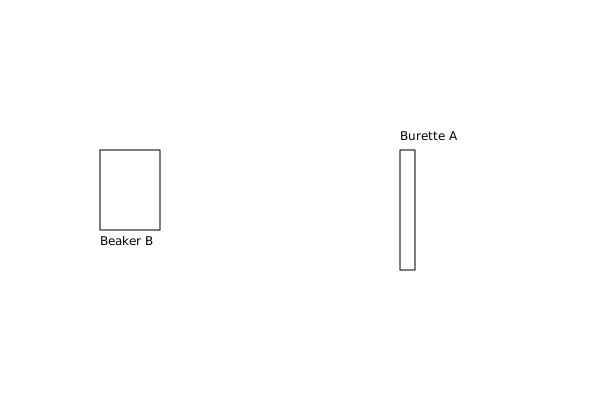
The diagram below shows a titration setup.
A. The burette contains HCl(aq).
B. The burette contains NaOH(aq).
C. The beaker contains HCl(aq).
D. The beaker contains NaOH(aq).
Question 10
A 50 g sample of a polymer is dissolved in 100 mL of a solvent. Calculate the molar mass of the polymer u\sing the equation: M = \( m / n \) * N_A.
A. 1000 g/mol
B. 2000 g/mol
C. 3000 g/mol
D. 4000 g/mol
Question 11
Determine the rate cons\tant (k) for the reaction: N2O5 → 2NO2 + 1/2O2, given that the initial concentration of N2O5 is 0.1 M and the concentration after 10 minutes is 0.05 M. The rate cons\tant is related to the half-life \( t1/2 \) by the equation: k = ln(2)/t1/2.
A. 0.05 min^-1
B. 0.1 min^-1
C. 0.2 min^-1
D. 0.5 min^-1
Question 12
A 2.0 g sample of an unknown hydrocarbon is burned in a bomb calorimeter, relea\sing 12.5 kJ of heat. What is the empirical formula of the hydrocarbon?
A. C2H4
B. C3H6
C. C4H8
D. C5H10
Question 13
A 25.0 mL sample of a solution containing 0.100 M NaCl is mixed with 25.0 mL of a solution containing 0.100 M AgNO3. If the reaction is complete, what is the concentration of the resulting solution?
A. 0.0500 M
B. 0.100 M
C. 0.150 M
D. 0.200 M
Question 14
A 0.1 M solution of H2SO4 is titrated with 0.1 M NaOH. If 20 mL of H2SO4 is required to reach the equivalence point, what is the pH of the solution at the equivalence point?
A. 1
B. 2
C. 3
D. 4
Question 15
The reaction of zinc metal with copper(II) sulfate solution is represented by the equation: Zn(s) + CuSO4(aq) → ZnSO4(aq) + Cu(s). What is the oxidation state of copper in the product Cu(s)?
A. 0
B. 1
C. 2
D. 3

Master the Exam!

You've seen a preview, but there are thousands more questions plus AI tutor to break down complex solutions.

Unlock Full Access Available for Android & Windows
Help others prepare! Share this practice hub: