POST UTME NILE UNIVERSITY 2022 Chemistry | Objective

Practice these randomly selected questions to test your readiness.

Question 1
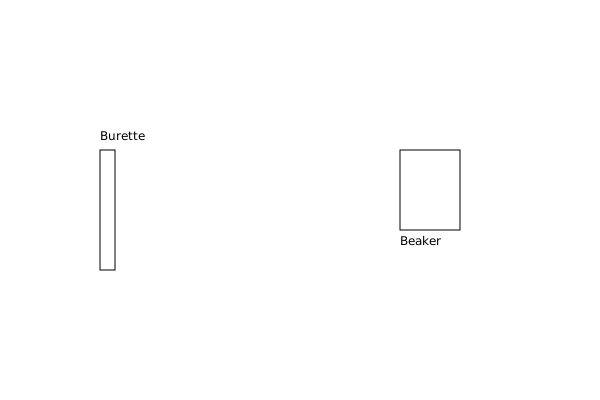
A diagram of a titration setup is shown below. What is the purpose of the burette?
A. To measure the volume of the acid
B. To measure the volume of the base
C. To measure the pH of the solution
D. To measure the temperature of the solution
Question 2
The reaction of hydrogen gas with oxygen gas is represented by the equation: 2H2(g) + O2(g) → 2H2O(l). What is the oxidation state of oxygen in the product H2O(l)?
A. -1
B. +1
C. +2
D. 0
Question 3
A diagram of a simple harmonic motion is shown below. What is the equation of motion for the system?
A. x(t) = A \cos\( ωt + φ \)
B. x(t) = A \sin\( ωt + φ \)
C. x(t) = A \cos(2πft)
D. x(t) = A \sin(2πft)
Question 4
A solution contains 0.1 M HCl and 0.1 M NaOH. What is the pH of the solution?
A. 1
B. 7
C. 10
D. 14
Question 5
Determine the number of moles of CO2 produced when 2.5 g of C6H12O6 is completely oxidized in the presence of excess O2 according to the equation: C6H12O6 + 6O2 → 6CO2 + 6H2O. The molar mass of C6H12O6 is 180 g/mol.
A. 0.025 mol
B. 0.05 mol
C. 0.1 mol
D. 0.15 mol
Question 6
A 2.0 L flask contains 0.5 mol of an ideal gas at a temperature of 300 K. If the pressure of the gas is 1.0 atm, what is the volume of the flask?
A. 2.0 L
B. 2.5 L
C. 3.0 L
D. 3.5 L
Question 7
A reaction is represented by the equation: 2A + B → 2C + D. If 2.0 g of A and 1.5 g of B are mixed and allowed to react, what is the limiting reac\tant?
A. A
B. B
C. C
D. D
Question 8
A sample of 1.0 g of a subs\tance is found to have a mass of 1.5 g after being dried in an oven at 120°C. What is the percentage of water in the original sample?
A. 10%
B. 20%
C. 30%
D. 40%
Question 9
A 2.5 M solution of HCl is mixed with a 2.5 M solution of NaOH in a 1:1 mole ratio. What is the resulting concentration of the solution after the reaction is complete?
A. 2.5 M
B. 1.25 M
C. 0.5 M
D. 0 M
Question 10
A mixture of 2.0 g of glu\cose (C6H12O6) and 3.0 g of fructose (C6H12O6) is dissolved in 100 mL of water. What is the molarity of the solution?
A. 0.1 M
B. 0.2 M
C. 0.3 M
D. 0.4 M
Question 11
The s\tandard enthalpy of formation of CO2(g) is -393.5 kJ/mol. Calculate the s\tandard enthalpy of combustion of 1 mole of carbon at 298 K.
A. -393.5 kJ/mol
B. -393.5 kJ/mol + 298 kJ/mol
C. -393.5 kJ/mol - 298 kJ/mol
D. -393.5 kJ/mol + 298 kJ/mol + 8.314 J/mol*K
Question 12
The reaction of zinc metal with copper(II) sulfate solution is represented by the equation: Zn(s) + CuSO4(aq) → ZnSO4(aq) + Cu(s). What is the oxidation state of copper in the product Cu(s)?
A. 0
B. +1
C. +2
D. -1
Question 13
A diagram of a titration setup is shown below. What is the purpose of the burette in this setup?
A. To measure the volume of the titrant
B. To measure the volume of the analyte
C. To mix the titrant and analyte
D. To separate the titrant and analyte
Question 14
The reaction of cyclohexane with bromine in the presence of light produces a mixture of 1,2-dibromocyclohexane and 1,4-dibromocyclohexane. Which of the following is the major product?
A. 1,2-dibromocyclohexane
B. 1,4-dibromocyclohexane
C. cis-1,2-dibromocyclohexane
D. trans-1,2-dibromocyclohexane
Question 15
A 2.5 g sample of a subs\tance is dissolved in 50 mL of water. Calculate the molarity of the solution.
A. 0.1 M
B. 0.2 M
C. 0.5 M
D. 1 M

Master the Exam!

You've seen a preview, but there are thousands more questions plus AI tutor to break down complex solutions.

Unlock Full Access Available for Android & Windows
Help others prepare! Share this practice hub: