POST UTME LEAD CITY UNIVERSITY 2025 Biology | Objective

Practice these randomly selected questions to test your readiness.

Question 1
The part of the brain that controls voluntary movements is the:
A. Cerebrum
B. Cerebellum
C. Brainstem
D. Spinal Cord
Question 2
A 2.0 L flask contains 1.0 M NaOH and 1.0 M HCl. What is the pH of the solution after the reaction is complete?
A. 1
B. 7
C. 10
D. 14
Question 3
A population of birds is found to have a frequency of 0.6 for the allele B, which codes for brown plumage, and a frequency of 0.4 for the allele b, which codes for white plumage. If the population is in Hardy-Weinberg equilibrium, what is the frequency of the genotype BB?
A. 0.36
B. 0.24
C. 0.16
D. 0.04
Question 4
The Hardy-Weinberg principle states that allele and genotype frequencies in a population will remain cons\tant from generation to generation in the absence of other evolutionary influences. Which of the following is a necessary condition for the Hardy-Weinberg principle to hold?
A. Random mating
B. No mutation
C. No gene flow
D. No natural selection
Question 5
The human nervous system consists of the central nervous system (CNS) and the peripheral nervous system (PNS). Which of the following is a function of the PNS?
A. Control of voluntary movements
B. Regulation of body temperature
C. Transmission of sensory information
D. Regulation of heart rate
Question 6
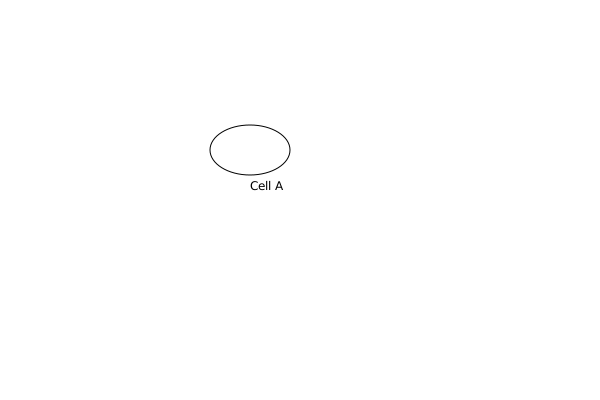
The diagram below shows the structure of a plant cell. Identify the part labeled 'A':
A. Cell wall
B. Nucleus
C. Cytoplasm
D. Mitochondria
Question 7
The process of photosynthesis in plants involves the conversion of light energy into chemical energy in the form of glu\cose. Which of the following is a byproduct of this process?
A. Oxygen
B. Carbon dioxide
C. Water
D. Nitrogen
Question 8
A researcher is studying the effects of a new medication on the cardiovascular system. Which of the following organs is most likely to be affected?
A. Heart
B. Lungs
C. Liver
D. Kidneys
Question 9
A patient with a rare genetic disorder has a mutation in the HFE gene, leading to an accumulation of iron in the body. Which of the following organs is most likely to be affected?
A. Liver
B. Pancreas
C. Kidneys
D. Heart
Question 10
In the context of cellular respiration, what is the primary function of the mitochondria?
A. To synthesize proteins
B. To store genetic information
C. To generate energy for the cell
D. To regulate cell growth
Question 11
A diagram of the human brain is shown below. What is the primary function of the cerebrum?
A. To regulate body temperature
B. To control movement
C. To process sensory information
D. To produce hormones
Question 12
A researcher is studying the effects of climate change on the distribution of a particular species of bird. Which of the following biomes is most likely to be affected?
A. Desert
B. Rainforest
C. Tundra
D. Grassland
Question 13
In a typical xylem vessel, what is the primary function of the lignin-rich secondary cell wall?
A. To provide structural support to the vessel
B. To facilitate the transport of water and minerals
C. To regulate the rate of transpiration
D. To store starch and other nutrients
Question 14
In the context of xylem transport, what is the primary mechanism by which water and minerals are absorbed by the roots and transported to the leaves?
A. Transpiration pull
B. Root pressure
C. Capillary action
D. Osmosis
Question 15
In the context of eco\logy, what is the term for the movement of water from the roots to the leaves of a plant?
A. Transpiration
B. Respiration
C. Photosynthesis
D. Translocation

Master the Exam!

You've seen a preview, but there are thousands more questions plus AI tutor to break down complex solutions.

Unlock Full Access Available for Android & Windows
Help others prepare! Share this practice hub: