POST UTME LAUTECH 2025 Chemistry | Objective

Practice these randomly selected questions to test your readiness.

Question 1
A 2.0 g sample of a non-metallic element is heated in a stream of oxygen gas. The resulting product is a white solid with a mass of 4.0 g. What is the empirical formula of the product?
A. O2
B. SO2
C. SO3
D. S2O3
Question 2
A solution of a weak acid (HA) has a pH of 4.5. If 10 mL of this solution is added to 90 mL of a solution of a strong base (NaOH), what is the pH of the resulting solution?
A. 6.5
B. 7.5
C. 8.5
D. 9.5
Question 3
The reaction between H2S and O2 is catalyzed by a platinum catalyst. The rate law for the reaction is given by: rate = k[H2S][O2]^2. If the initial concentrations of H2S and O2 are 0.100 M and 0.0500 M, respectively, and the rate of reaction is 0.0100 M/s, what is the value of the rate cons\tant (k)?
A. \( k = \frac{rate}{[H2S][O2]^2} \)
B. \( k = \frac{[H2S][O2]^2}{rate} \)
C. \( k = \frac{rate}{[H2S]^2[O2]} \)
D. \( k = \frac{[H2S]^2[O2]}{rate} \)
Question 4
A 2.0 M solution of potassium nitrate (KNO3) is prepared by dissolving 20 g of KNO3 in water to make 100 mL of solution. What is the molarity of the solution?
A. 1.0 M
B. 2.0 M
C. 3.0 M
D. 4.0 M
Question 5
Determine the s\tandard enthalpy of formation of CH3OH(l) from the following data: ΔHf(CO2(g)) = -393.5 kJ/mol, ΔHf(H2O(l)) = -285.8 kJ/mol, ΔHf(CH4(g)) = -74.8 kJ/mol, ΔHf(O2(g)) = 0 kJ/mol.
A. -238.7 kJ/mol
B. -285.8 kJ/mol
C. -393.5 kJ/mol
D. -74.8 kJ/mol
Question 6
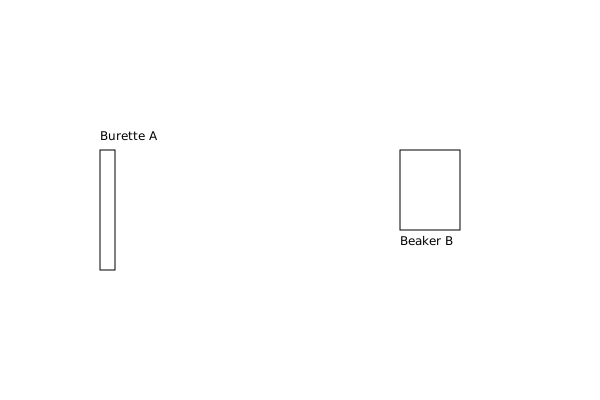
The diagram below shows a chemical apparatus setup. If 10.0 mL of HCl is added to 20.0 mL of NaOH, what is the resulting pH?
A. 1.00
B. 2.00
C. 3.00
D. 4.00
Question 7
A 50.0 mL sample of a 0.100 M solution of Fe2+ is mixed with 50.0 mL of a 0.100 M solution of MnO4-. What is the resulting concentration of Fe3+?
A. 0.0500 M
B. 0.0750 M
C. 0.100 M
D. 0.125 M
Question 8
A sample of gas occupies a volume of 2.5 L at a pressure of 1.5 atm. If the temperature is increased to 300 K, what is the new volume of the gas?
A. 3.5 L
B. 4.5 L
C. 5.5 L
D. 6.5 L
Question 9
A 2.5 M solution of sulfuric acid (H2SO4) is prepared by dissolving 50 g of H2SO4 in water to make 250 mL of solution. What is the molarity of the solution?
A. 1.0 M
B. 2.0 M
C. 2.5 M
D. 5.0 M
Question 10
The half-life of a radioactive subs\tance is 5 years. If 100 g of the subs\tance is present initially, how much will remain after 10 years?
A. 50 g
B. 25 g
C. 12.5 g
D. 6.25 g
Question 11
The s\tandard enthalpy of formation of CO2(g) is -393.5 kJ/mol. Calculate the s\tandard enthalpy of formation of C(s) + O2(g) → CO2(g).
A. 0 kJ/mol
B. -393.5 kJ/mol
C. 393.5 kJ/mol
D. 0 kJ/mol
Question 12
In a reaction between zinc metal and copper(II) sulfate solution, 25.0 cm³ of 0.100 M zinc sulfate solution is required to react with 25.0 cm³ of 0.100 M copper(II) sulfate solution. Calculate the number of moles of copper(II) ions that reacted.
A. 0.00125 mol
B. 0.0025 mol
C. 0.005 mol
D. 0.0125 mol
Question 13
A 10 g sample of a solid is dissolved in 100 mL of water. The resulting solution has a concentration of 0.1 M. Calculate the molar mass of the solid.
A. 100 g/mol
B. 200 g/mol
C. 300 g/mol
D. 400 g/mol
Question 14
A 2.50 g sample of a polymer is dissolved in 100.0 mL of a solvent. The resulting solution has a vis\cosity of 1.25 cP. What is the molar mass of the polymer?
A. 5000 g/mol
B. 10000 g/mol
C. 15000 g/mol
D. 20000 g/mol
Question 15
The reaction between sodium carbonate and hydrochloric acid is represented by the equation: Na2CO3(s) + 2HCl(aq) → 2NaCl(aq) + H2O(l) + CO2(g). What is the type of reaction?
A. Synthesis reaction
B. Decomposition reaction
C. Neutralization reaction
D. Combustion reaction

Master the Exam!

You've seen a preview, but there are thousands more questions plus AI tutor to break down complex solutions.

Unlock Full Access Available for Android & Windows
Help others prepare! Share this practice hub: