POST UTME LAUTECH 2018 Government | Objective

Practice these randomly selected questions to test your readiness.

Question 1
The African Union's (AU) peace and security architecture is designed to promote peace and stability on the continent. Which of the following is a key instrument used by the AU to promote peace and security?
A. The African Peace and Security Architecture (APSA)
B. The African Union's Peace and Security Council (PSC)
C. The African Union's Mission in Somalia (AMISOM)
D. The African Union's Regional Economic Communities (RECs)
Question 2
The separation of powers is a fundamental principle of democratic government, and it is designed to prevent the concentration of power in any one branch of government. Discuss the role of the judiciary in the separation of powers, and explain how the judiciary checks the power of the other branches.
A. The judiciary has the power to declare laws and policies unconstitutional, and it can also check the power of the executive branch.
B. The judiciary has the power to declare laws and policies unconstitutional, but it cannot check the power of the executive branch.
C. The judiciary has no power to check the power of the other branches, and it is limited to interpreting the law.
D. The judiciary has the power to check the power of the legislative branch, but it cannot check the power of the executive branch.
Question 3
The Economic Community of West African States (ECOWAS) was established in 1975 with the goal of promoting economic integration among its member states. Which of the following is a key feature of ECOWAS?
A. A single currency for all member states
B. A common external tariff for all member states
C. A free movement of people, goods, and services among member states
D. A regional defense pact among member states
Question 4
The pre-colonial administration in Nigeria was characterized by the existence of various kingdoms and empires. Which of the following was one of the major kingdoms in pre-colonial Nigeria?
A. The Hausa Kingdom
B. The Yoruba Kingdom
C. The Igbo Kingdom
D. The Nupe Kingdom
Question 5
The concept of 'checks and balances' is a fundamental principle of which system of government?
A. Unitary System
B. Federal System
C. Confederation System
D. Parliamentary System
Question 6
The United Nations (UN) has a number of specialized agencies that work to promote economic and social development around the world. Which of the following is a key goal of the United Nations Development Programme (UNDP)?
A. To promote economic growth and reduce poverty
B. To improve access to education and healthcare
C. To promote democracy and human rights
D. To reduce inequality and promote social justice
Question 7
A country's foreign policy is shaped by its national interests, values, and goals. Discuss the role of national interests in shaping a country's foreign policy, and provide examples of how national interests have influenced foreign policy decisions.
A. National interests are the primary driver of a country's foreign policy, and they are often prioritized over values and goals.
B. National interests are one of several factors that influence a country's foreign policy, and they are often balanced against values and goals.
C. National interests are not a significant factor in shaping a country's foreign policy, and values and goals are more important.
D. National interests are irrelevant to a country's foreign policy, and values and goals are the primary drivers.
Question 8
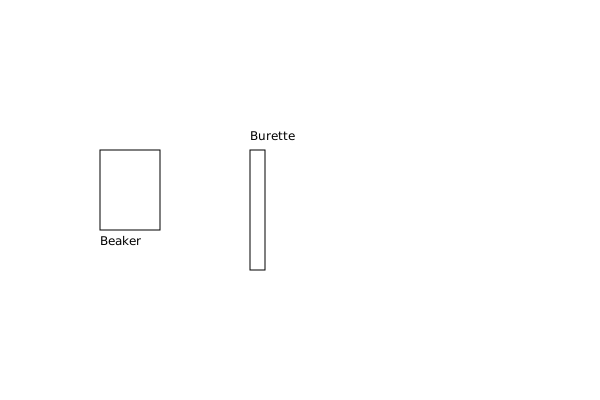
A diagram of a titration setup is shown below. What is the purpose of the burette in this experiment?
A. To measure the volume of the titrant.
B. To measure the volume of the analyte.
C. To mix the titrant and analyte.
D. To separate the titrant and analyte.
Question 9
The concept of constitutionalism is closely related to the idea of the rule of law. Discuss the implications of this relationship on the separation of powers in a democratic government.
A. The separation of powers is reinforced by the rule of law.
B. The rule of law undermines the separation of powers.
C. The separation of powers is not affected by the rule of law.
D. The rule of law is a substitute for the separation of powers.
Question 10
The concept of power in international relations refers to the ability of a state or other actor to achieve its goals and influence the behavior of others. Which of the following is a key source of power in international relations?
A. Economic power
B. Military power
C. Cultural power
D. All of the above
Question 11
The pre-colonial period in West Africa was characterized by a number of different empires and kingdoms. Which of the following was a key feature of the Mali Empire?
A. A strong centralized government
B. A decentralized system of government
C. A system of feudalism
D. A system of slavery
Question 12
Analyze the implications of the 1963 Republican Constitution on the development of Nigeria's federal system of government.
A. The constitution entrenched the federal system, leading to a more decentralized government.
B. The constitution introduced a parliamentary system, which was later abandoned.
C. The constitution established a presidential system, which has been in place since.
D. The constitution did not significantly impact the development of Nigeria's federal system.
Question 13
The concept of checks and balances in the Nigerian Constitution is primarily aimed at preventing the concentration of power in one branch of government. Which of the following is a correct example of checks and balances in the Nigerian Constitution?
A. The power of the President to appoint the Chief Justice of Nigeria
B. The power of the National Assembly to approve or reject the President's appointments
C. The power of the President to dissolve the National Assembly
D. The power of the judiciary to declare laws passed by the National Assembly as unconstitutional
Question 14
The Local Government system in Nigeria is based on the principle of _______
A. Decentralization
B. Centralization
C. Federalism
D. Unitarism
Question 15
The Nigerian Constitution provides for the protection of individual rights and freedoms. Which of the following is a key provision of this section?
A. Right to life
B. Right to freedom of speech
C. Right to freedom of assembly
D. Right to freedom of association

Master the Exam!

You've seen a preview, but there are thousands more questions plus AI tutor to break down complex solutions.

Unlock Full Access Available for Android & Windows
Help others prepare! Share this practice hub: