POST UTME KSU 2023 Chemistry | Objective
Practice these randomly selected questions to test your readiness.
Question 1
A solution of 0.1M NaOH is mixed with a solution of 0.1M HCl. What is the pH of the resulting solution?
Question 2
A 2.00 M solution of NaOH is titrated with a 1.00 M solution of HCl. If 25.0 mL of HCl is required to reach the equivalence point, calculate the pH of the resulting solution.
Question 3
A sample of a metal (X) has a density of 8.5 g/cm3 and a volume of 2.5 cm3. If the metal is 85% pure, calculate the mass of the impurities present.
Question 4
A 25 mL sample of a solution containing 0.5 M NaOH is titrated with 0.5 M HCl. Calculate the volume of HCl required to reach the equivalence point.
Question 5
A sample of a metal, M, has a mass of 25.0 g and a volume of 2.50 cm3. If the density of the metal is 5.50 g/cm3, calculate the molar mass of M.
Question 6
A metal alloy is composed of 75% copper and 25% zinc. If 500g of the alloy is heated to 1000°C, what is the mass of copper that will be oxidized?
Question 7
A 2.0 g sample of a non-metallic oxide is analyzed by acid-base titration. The titration curve shows a pH of 7 at the equivalence point. What is the molar mass of the oxide?
Question 8
A sample of a gas has a volume of 2.50 L at a pressure of 1.00 atm and a temperature of 25.0°C. If the pressure is increased to 2.00 atm and the temperature is increased to 50.0°C, calculate the new volume of the gas.
Question 9
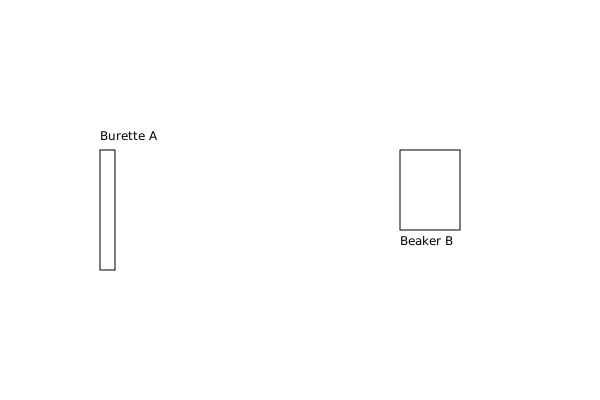
A diagram of a titration setup is shown below.
Question 10
A solution of 0.1M NaOH is mixed with a solution of 0.1M HCl. What is the concentration of the resulting solution?
Question 11
A metal alloy is composed of 75% copper and 25% zinc. If 500g of the alloy is heated to 1000°C, what is the mass of zinc that will be oxidized?
Question 12
Determine the pH of a 0.1 M solution of hydrochloric acid (HCl) at 25°C.
Question 13
A sample of water contains 10ppm of dissolved oxygen. What is the concentration of oxygen in mg/L?
Question 14
A metal (X) reacts with chlorine gas to form a white solid. The reaction is as follows: 2X + Cl2 → 2XCl. If 2.5 g of X reacts with 1.8 g of Cl2, calculate the molar mass of X.
Question 15
A 2.0 g sample of an unknown hydrocarbon is burned in a combustion calorimeter, producing 3.2 g of CO2 and 1.8 g of H2O. Calculate the empirical formula of the hydrocarbon.
Master the Exam!
You've seen a preview, but there are thousands more questions plus AI tutor to break down complex solutions.
Unlock Full Access
Available for Android & Windows