POST UTME KSU 2022 Chemistry | Objective

Practice these randomly selected questions to test your readiness.

Question 1
A metal (M) reacts with chlorine gas to form a white solid. The reaction is as follows: 2M(s) + Cl2(g) → 2MCl(s). If 2.5 g of MCl is produced, what is the mass of M used?
A. 1.25 g
B. 2.5 g
C. 3.75 g
D. 5.0 g
Question 2
A 1.0 M solution of a weak acid, HA, is titrated with 1.0 M NaOH. The initial pH of the solution is 3.0. What is the pH of the solution after the addition of 20 mL of 1.0 M NaOH?
A. 7.0
B. 8.0
C. 9.0
D. 10.0
Question 3
A 0.500 M solution of NaOH is mixed with a 0.500 M solution of HCl. What is the pH of the resulting solution?
A. 1.00
B. 2.00
C. 3.00
D. 4.00
Question 4
A sample of a metal (M) is treated with 10 mL of 1 M HCl. The reaction is complete, and the resulting solution is titrated with 0.1 M NaOH. If 20 mL of NaOH is required to reach the equivalence point, what is the concentration of M in the original sample?
A. 0.1 M
B. 0.2 M
C. 0.3 M
D. 0.4 M
Question 5
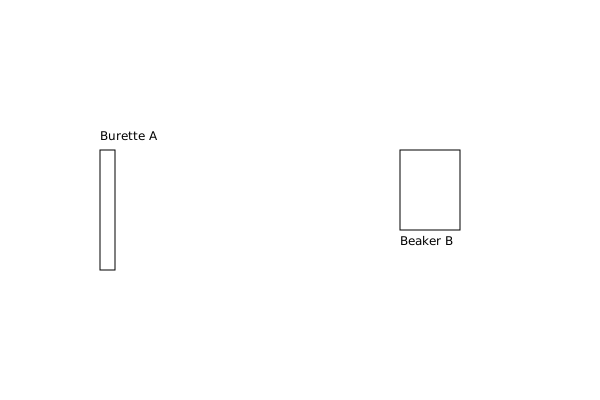
A diagram of a titration setup is shown below. If 35.0 mL of 0.100 M NaOH is required to reach the equivalence point, what is the concentration of the HCl solution?
A. 0.100 M
B. 0.200 M
C. 0.500 M
D. 1.00 M
Question 6
The entropy change (ΔS) for the reaction N2(g) + 3H2(g) → 2NH3(g) at 298 K is 199.3 J/K mol. What is the s\tandard enthalpy change (ΔH) for the reaction?
A. -45.9 kJ/mol
B. -92.0 kJ/mol
C. -137.9 kJ/mol
D. -182.0 kJ/mol
Question 7
The atomic radius of an element is the dis\tance from the nucleus to the outermost electron in a neutral atom. What is the unit of atomic radius?
A. pm
B. nm
C. cm
D. m
Question 8
A solution contains 0.1 M NaCl. If 10 mL of this solution is diluted to 100 mL, what is the concentration of the resulting solution?
A. 0.01 M
B. 0.1 M
C. 1 M
D. 10 M
Question 9
The rate cons\tant of a first-order reaction is given by the equation \( k = \frac{2.303}{t} \log_{10} left\( \frac{[A]_0}{[A]_t} \right \ \) ). If the initial concentration of the reac\tant is 0.1 M and the concentration at time t is 0.01 M, calculate the rate cons\tant k.
A. 0.01 min^-1
B. 0.1 min^-1
C. 1 min^-1
D. 10 min^-1
Question 10
The s\tandard enthalpy of formation of H2O(l) is -285.8 kJ/mol. What is the s\tandard enthalpy of formation of H2(g)?
A. 0 kJ/mol
B. 57.8 kJ/mol
C. 114.0 kJ/mol
D. 171.0 kJ/mol
Question 11
A 2.5 g sample of an unknown hydrocarbon is burned in a combustion calorimeter. The temperature of the calorimeter increases by 23.5°C. If the calorimeter cons\tant is 2.5 J/g°C, what is the heat of combustion of the hydrocarbon, assuming it is a pure subs\tance?
A. 100 kJ/mol
B. 200 kJ/mol
C. 300 kJ/mol
D. 400 kJ/mol
Question 12
At 298 K, the s\tandard enthalpy of formation of CO2(g) is -393.5 kJ/mol. Calculate the s\tandard enthalpy of formation of CO(g) if the s\tandard enthalpy of formation of O2(g) is 0 kJ/mol.
A. -110.5 kJ/mol
B. -393.5 kJ/mol
C. 110.5 kJ/mol
D. 393.5 kJ/mol
Question 13
The compound 1,2-dimethylcyclohexane is an example of a branched alkane. Draw the structure of this compound.
A. CH3CH2CH2CH3
B. CH3C(CH3)2CH3
C. CH3CH(CH3)CH3
D. CH3CH2CH(CH3)CH3
Question 14
A 1 M solution of FeCl3 is treated with 10 mL of 1 M NaOH. If the reaction is complete, what is the concentration of Fe(OH)3 in the resulting solution?
A. 0.1 M
B. 0.2 M
C. 0.3 M
D. 0.4 M
Question 15
A sample of nitrogen gas occupies a volume of 2.5 L at a pressure of 1.5 atm and a temperature of 298 K. What is the number of moles of nitrogen gas present?
A. 0.25 mol
B. 0.5 mol
C. 0.75 mol
D. 1.0 mol

Master the Exam!

You've seen a preview, but there are thousands more questions plus AI tutor to break down complex solutions.

Unlock Full Access Available for Android & Windows
Help others prepare! Share this practice hub: