POST UTME JOSEPH AYO BABALOLA UNIVERSITY 2017 Government | Objective

Practice these randomly selected questions to test your readiness.

Question 1
The concept of Rule of Law is essential in a democratic society. Which of the following is a characteristic of the Rule of Law?
A. The government should have absolute power to make laws.
B. The government should be accountable to the people.
C. The government should have the power to suspend the constitution.
D. The government should be bound by the law.
Question 2
The concept of constitutionalism is closely related to the idea of the rule of law. Discuss the relationship between these two concepts, using examples from the Nigerian Constitution.
A. Constitutionalism is a system of government where the constitution is supreme and all laws must conform to it.
B. The rule of law is a principle that ensures that all citizens are treated equally under the law.
C. Constitutionalism is a system of government where the constitution is supreme and all laws must conform to it, but the rule of law is not necessarily a principle of constitutionalism.
D. The rule of law is a principle that ensures that all citizens are treated equally under the law, but constitutionalism is not necessarily a system of government where the constitution is supreme.
Question 3
The concept of legitimacy in government is closely related to the idea of authority. Explain how legitimacy is derived from authority, using the example of a democratically elected government.
A. Legitimacy is derived from authority when the government is able to maintain control and stability.
B. Legitimacy is derived from authority when the government is able to provide for the basic needs of its citizens.
C. Legitimacy is derived from authority when the government is able to make decisions that are in the best interest of its citizens.
D. Legitimacy is derived from authority when the government is able to maintain a strong military presence.
Question 4
The United Nations has five permanent members on its Security Council. Which of the following is a characteristic of these five permanent members?
A. They have veto power over all Security Council decisions.
B. They are responsible for providing military personnel for UN peacekeeping missions.
C. They have the power to appoint the UN Secretary-General.
D. They are responsible for providing financial support to the UN.
Question 5
Explain the concept of checks and balances in a democratic system of government. How do they prevent the concentration of power?
A. Checks and balances prevent the concentration of power by dividing it among different branches of government.
B. Checks and balances promote the concentration of power by giving more authority to the executive branch.
C. Checks and balances have no effect on the concentration of power, as they are irrelevant to the functioning of government.
D. Checks and balances are a feature of authoritarian regimes, not democratic systems.
Question 6
The concept of power in international relations is often associated with the idea of coercion. Discuss how coercion is used as a means of exerting power in international relations.
A. Coercion is used as a means of exerting power through the use of military force.
B. Coercion is used as a means of exerting power through the use of economic sanctions.
C. Coercion is used as a means of exerting power through the use of diplomacy.
D. Coercion is not used as a means of exerting power in international relations.
Question 7
The concept of 'checks and balances' in a presidential system of government is exemplified by the relationship between the legislative and executive branches. Which of the following is a characteristic of this relationship?
A. The President has the power to veto legislation passed by Congress.
B. Congress has the power to impeach the President.
C. The President has the power to appoint federal judges with the advice and consent of the Senate.
D. The President has the power to dissolve Congress.
Question 8
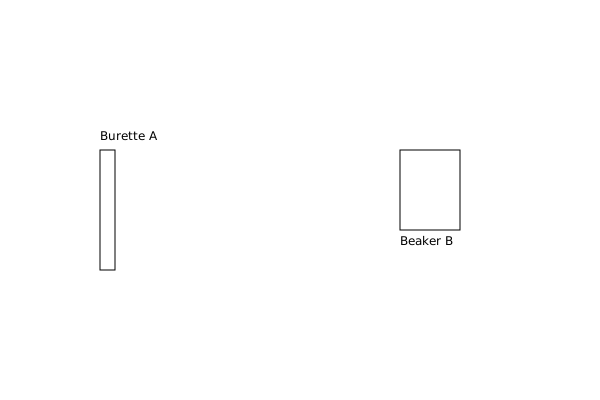
A diagram of a simple titration setup is shown below. What is the purpose of the burette in this setup?
A. To measure the volume of the titrant.
B. To measure the volume of the analyte.
C. To mix the titrant and analyte.
D. To separate the titrant and analyte.
Question 9
Analyze the concept of legitimacy in the context of political power. How does it relate to the authority of a government?
A. Legitimacy is the moral right to govern, while authority is the power to enforce laws.
B. Authority is the source of legitimacy, and legitimacy is the outcome of authority.
C. Legitimacy is the acceptance of authority by the people, while authority is the power to govern.
D. Legitimacy is the power to govern, while authority is the moral right to do so.
Question 10
The concept of Human Rights is a fundamental principle of democracy. Which of the following is a right that is guaranteed by the constitution?
A. The right to bear arms.
B. The right to freedom of speech.
C. The right to a fair trial.
D. The right to vote.
Question 11
The concept of authority in government is closely related to the idea of legitimacy. Explain how authority is derived from legitimacy, using the example of a monarch.
A. Authority is derived from legitimacy when the monarch is able to maintain control and stability.
B. Authority is derived from legitimacy when the monarch is able to provide for the basic needs of its citizens.
C. Authority is derived from legitimacy when the monarch is able to make decisions that are in the best interest of its citizens.
D. Authority is derived from legitimacy when the monarch is able to maintain a strong military presence.
Question 12
The Constitution of the Federal Republic of Nigeria is the supreme law of the land. Discuss the importance of the Constitution in promoting democracy and protecting individual rights and freedoms.
A. The Constitution provides a framework for the protection of individual rights and freedoms.
B. The Constitution promotes social justice and equality.
C. The Constitution ensures that the government and its agencies are accountable to the people.
D. The Constitution is a means of controlling the behavior of citizens.
Question 13
The Independent National Electoral Commission (INEC) is responsible for conducting elections in Nigeria. Discuss the role of INEC in promoting free and fair elections in Nigeria.
A. INEC has been successful in conducting free and fair elections in Nigeria.
B. INEC has played a crucial role in promoting electoral reform and improving the electoral process.
C. INEC has been effective in protecting the rights of voters and promoting electoral integrity.
D. INEC has failed to conduct free and fair elections in Nigeria.
Question 14
Analyze the concept of pre-colonial administration in Africa. How did traditional systems of governance prepare the continent for colonial rule?
A. Pre-colonial administration in Africa was characterized by decentralized systems of governance, which made it easier for colonial powers to impose their rule.
B. Pre-colonial administration in Africa was characterized by centralized systems of governance, which resisted colonial rule.
C. Pre-colonial administration in Africa had no impact on the continent's preparedness for colonial rule.
D. Pre-colonial administration in Africa was a product of colonial rule, not a precursor to it.
Question 15
What is the primary function of the International Monetary Fund (IMF) in the global economy?
A. To regulate international trade and commerce.
B. To provide financial assistance to countries facing economic difficulties.
C. To promote economic growth and development in member countries.
D. To establish a global currency and monetary policy.

Master the Exam!

You've seen a preview, but there are thousands more questions plus AI tutor to break down complex solutions.

Unlock Full Access Available for Android & Windows
Help others prepare! Share this practice hub: