POST UTME IMS U 2025 Chemistry | Objective

Practice these randomly selected questions to test your readiness.

Question 1
A 25.0 mL sample of 0.100 M HCl is titrated with 0.0500 M NaOH. Calculate the number of moles of HCl that react with NaOH.
A. 0.00250 mol
B. 0.00500 mol
C. 0.00750 mol
D. 0.0100 mol
Question 2
The s\tandard enthalpy of formation of CO2(g) is -393.5 kJ/mol. Calculate the s\tandard enthalpy of combustion of 1 mol of C(s) at 298 K.
A. -393.5 kJ/mol
B. -393.5 kJ/mol + 393.5 kJ/mol
C. -393.5 kJ/mol + 298 kJ/mol
D. -393.5 kJ/mol - 298 kJ/mol
Question 3
A diagram of a chemical apparatus setup is shown below. What is the purpose of the beaker in this setup?
A. To mix the titrant and analyte
B. To separate the titrant and analyte
C. To measure the volume of the titrant
D. To measure the volume of the analyte
Question 4
A 2.00 g sample of a polymer is dissolved in 50.0 mL of a solvent. The solution is then diluted to 100.0 mL. Calculate the concentration of the polymer solution in g/L.
A. 0.100 g/L
B. 0.200 g/L
C. 0.400 g/L
D. 0.800 g/L
Question 5
Determine the pH of a 0.1 M solution of hydrochloric acid (HCl) at 25°C. The dissociation cons\tant of HCl is 10^\( -7 \).
A. 1
B. 2
C. 3
D. 4
Question 6
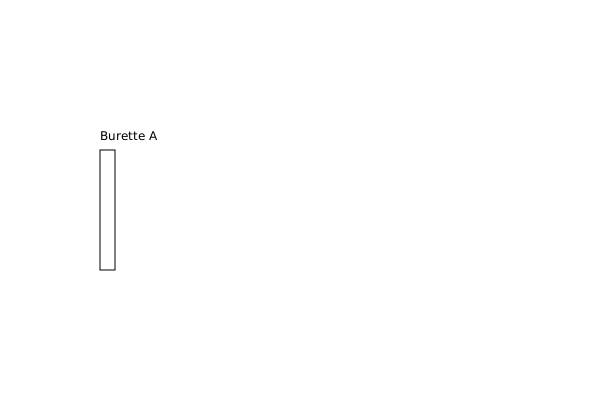
A diagram of a titration setup is shown below. What is the purpose of the burette in this setup?
A. To measure the volume of the titrant
B. To measure the volume of the analyte
C. To mix the titrant and analyte
D. To separate the titrant and analyte
Question 7
Determine the s\tandard electrode potential of the reaction: MnO4- + 8H+ + 5e- → Mn2+ + 4H2O. Given that the s\tandard electrode potential of the O2/O2 couple is 1.23 V.
A. -1.51 V
B. -1.23 V
C. -1.51 V
D. +1.23 V
Question 8
A 1 M solution of NaOH is mixed with a 1 M solution of HCl. What is the concentration of OH- ions in the resulting solution?
A. 1 M
B. 0.5 M
C. 0.1 M
D. 0.01 M
Question 9
The reaction of nitrogen dioxide with water produces nitric acid and nitric oxide. Write the balanced chemical equation for this reaction, including the states of all reac\tants and products.
A. \text{NO}_2(g) + \text{H}_2\text{O}(l) \rightarrow \text{HNO}_3(aq) + \text{NO}(g)
B. \text{NO}_2(g) + \text{H}_2\text{O}(l) \rightarrow \text{HNO}_3(aq) + \text{NO}_2(g)
C. \text{NO}_2(g) + \text{H}_2\text{O}(l) \rightarrow \text{HNO}_3(aq) + \text{O}_2(g)
D. \text{NO}_2(g) + \text{H}_2\text{O}(l) \rightarrow \text{HNO}_3(aq) + \text{H}_2(g)
Question 10
The reaction of sodium hydroxide with hydrochloric acid produces sodium chloride and water. Write the balanced chemical equation for this reaction, including the states of all reac\tants and products.
A. \text{NaOH}(aq) + \text{HCl}(aq) \rightarrow \text{NaCl}(aq) + \text{H}_2\text{O}(l)
B. \text{NaOH}(aq) + \text{HCl}(aq) \rightarrow \text{NaCl}(l) + \text{H}_2\text{O}(g)
C. \text{NaOH}(aq) + \text{HCl}(aq) \rightarrow \text{NaCl}(aq) + \text{H}_2\text{O}(g)
D. \text{NaOH}(l) + \text{HCl}(aq) \rightarrow \text{NaCl}(aq) + \text{H}_2\text{O}(l)
Question 11
A 2.00 g sample of a polymer is dissolved in 50.0 mL of a solvent. The solution is then diluted to 100.0 mL. Calculate the concentration of the polymer solution in g/L.
A. 0.100 g/L
B. 0.200 g/L
C. 0.400 g/L
D. 0.800 g/L
Question 12
A 2.5 L sample of a gas at 27°C and 1.2 atm is compressed to 0.5 L at 37°C. Calculate the final pressure of the gas.
A. 2.5 atm
B. 1.2 atm
C. 0.6 atm
D. 1.5 atm
Question 13
The half-life of a radioactive subs\tance is 5 years. If 100 g of the subs\tance is present initially, how much will be left after 10 years?
A. 50 g
B. 25 g
C. 12.5 g
D. 6.25 g
Question 14
The periodic table is arranged in a way that elements with similar properties are placed in the same group. Which of the following elements is a member of group 17?
A. Chlorine
B. Bromine
C. Fluorine
D. Iodine
Question 15
Determine the number of moles of ΔH2O produced when 2.50 g of glu\cose (C6H12O6) is completely oxidized in a combustion reaction.
A. 0.0500 mol
B. 0.100 mol
C. 0.150 mol
D. 0.200 mol

Master the Exam!

You've seen a preview, but there are thousands more questions plus AI tutor to break down complex solutions.

Unlock Full Access Available for Android & Windows
Help others prepare! Share this practice hub: