POST UTME IGBINEDION UNIVERSITY 2020 Biology | Objective

Practice these randomly selected questions to test your readiness.

Question 1
A bacterium has a mutation in its DNA that causes it to produce a toxin. The toxin is encoded by a gene that is located on a plasmid. If the plasmid is 5 kb in size and the gene is 2 kb in size, what is the percentage of the plasmid that is occupied by the gene?
A. 40%
B. 50%
C. 60%
D. 80%
Question 2
A diagram of a plant cell is shown below. What is the function of the structure labeled 'X'?
A. It is the site of protein synthesis
B. It is the site of lipid synthesis
C. It is the site of carbohydrate synthesis
D. It is the site of DNA replication
Question 3
In the process of photosynthesis, what is the role of the enzyme RuBisCO?
A. It catalyzes the conversion of CO2 to glu\cose
B. It is involved in the light-dep\endent reactions of photosynthesis
C. It is a key enzyme in the Calvin cycle
D. It is responsible for the absorption of light energy
Question 4
A 30-year-old woman is diagnosed with a rare disease that affects the kidneys. The disease is caused by a mutation in a gene that codes for a protein involved in the regulation of blood pressure. What is the likely effect of this mutation on the woman's blood pressure?
A. \downarrow
B. \uparrow
C. \leftrightarrow
D. \rightarrow
Question 5
A population of bacteria is growing exponentially. If the initial population is 100 and the doubling time is 2 hours, what is the population after 6 hours?
A. 1600
B. 3200
C. 6400
D. 12800
Question 6
What is the term for the process by which a cell becomes specialized to perform a specific function?
A. Differentiation
B. Mitosis
C. Meiosis
D. Symbiosis
Question 7
A researcher is studying the effect of a new pesticide on a population of insects. The pesticide is applied to the insects at a concentration of 10 mg/L. What is the expected effect of this pesticide on the population of insects?
A. \uparrow
B. \downarrow
C. \leftrightarrow
D. \rightarrow
Question 8
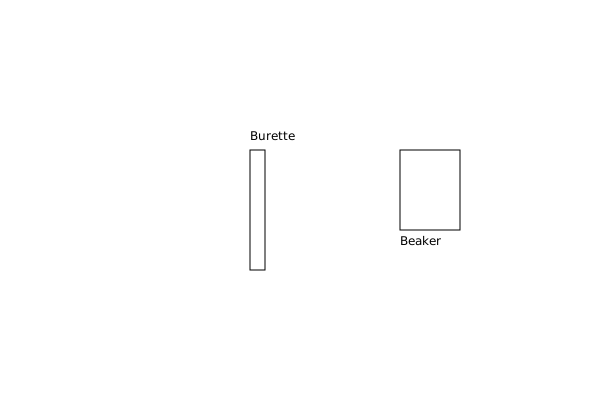
The following diagram shows a titration setup. What is the purpose of the burette?
A. To measure the volume of the acid
B. To measure the volume of the base
C. To mix the acid and base
D. To measure the pH of the solution
Question 9
A 45-year-old man is diagnosed with hypertension. His blood pressure is 160/100 mmHg, and his heart rate is 80 beats/min. Which of the following is the most appropriate treatment option?
A. Li\sinopril only
B. Amlodipine only
C. Hydrochlorothiazide only
D. Combination of li\sinopril and amlodipine
Question 10
A plant has a genetic disorder that causes it to produce abnormal flowers. The disorder is caused by a mutation in a gene that is located on a chromosome. If the chromosome is 10 cm in length and the gene is 2 cm in length, what is the percentage of the chromosome that is occupied by the gene?
A. 20%
B. 30%
C. 40%
D. 50%
Question 11
In a population of 1000 individuals, 80% are susceptible to a particular disease, 15% are infected, and 5% are recovered. Assuming the disease is caused by a virus and the population is homogeneous, calculate the basic reproduction number (R0) u\sing the formula R0 = β * S / γ, where β is the transmission rate, S is the number of susceptible individuals, and γ is the recovery rate. Given that β = 0.2 and γ = 0.1, what is the value of R0?
A. 1.6
B. 1.8
C. 2.0
D. 2.2
Question 12
The following diagram shows a cross-section of a plant root. Which part of the root is responsible for absorbing water and minerals from the soil?
A. Root Hair
B. Xylem
C. Phloem
D. Cortex
Question 13
A 2-year-old child is brought to the hospital with symptoms of pneumonia. The child's white blood cell count is 15,000 cells/μL, and the child's temperature is 38.5°C. Which of the following is the most likely cause of the child's symptoms?
A. Streptococcus pneumoniae
B. Haemophilus influenzae
C. Pseudomonas aeruginosa
D. Escherichia coli
Question 14
A diagram of a simple harmonic motion is shown below. What is the amplitude of the motion?
A. 2
B. 4
C. 6
D. 8
Question 15
The process of osmoregulation in plants involves the movement of water from the roots to the xylem. Which of the following statements is true about the xylem?
A. The xylem is responsible for the transport of sugars from the leaves to the roots.
B. The xylem is responsible for the transport of water from the roots to the leaves.
C. The xylem is responsible for the transport of minerals from the roots to the leaves.
D. The xylem is responsible for the transport of gases from the leaves to the roots.

Master the Exam!

You've seen a preview, but there are thousands more questions plus AI tutor to break down complex solutions.

Unlock Full Access Available for Android & Windows
Help others prepare! Share this practice hub: