POST UTME GREENFIELD UNIVERSITY 2022 Biology | Objective

Practice these randomly selected questions to test your readiness.

Question 1
A cell is placed in a solution with a high concentration of salt. What is the likely effect on the cell's osmotic balance?
A. The cell will shrink due to water loss
B. The cell will swell due to water gain
C. The cell's osmotic balance will remain unchanged
D. The cell will undergo apoptosis
Question 2
A patient is diagnosed with a bacterial infection caused by Staphylococcus aureus. Which of the following antibiotics is most effective against this type of bacteria?
A. Penicillin
B. Erythromycin
C. Ciprofloxacin
D. Vancomycin
Question 3
In a population of 1000 individuals, 70% are heterozygous for the ABO blood group gene. If 50 individuals are randomly selected, what is the probability that at least 30 of them will be heterozygous?
A. 0.05
B. 0.15
C. 0.25
D. 0.35
Question 4
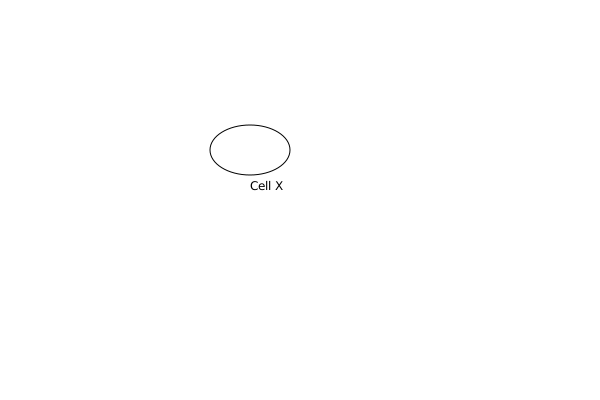
A diagram of a plant cell is shown below. What is the function of the structure labeled 'X'?
A. To regulate the movement of materials in and out of the cell
B. To synthesize proteins
C. To store genetic information
D. To provide structural support
Question 5
A diagram of a human kidney is shown below. Identify the component labeled 'Y'.
A. Renal Papilla
B. Renal Cortex
C. Renal Medulla
D. Ureter
Question 6
The graph below represents the growth of a population of microorganisms over time. Which of the following best describes the type of growth depicted in the graph?
A. Exponential growth
B. Logarithmic growth
C. Linear growth
D. Sigmoid growth
Question 7
A 50-year-old woman presents with a 5-year history of infertility. Her husband has a normal semen analysis. What is the most likely cause of her infertility?
A. Tubal ligation
B. Endometriosis
C. Polycystic ovary syndrome
D. Premature ovarian failure
Question 8
What is the primary mechanism by which the kidneys regulate the concentration of ions in the blood?
A. Reabsorption of ions in the proximal convoluted tubule
B. Secretion of ions in the distal convoluted tubule
C. Regulation of ion channels in the collecting duct
D. Excretion of ions in the urine
Question 9
A species of bird has a unique mating ritual where the male presents the female with a specific type of food. What is the likely reason for this behavior?
A. To attract a mate
B. To establish dominance
C. To provide nutrients for offspring
D. To signal the start of breeding season
Question 10
In a desert e\cosystem, what is the primary mechanism by which plants regulate water loss through their leaves?
A. Stomatal closure
B. Transpiration
C. Cuticular transpiration
D. Root pressure
Question 11
A genetic disorder is caused by a mutation in the BRCA1 gene, which is responsible for repairing DNA damage. Which of the following types of mutations is most likely to occur in this gene?
A. Point mutation
B. Frameshift mutation
C. Deletion mutation
D. Insertion mutation
Question 12
In a desert e\cosystem, what is the primary role of the xerophyte plant?
A. To produce shade
B. To provide food for herbivores
C. To conserve water
D. To regulate soil temperature
Question 13
In a population of rabbits, what is the term for the process by which the frequency of a particular trait increases over time?
A. Natural selection
B. Genetic drift
C. Gene flow
D. Mutation
Question 14
A 2.5 L flask contains 0.5 M NaCl solution. If 10 mL of 2 M HCl is added to the solution, what is the new concentration of NaCl?
A. 0.4 M
B. 0.5 M
C. 0.6 M
D. 0.7 M
Question 15
In a tropical rainforest e\cosystem, what is the primary role of the leafy canopy in regulating the environment?
A. To absorb and store sunlight for photosynthesis
B. To regulate the temperature and humidity levels
C. To provide shelter and habitat for various species
D. To facilitate the movement of water and nutrients

Master the Exam!

You've seen a preview, but there are thousands more questions plus AI tutor to break down complex solutions.

Unlock Full Access Available for Android & Windows
Help others prepare! Share this practice hub: