POST UTME FUTO 2020 Chemistry | Objective

Practice these randomly selected questions to test your readiness.

Question 1
The atomic radius of an element in the third period of the periodic table is 1.5 Å. What is the atomic radius of the element in the fifth period?
A. 1.5 Å
B. 2.0 Å
C. 2.5 Å
D. 3.0 Å
Question 2
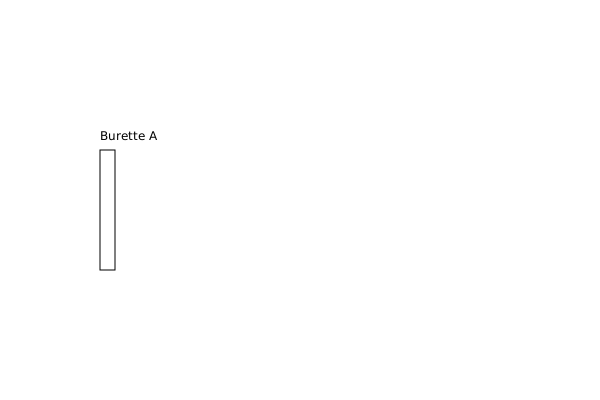
The diagram below shows a titration setup. Identify the part labeled 'A'.
A. Burette
B. Conical Flask
C. Pipette
D. Thermometer
Question 3
A solution of sodium chloride (NaCl) is prepared by dissolving 35.5 g of NaCl in 100 mL of water. Calculate the molar concentration of the solution. \( R = 0.0821 L atm K-1 mol-1, T = 298 K \).
A. 0.5 M
B. 1.0 M
C. 1.5 M
D. 2.0 M
Question 4
A 2.50 g sample of a non-metallic solid is heated in a crucible until it reaches a temperature of 1273 K. Calculate the energy required to heat the sample from 298 K to 1273 K.
A. 100 J
B. 200 J
C. 300 J
D. 400 J
Question 5
A 25.0 mL sample of a solution containing 0.100 M NaCl is titrated with 0.100 M AgNO_3. What is the pH of the solution after the reaction is complete?
A. \( pH = 7 \)
B. \( pH = 8 \)
C. \( pH = 9 \)
D. \( pH = 10 \)
Question 6
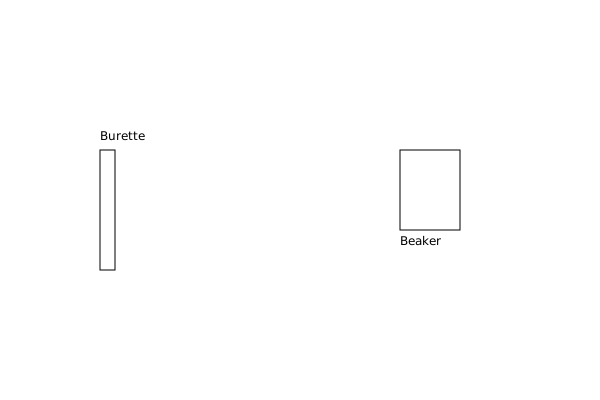
The diagram below shows a simple black and white chemistry apparatus showing titration setup.
A. The burette contains the acid.
B. The beaker contains the acid.
C. The burette contains the base.
D. The beaker contains the base.
Question 7
Determine the number of moles of iron(III) oxide (Fe2O3) produced when 2.5 moles of iron(II) sulfate (FeSO4) react with 1.5 moles of sodium hydroxide (NaOH) in the following reaction: 2FeSO4 + 3NaOH + Fe2O3 → Fe2O3 + 2Na2SO4 + 3H2O.
A. 1.5 moles
B. 2.0 moles
C. 2.5 moles
D. 3.0 moles
Question 8
A solution contains 0.1 M NaCl. If 10 mL of this solution is diluted to 100 mL, what is the concentration of the resulting solution?
A. 0.01 M
B. 0.01 M
C. 0.01 M
D. 0.01 M
Question 9
The reaction of potassium permanganate with hydrogen peroxide in acidic medium is a classic example of a redox reaction. What is the half-reaction that involves the reduction of permanganate ion \( MnO4- \)?
A. MnO4- + 8H+ + 5e- → Mn2+ + 4H2O
B. MnO4- + 8H+ + 5e- → MnO2 + 4H2O
C. MnO4- + 8H+ + 5e- → Mn2+ + 4H2O + 2H2
D. MnO4- + 8H+ + 5e- → MnO2 + 4H2O + 2H2
Question 10
Determine the number of moles of nitrogen gas (N2) produced when 2.5 moles of ammonia (NH3) react with 2.5 moles of oxygen gas (O2) according to the following equation: 4NH3 + 5O2 → 4N2 + 6H2O.
A. 1.25
B. 2.5
C. 3.75
D. 5.0
Question 11
A polymer is a large molecule composed of many repeated subunits called monomers. Which of the following is a characteristic of a polymer?
A. It has a high melting point
B. It has a low boiling point
C. It is soluble in water
D. It has a high molecular weight
Question 12
A chemical reaction is said to be at equilibrium when the rates of the forward and reverse reactions are equal. Which of the following is a characteristic of a system at equilibrium?
A. The concentrations of the reac\tants and products are equal
B. The rates of the forward and reverse reactions are not equal
C. The system is not in a state of dynamic equilibrium
D. The reaction is spon\taneous
Question 13
A 2.50-g sample of sodium chloride (NaCl) is dissolved in 100.0 mL of water. If the density of the solution is 1.05 g/mL, what is the molarity of the solution?
A. 0.100
B. 0.200
C. 0.300
D. 0.400
Question 14
The boiling point of a solution containing 10% ethanol (C2H5OH) and 90% water (H2O) is 78.5°C. What is the boiling point elevation of the solution?
A. 0.5°C
B. 1.0°C
C. 1.5°C
D. 2.0°C
Question 15
The reaction between sulfuric acid and sodium hydroxide is a classic example of a double displacement reaction. What is the net ionic equation for this reaction?
A. \( H_2SO_4 + 2NaOH \rightarrow Na_2SO_4 + 2H_2O \)
B. \( H_2SO_4 + 2NaOH \rightarrow Na_2SO_4 + 2H_2O + 2Na^+ \)
C. \( H_2SO_4 + 2NaOH \rightarrow Na_2SO_4 + 2H_2O + 2H^+ \)
D. \( H_2SO_4 + 2NaOH \rightarrow Na_2SO_4 + 2H_2O + 2OH^- \)

Master the Exam!

You've seen a preview, but there are thousands more questions plus AI tutor to break down complex solutions.

Unlock Full Access Available for Android & Windows
Help others prepare! Share this practice hub: