POST UTME ELIZADE UNIVERSITY 2024 Chemistry | Objective
Practice these randomly selected questions to test your readiness.
Question 1
A 2.50 g sample of a gas at 25°C and 1.00 atm is collected over water at 25°C. If the vapor pressure of water at 25°C is 23.8 mmHg, calculate the partial pressure of the gas.
Question 2
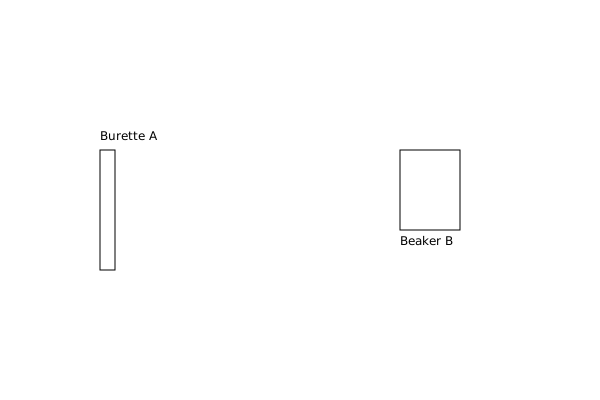
The diagram below represents a titration setup. Identify the part labeled A.
Question 3
A solution of 10 g of glu\cose in 100 mL of water has a boiling point elevation of 0.5°C. What is the molar mass of glu\cose?
Question 4
A 1.00 L flask contains 0.100 M NaCl. What is the concentration of Cl- ions in the solution?
Question 5
A 0.1 M solution of NaOH is prepared by dissolving 4 g of NaOH in 100 mL of water. Calculate the molarity of the solution.
Question 6
The molar mass of a compound is 180 g/mol. If 10 g of the compound is dissolved in 100 mL of water, what is the concentration of the solution in g/L?
Question 7
A sample of a gas occupies a volume of 2.5 L at a pressure of 3.0 atm and a temperature of 298 K. What is the new volume of the gas if the pressure is increased to 4.0 atm and the temperature is decreased to 273 K?
Question 8
A sample of a polymer has a molecular weight of 50,000 g/mol. What is the number of monomer units in the polymer?
Question 9
A 2.00 M solution of NaOH is mixed with a 2.00 M solution of HCl. What is the pH of the resulting solution?
Question 10
Determine the type of bond present in the molecule H2S.
Question 11
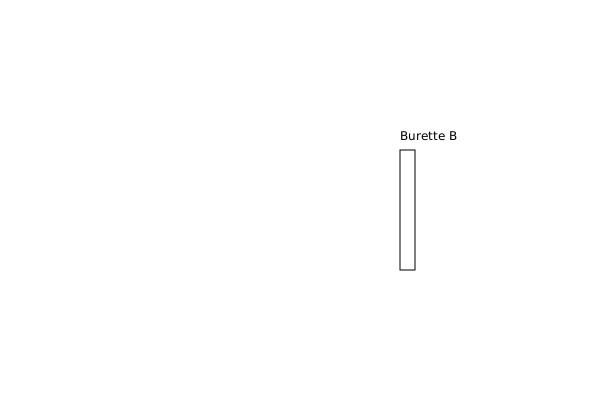
The diagram below represents a chemical apparatus setup. Identify the part labeled B.
Question 12
A 2.00 g sample of a subs\tance is found to have a mass of 2.50 g after being heated in a furnace at 1000°C for 1 hour. What is the percentage increase in mass?
Question 13
The s\tandard enthalpy of formation of CO2(g) is -393.5 kJ/mol. Calculate the s\tandard enthalpy of formation of C(s) + O2(g) → CO2(g).
Question 14
A colloidal solution of starch in water has a Tyndall effect. What is the reason for this phenomenon?
Question 15
A mixture of gases is composed of 20% helium, 30% oxygen, and 50% nitrogen by volume. If the total pressure of the mixture is 2.5 atm, what is the partial pressure of helium?
Master the Exam!
You've seen a preview, but there are thousands more questions plus AI tutor to break down complex solutions.
Unlock Full Access
Available for Android & Windows