POST UTME EKSU 2025 Geography | Objective

Practice these randomly selected questions to test your readiness.

Question 1
The diagram below shows the structure of a river. Which part of the river is represented by the arrow pointing to the left?
A. Floodplain
B. Channel
C. Delta
D. Source
Question 2
The diagram below shows the distribution of vegetation belts in Nigeria. Which of the following vegetation belts is NOT found in the savanna region?
A. Tropical Rainforest
B. Mangrove
C. Sahel
D. Desert
Question 3
The diagram below represents the water cycle. Which process is represented by the arrow pointing from the ocean to the atmosphere?
A. Evaporation
B. Condensation
C. Precipitation
D. Runoff
Question 4
The process of plate tectonics that involves the movement of the Earth's lithosphere as a result of convection currents in the mantle is known as:
A. Continental Drift
B. Sea-Floor Spreading
C. Plate Tectonics
D. Convection Currents
Question 5
The diagram below shows a simple map of a city. What is the name of the feature labeled 'A'?
A. City
B. River
C. Mountain
D. Valley
Question 6
The diagram below shows the movement of tectonic plates. Which type of plate boundary is represented by the arrows?
A. Divergent boundary
B. Convergent boundary
C. Transform boundary
D. Plate boundary
Question 7
What is the primary factor that determines the distribution of population in a region?
A. Availability of natural resources
B. Climate and geography
C. Economic opportunities
D. Cultural and social factors
Question 8
The diagram below shows the structure of a typical river system. What is the primary function of the meandering section?
A. To slow down the flow of water
B. To increase the depth of the river
C. To create a natural reservoir
D. To provide a habitat for aquatic life
Question 9
The diagram below represents the climate zones of Nigeria. Which climate zone is represented by the arrow pointing to the north?
A. Tropical rainforest
B. Savanna
C. Desert
D. Mountain
Question 10
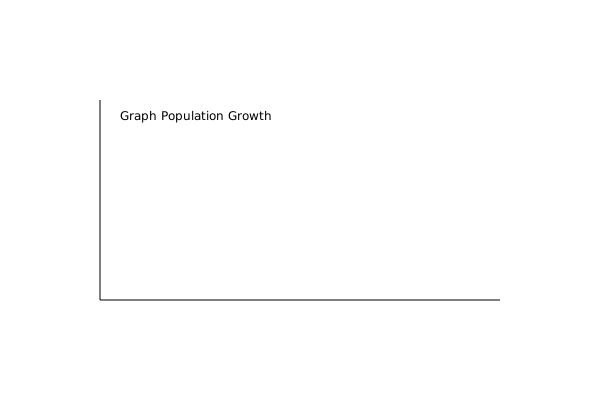
The diagram below shows a graph of population growth over time. What is the rate of population growth between 2000 and 2010?
A. 2%
B. 3%
C. 4%
D. 5%
Question 11
The process of weathering that involves the breakdown of rocks into smaller fragments due to the expansion and contraction of water within the rock's pores is known as:
A. Mechanical Weathering
B. Chemical Weathering
C. Physical Weathering
D. Biological Weathering
Question 12
The diagram below shows a graph of the relationship between the price of a commodity and the quantity demanded. Which of the following is a characteristic of the demand curve?
A. It slopes upwards to the right
B. It slopes downwards to the right
C. It is a straight line
D. It is a curve
Question 13
The map below shows the distribution of different rock types in Nigeria. What type of rock is most commonly found in the Basement Complex?
A. Granite
B. Gneiss
C. Schist
D. Phyllite
Question 14
Using the concept of the solar system, explain the formation of the Earth's atmosphere.
A. The Earth's atmosphere was formed through the condensation of water vapor from the solar nebula.
B. The Earth's atmosphere was formed through the release of gases from the Earth's interior.
C. The Earth's atmosphere was formed through the impact of comets and meteorites.
D. The Earth's atmosphere was formed through the interaction of the Earth's magnetic field with the solar wind.
Question 15
The diagram below shows a cross-section of a river delta. Which of the following processes is responsible for the formation of the delta?
A. Tectonic Uplift
B. Deposition
C. Erosion
D. Weathering

Master the Exam!

You've seen a preview, but there are thousands more questions plus AI tutor to break down complex solutions.

Unlock Full Access Available for Android & Windows
Help others prepare! Share this practice hub: