POST UTME EKSU 2019 Biology | Objective

Practice these randomly selected questions to test your readiness.

Question 1
A population of bacteria is growing at a rate of 20% per hour. If the initial population is 1000, what will be the population after 3 hours?
A. 1600
B. 1800
C. 2000
D. 2200
Question 2
In the context of mitosis, what is the primary function of the spindle fibers?
A. To separate the sister chromatids
B. To align the chromosomes at the metaphase plate
C. To pull the chromosomes apart during anaphase
D. To form the nuclear envelope during telophase
Question 3
In a eukaryotic cell, the process of mitosis is initiated by the breakdown of the nuclear envelope, resulting in the release of the chromosomes into the cytoplasm. Which of the following structures is responsible for the breakdown of the nuclear envelope?
A. Nuclear lamina
B. Nuclear envelope
C. Mitotic spindle
D. Centrioles
Question 4
A plant has a genotype of Bb. What is the probability that it will produce a gamete with the genotype bb?
A. 0.1
B. 0.2
C. 0.3
D. 0.4
Question 5
The xylem in plants is responsible for transporting
A. water and minerals from the roots to the leaves
B. sugars and amino acids from the leaves to the roots
C. hormones and other signaling molecules throughout the plant
D. waste products from the leaves to the roots
Question 6
A diagram of the human circulatory system is shown below.
A. The heart is responsible for pumping blood to the lungs
B. The heart is responsible for pumping blood to the body
C. The arteries are responsible for transporting oxygenated blood
D. The veins are responsible for transporting deoxygenated blood
Question 7
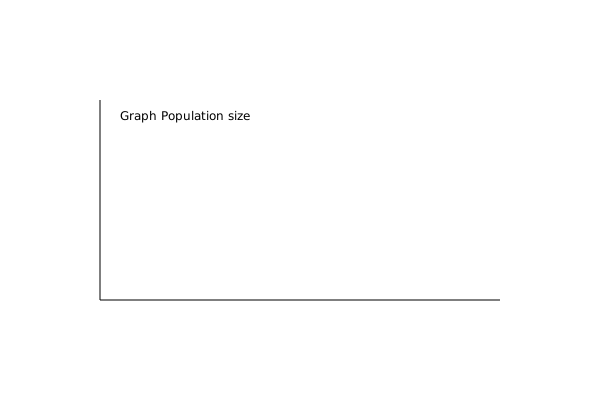
The following graph represents the growth of a population over time. What is the term for the point at which the population reaches its maximum size?
A. Carrying capacity
B. Intrinsic rate of increase
C. Environmental resis\tance
D. Population density
Question 8
A plant with the genotype 'Rr' is crossed with a plant with the genotype 'RR'. What is the probability that the offspring will be homozygous recessive?
A. 0.25
B. 0.5
C. 0.75
D. 0.9
Question 9
A plant cell is placed in a solution containing 0.1 M glu\cose. The cell membrane is permeable to glu\cose, but not to other solutes. What will happen to the concentration of glu\cose inside the cell?
A. The concentration of glu\cose will increase inside the cell
B. The concentration of glu\cose will decrease inside the cell
C. The concentration of glu\cose will remain the same inside the cell
D. The concentration of glu\cose will increase outside the cell
Question 10
Asexual reproduction in plants can occur through the production of
A. seeds
B. spores
C. bulbs
D. tubers
Question 11
A population of 500 individuals is divided into 5 equal groups. If 20% of the individuals in each group are heterozygous for the gene controlling the flower color, what is the frequency of the dominant allele?
A. 0.2
B. 0.3
C. 0.4
D. 0.5
Question 12
A diagram of the human respiratory system is shown below.
A. The trachea is responsible for gas exchange
B. The diaphragm is responsible for gas exchange
C. The lungs are responsible for gas exchange
D. The trachea is responsible for transporting air to the lungs
Question 13
In the context of population eco\logy, what is the term for the rate at which a population grows or declines?
A. Intrinsic rate of increase
B. Carrying capacity
C. Environmental resis\tance
D. Population density
Question 14
A population of bacteria is growing in a culture medium. The growth rate of the population is proportional to the product of the current population size and the amount of available nutrients. If the initial population size is 100 bacteria and the amount of available nutrients is 10 units, what will be the population size after 5 generations?
A. 500 bacteria
B. 1000 bacteria
C. 2000 bacteria
D. 5000 bacteria
Question 15
The diagram below shows a plant cell with a large vacuole. Which of the following statements is true about the vacuole?
A. The vacuole is responsible for storing water and salts.
B. The vacuole is responsible for storing sugars and amino acids.
C. The vacuole is responsible for storing waste products.
D. The vacuole is responsible for storing pigments.

Master the Exam!

You've seen a preview, but there are thousands more questions plus AI tutor to break down complex solutions.

Unlock Full Access Available for Android & Windows
Help others prepare! Share this practice hub: