POST UTME DELSU 2018 Chemistry | Objective

Are you preparing for POST UTME DELSU exams? Reviewing past questions is one of the most effective ways to guarantee a high score. This practice hub features authentic 2018 Chemistry (Objective) questions designed to simulate the real exam environment.

Practice these randomly selected questions to test your readiness.

Question 1
Determine the rate cons\tant (k) for the reaction: 2NO(g) + O2(g) → 2NO2(g), given that the initial concentrations of NO and O2 are 0.1 M and 0.05 M, respectively, and the rate of disappearance of NO is 2.5 × 10^\( -3 \) M/s.
A. \( 2.5 \times 10^3 \) M^\( -1 \)s^\( -1 \)
Correct B. \( 5.0 \times 10^3 \) M^\( -1 \)s^\( -1 \)
C. \( 1.0 \times 10^4 \) M^\( -1 \)s^\( -1 \)
D. \( 2.0 \times 10^4 \) M^\( -1 \)s^\( -1 \)

Correct Answer: B

Want to see the full step-by-step solution? Unlock AI Explanation & Analytics
Question 2
A 0.5 M solution of HCl is mixed with a 0.5 M solution of NaOH. Calculate the pH of the resulting solution after 10 minutes.
A. ( 2.0 )
Correct B. ( 3.0 )
C. ( 4.0 )
D. ( 5.0 )

Correct Answer: B

Want to see the full step-by-step solution? Unlock AI Explanation & Analytics
Question 3
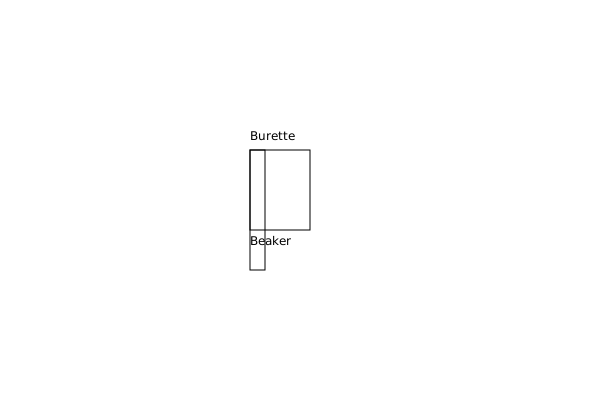
The diagram below represents a titration setup. Identify the subs\tance being titrated.
Correct A. ( HCl )
B. ( NaOH )
C. \( H_2SO_4 \)
D. \( NH_3 \)

Correct Answer: A

Want to see the full step-by-step solution? Unlock AI Explanation & Analytics
Question 4
A sample of CO2 gas is collected over water at a temperature of 25°C and a pressure of 1 atm. Calculate the partial pressure of CO2 in the gas mixture.
A. ( 0.5 ) atm
Correct B. ( 0.7 ) atm
C. ( 0.9 ) atm
D. ( 1.1 ) atm

Correct Answer: B

Want to see the full step-by-step solution? Unlock AI Explanation & Analytics
Question 5
The s\tandard enthalpy of formation of CO2(g) is -393.5 kJ/mol. Calculate the s\tandard enthalpy of combustion of 1 mole of C(s) to form CO2(g).
Correct A. \( -393.5 \) kJ/mol
B. \( -397.5 \) kJ/mol
C. \( -401.5 \) kJ/mol
D. \( -405.5 \) kJ/mol

Correct Answer: A

Want to see the full step-by-step solution? Unlock AI Explanation & Analytics
Question 6
The rate cons\tant of a first-order reaction is 0.05 min^-1. If the initial concentration of the reac\tant is 0.1 M, calculate the concentration of the reac\tant after 10 minutes.
Correct A. 0.005 M
B. 0.01 M
C. 0.05 M
D. 0.1 M

Correct Answer: A

Want to see the full step-by-step solution? Unlock AI Explanation & Analytics
Question 7
A 0.1 M solution of NaCl is prepared by dissolving 6.0 g of NaCl in 100 mL of water. What is the molarity of the solution?
Correct A. 0.1 M
B. 0.2 M
C. 0.3 M
D. 0.4 M

Correct Answer: A

Want to see the full step-by-step solution? Unlock AI Explanation & Analytics
Question 8
The s\tandard electrode potential of the cell is 1.5 V. If the cell is connected to a 1.5 V battery, what is the cell potential?
A. 0 V
Correct B. 1.5 V
C. 2.5 V
D. 3.5 V

Correct Answer: B

Want to see the full step-by-step solution? Unlock AI Explanation & Analytics
Question 9
A solution of HCl is prepared by dissolving 10 g of HCl in 100 mL of water. What is the molarity of the solution?
Correct A. 1 M
B. 2 M
C. 3 M
D. 4 M

Correct Answer: A

Want to see the full step-by-step solution? Unlock AI Explanation & Analytics
Question 10
A 0.1 M solution of NaOH is prepared by dissolving 4.0 g of NaOH in 100 mL of water. What is the molarity of the solution?
Correct A. 0.1 M
B. 0.2 M
C. 0.3 M
D. 0.4 M

Correct Answer: A

Want to see the full step-by-step solution? Unlock AI Explanation & Analytics
Question 11
The rate cons\tant (k) for a first-order reaction is given by the equation: k = Ae^\( -Ea/RT \). If the activation energy (Ea) is 100 kJ/mol, the gas cons\tant (R) is 8.314 J/mol*K, and the temperature (T) is 300 K, what is the value of the rate cons\tant (k) if the pre-exponential factor (A) is 1.0 x 10^10 s^-1?
A. 1.0 x 10^5 s^-1
B. 1.0 x 10^6 s^-1
C. 1.0 x 10^7 s^-1
Correct D. 1.0 x 10^8 s^-1

Correct Answer: D

Want to see the full step-by-step solution? Unlock AI Explanation & Analytics
Question 12
The equilibrium cons\tant (K) for the reaction: N2(g) + 3H2(g) ⇌ 2NH3(g) is 0.05 at 500 K. If the initial concentrations of N2 and H2 are 1.0 M and 3.0 M, respectively, what is the concentration of NH3 at equilibrium?
Correct A. 0.01 M
B. 0.02 M
C. 0.03 M
D. 0.04 M

Correct Answer: A

Want to see the full step-by-step solution? Unlock AI Explanation & Analytics
Question 13
The s\tandard enthalpy of formation (ΔHf) for the compound CO2(g) is -393.5 kJ/mol. If 2.0 mol of CO2 is formed at 298 K, what is the total enthalpy change (ΔH) for the reaction?
Correct A. -787 kJ
B. -786 kJ
C. -785 kJ
D. -784 kJ

Correct Answer: A

Want to see the full step-by-step solution? Unlock AI Explanation & Analytics
Question 14
The atomic radius of a certain element is 100 pm. If the element has an atomic number of 20, what is the number of protons in the nucleus?
A. 10
Correct B. 20
C. 30
D. 40

Correct Answer: B

Want to see the full step-by-step solution? Unlock AI Explanation & Analytics
Question 15
The half-life \( t1/2 \) of a radioactive subs\tance is 10 years. If the initial amount of the subs\tance is 100 g, what is the amount of the subs\tance remaining after 20 years?
Correct A. 12.5 g
B. 25 g
C. 37.5 g
D. 50 g

Correct Answer: A

Want to see the full step-by-step solution? Unlock AI Explanation & Analytics
Question 16
The concentration of a certain pollu\tant in a river is 10 mg/L. If the river flows at a rate of 100 L/min, what is the mass of the pollu\tant entering the river per minute?
A. 1 mg/min
B. 10 mg/min
Correct C. 100 mg/min
D. 1000 mg/min

Correct Answer: C

Want to see the full step-by-step solution? Unlock AI Explanation & Analytics
Question 17
The s\tandard enthalpy of formation (ΔHf) for the compound H2O(l) is -285.8 kJ/mol. If 2.0 mol of H2O is formed at 298 K, what is the total enthalpy change (ΔH) for the reaction?
Correct A. -571.6 kJ
B. -571.5 kJ
C. -571.4 kJ
D. -571.3 kJ

Correct Answer: A

Want to see the full step-by-step solution? Unlock AI Explanation & Analytics
Question 18
The atomic radius of a certain element is 150 pm. If the element has an atomic number of 30, what is the number of protons in the nucleus?
A. 15
Correct B. 30
C. 45
D. 60

Correct Answer: B

Want to see the full step-by-step solution? Unlock AI Explanation & Analytics
Question 19
Determine the pH of a 0.1 M solution of HCl after 10 mL of 0.1 M NaOH has been added to 20 mL of the HCl solution. Assume that the volume of the resulting solution is 30 mL.
A. 1
Correct B. 2
C. 3
D. 4

Correct Answer: B

Want to see the full step-by-step solution? Unlock AI Explanation & Analytics
Question 20
A 25 mL sample of a polymer solution containing 10% \( w/v \) of a polymer is titrated with 0.1 M NaOH. The equivalence point is reached when 25 mL of NaOH has been added. What is the molar mass of the polymer?
A. 1000 g/mol
B. 2000 g/mol
Correct C. 5000 g/mol
D. 10000 g/mol

Correct Answer: C

Want to see the full step-by-step solution? Unlock AI Explanation & Analytics
Question 21
A metal M (atomic number 20) reacts with chlorine gas to form a white solid. The reaction is as follows: M + Cl2 → MCl2. What is the identity of the metal M?
A. Ca
Correct B. Mg
C. Zn
D. Cd

Correct Answer: B

Want to see the full step-by-step solution? Unlock AI Explanation & Analytics
Question 22
A 1.0 L solution of 0.1 M HCl is titrated with 0.1 M NaOH. What is the pH of the solution at the equivalence point?
A. 1
Correct B. 2
C. 3
D. 4

Correct Answer: B

Want to see the full step-by-step solution? Unlock AI Explanation & Analytics
Question 23
A 25 mL sample of a solution containing 10% \( w/v \) of a polymer is titrated with 0.1 M NaOH. The equivalence point is reached when 25 mL of NaOH has been added. What is the molar mass of the polymer?
A. 1000 g/mol
B. 2000 g/mol
Correct C. 5000 g/mol
D. 10000 g/mol

Correct Answer: C

Want to see the full step-by-step solution? Unlock AI Explanation & Analytics
Question 24
A 0.1 M solution of a weak acid HA is titrated with 0.1 M NaOH. If the initial pH of the acid solution is 3.5, what is the pH after the addition of 20 mL of NaOH?
A. 4.5
B. 5.5
Correct C. 6.5
D. 7.5

Correct Answer: C

Want to see the full step-by-step solution? Unlock AI Explanation & Analytics
Question 25
A metal M (atomic number 23) reacts with chlorine gas to form a white solid. The reaction is as follows: M + Cl2 → MCl2. If 2.5 g of M is used in the reaction, what is the mass of Cl2 required?
A. 3.2 g
Correct B. 4.2 g
C. 5.2 g
D. 6.2 g

Correct Answer: B

Want to see the full step-by-step solution? Unlock AI Explanation & Analytics

Master the Exam!

You've seen a preview, but there are thousands more questions plus AI tutor to break down complex solutions.

Unlock Full Access Available for Android & Windows
Help others prepare! Share this practice hub:
Chat with Support