POST UTME CRAWFORD UNIVERSITY 2020 Chemistry | Objective

Practice these randomly selected questions to test your readiness.

Question 1
The graph below represents the relationship between temperature and the volume of a gas at cons\tant pressure.
A. Charles' Law
B. Gay-Lussac's Law
C. Avogadro's Law
D. Boyle's Law
Question 2
The reaction of aluminum with copper(II) sulfate to form aluminum sulfate and copper is represented by the equation: \( 2Al + 3CuSO_4 \rightarrow Al_2\( SO_4 \ \)_3 + 3Cu ). If 25 g of aluminum is allowed to react with excess copper(II) sulfate, what is the mass of copper produced?
A. 50 g
B. 75 g
C. 100 g
D. 125 g
Question 3
A sample of 1.0 g of a metal is heated to 1000°C. If the specific heat capacity of the metal is 0.1 J/g°C, calculate the energy required to heat the metal.
A. 100 J
B. 200 J
C. 300 J
D. 400 J
Question 4
The rate cons\tant (k) for a first-order reaction is 0.05 min^-1. If the initial concentration of the reac\tant is 0.1 M, what is the concentration after 10 minutes?
A. 0.01 M
B. 0.05 M
C. 0.1 M
D. 0.2 M
Question 5
The rate cons\tant (k) of a first-order reaction is 0.05 min-1. Calculate the half-life of the reaction.
A. 1.38 min
B. 2.76 min
C. 4.14 min
D. 5.52 min
Question 6
A 25 mL sample of 0.5 M NaOH is titrated with 0.5 M HCl. What is the pH of the solution after the addition of 15 mL of HCl?
A. 1
B. 2
C. 3
D. 4
Question 7
The s\tandard enthalpy of formation of CO2(g) is -393.5 kJ/mol. Calculate the s\tandard enthalpy of combustion of 1 mole of C(s) to form CO2(g).
A. -393.5 kJ/mol
B. -393.5 kJ/mol + 1 kJ/mol
C. -393.5 kJ/mol - 1 kJ/mol
D. -393.5 kJ/mol + 2 kJ/mol
Question 8
A gas at 25°C and 1 atm is compressed to 2 atm. Calculate the change in entropy for the gas u\sing the ideal gas equation.
A. -1.05 J/K
B. -1.10 J/K
C. -1.15 J/K
D. -1.20 J/K
Question 9
The reaction of nitrogen dioxide with water to form nitric acid and nitrous acid is represented by the equation: \( 3NO_2 + H_2O \rightarrow HNO_3 + HNO_2 \). If 2.5 g of nitrogen dioxide is allowed to react with excess water, what is the maximum mass of nitric acid that can be produced?
A. 3.75 g
B. 4.25 g
C. 5.0 g
D. 6.25 g
Question 10
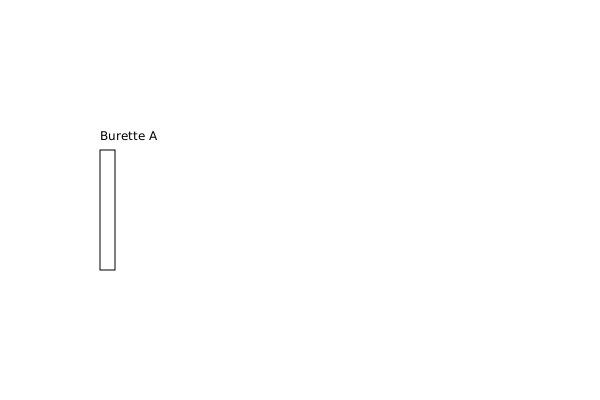
A diagram of a titration setup is shown below. If the burette contains 0.1 M HCl and the flask contains 20 mL of 0.1 M NaOH, what is the pH of the solution after 10 mL of HCl has been added?
A. 1
B. 2
C. 3
D. 4
Question 11
The graph below represents the relationship between pressure and volume of a gas at cons\tant temperature.
A. Boyle's Law
B. Charles' Law
C. Gay-Lussac's Law
D. Avogadro's Law
Question 12
The reaction of sodium with water to form sodium hydroxide and hydrogen gas is represented by the equation: \( 2Na + 2H_2O \rightarrow 2NaOH + H_2 \). If 10 g of sodium is allowed to react with excess water, what is the mass of hydrogen gas produced?
A. 2.0 g
B. 4.0 g
C. 6.0 g
D. 8.0 g
Question 13
A 2.0 M solution of sulfuric acid is mixed with a 1.5 M solution of sodium hydroxide. If 50 mL of each solution is used, what is the concentration of the resulting solution?
A. 0.75 M
B. 1.0 M
C. 1.25 M
D. 1.5 M
Question 14
A 10 mL sample of 0.1 M HCl is titrated with 0.1 M NaOH. What is the pH of the solution after the addition of 5 mL of NaOH?
A. 1
B. 2
C. 3
D. 4
Question 15
The atomic radius of a metal atom is 200 pm. If the electron cloud is assumed to be spherical, calculate the volume of the electron cloud in cubic meters.
A. 1.33 \times 10^{-28} m^3
B. 1.33 \times 10^{-27} m^3
C. 1.33 \times 10^{-29} m^3
D. 1.33 \times 10^{-30} m^3

Master the Exam!

You've seen a preview, but there are thousands more questions plus AI tutor to break down complex solutions.

Unlock Full Access Available for Android & Windows
Help others prepare! Share this practice hub: