POST UTME COVENANT UNIVERSITY 2025 Biology | Objective

Practice these randomly selected questions to test your readiness.

Question 1
In the context of hormonal coordination, what is the primary function of the hypothalamic-pituitary-adrenal (HPA) axis?
A. Regulation of body temperature
B. Modulation of the immune response
C. Stimulation of the reproductive system
D. Maintenance of homeostasis through the release of hormones
Question 2
In the human body, the circulatory system is responsible for transporting oxygen and nutrients to cells and removing waste products. Which of the following organs plays a crucial role in the circulatory system?
A. Heart
B. Lungs
C. Liver
D. Kidneys
Question 3
A plant with the genotype 'Rr' is crossed with a plant with the genotype 'RR'. What is the probability that the offspring will have the genotype 'Rr'?
A. 0.25
B. 0.5
C. 0.75
D. 0.33
Question 4
In a closed e\cosystem, what is the primary mechanism by which oxygen is removed from the atmosphere?
A. Respiration
B. Photosynthesis
C. Decomposition
D. Evaporation
Question 5
The process of cellular respiration in plants involves the breakdown of glu\cose to produce
A. ATP and NADH
B. glu\cose and oxygen
C. carbon dioxide and water
D. ethanol and carbon dioxide
Question 6
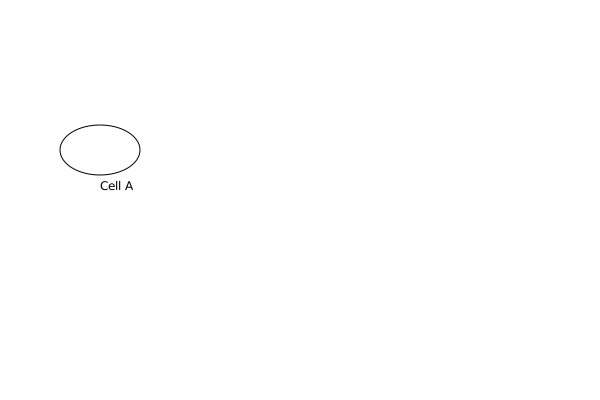
A diagram of a plant cell is shown below. Identify the part labeled 'A'.
A. plasma membrane
B. cell wall
C. nucleus
D. mitochondria
Question 7
A researcher studying the eco\logy of a freshwater lake observes that the water level fluctuates seasonally. What is the most likely explanation for this phenomenon?
A. Changes in precipitation patterns
B. Evaporation due to increased temperature
C. Inflow of water from surrounding land
D. Outflow of water through a natural outlet
Question 8
A plant cell is placed in a solution containing 0.1 M glu\cose. If the cell membrane is permeable to glu\cose, what will happen to the concentration of glu\cose inside the cell?
A. Increase
B. Decrease
C. Remain the same
D. No change
Question 9
A 30-year-old patient presents with symptoms of depression. Which of the following is the most effective treatment for this patient?
A. Selective serotonin reuptake inhibitors (SSRIs)
B. Tricyclic antidepressants (TCAs)
C. Monoamine oxidase inhibitors (MAOIs)
D. Lithium
Question 10
In a tropical rainforest, the primary consumers are primarily composed of
A. herbivorous insects
B. omnivorous mammals
C. carnivorous birds
D. detritivorous fungi
Question 11
A population of 1000 individuals has a birth rate of 0.05 and a death rate of 0.02. What is the expected population size after 10 years?
A. 1200
B. 1500
C. 1800
D. 2000
Question 12
A plant cell has a cell wall, a large central vacuole, and a small nucleus. Which of the following is NOT a characteristic of plant cells?
A. Mitochondria
B. Chloroplasts
C. Cell wall
D. Vacuole
Question 13
A 2.0 L sample of a gas at 25°C and 1.0 atm is collected over water. If the vapor pressure of water at 25°C is 23.8 mmHg, what is the partial pressure of the gas?
A. 0.97 atm
B. 1.03 atm
C. 1.07 atm
D. 1.12 atm
Question 14
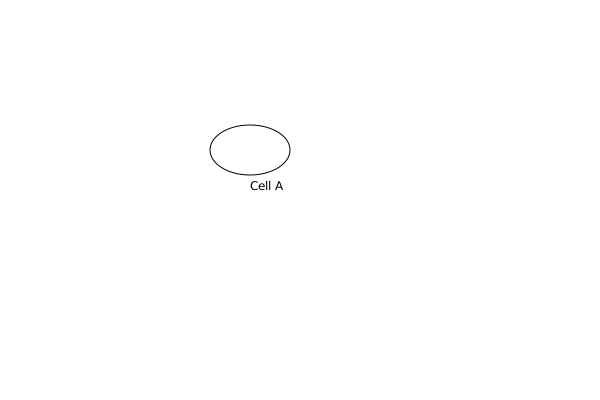
A diagram of a plant cell is shown below. Identify the structure labeled 'A'.
A. Nucleus
B. Mitochondria
C. Chloroplast
D. Vacuole
Question 15
In a typical human eye, the cornea and lens work together to focus light on the retina. However, in a condition known as cataract, the lens becomes cloudy and prevents light from pas\sing through. Which of the following best describes the effect of cataract on vision?
A. Near-sightedness
B. Far-sightedness
C. Blindness
D. Double vision

Master the Exam!

You've seen a preview, but there are thousands more questions plus AI tutor to break down complex solutions.

Unlock Full Access Available for Android & Windows
Help others prepare! Share this practice hub: