POST UTME COVENANT UNIVERSITY 2019 Biology | Objective

Practice these randomly selected questions to test your readiness.

Question 1
The process of natural selection acts on the variation in a population, leading to the adaptation of the population to its environment. What is the primary mechanism by which natural selection acts on variation?
A. Genetic drift
B. Gene flow
C. Mutation
D. Selection pressure
Question 2
The xylem is a type of vascular tissue in plants that is responsible for transporting water and minerals from the roots to the leaves. Which of the following is a characteristic of xylem tissue?
A. It is composed of dead cells
B. It is composed of living cells
C. It is responsible for transporting sugars from the leaves to the roots
D. It is responsible for transporting water and minerals from the roots to the leaves
Question 3
A 50 g sample of a subs\tance is dissolved in 100 mL of water. If the subs\tance has a molar mass of 200 g/mol, and the concentration of the solution is 0.5 M, what is the number of moles of the subs\tance in the solution?
A. 0.025 mol
B. 0.05 mol
C. 0.075 mol
D. 0.1 mol
Question 4
The nervous system's coordination of voluntary movements involves the integration of sensory information from proprioceptors, which are specialized sensory receptors found in muscles, t\endons, and joints. What is the primary function of proprioceptors in the context of motor control?
A. To detect changes in muscle length and tension
B. To provide feedback on the position and velocity of the body
C. To regulate the contraction and relaxation of muscles
D. To transmit signals to the brain about the force of muscle contractions
Question 5
The process of excretion in humans involves the removal of waste products from the body. Which of the following is a critical component of the excretory system?
A. Kidneys
B. Liver
C. Pancreas
D. Small intestine
Question 6
What is the primary function of the mitochondria in the process of cellular respiration?
A. To generate ATP
B. To synthesize proteins
C. To store genetic information
D. To regulate cell growth
Question 7
The growth and development of an organism are regulated by a complex interplay of genetic and environmental factors. What is the primary mechanism by which the growth and development of an organism are regulated?
A. Hormonal regulation
B. Genetic regulation
C. Environmental regulation
D. All of the above
Question 8
The process by which a cell becomes specialized in structure and function to perform a specific role in the body is known as
A. Differentiation
B. Mitosis
C. Meiosis
D. Apoptosis
Question 9
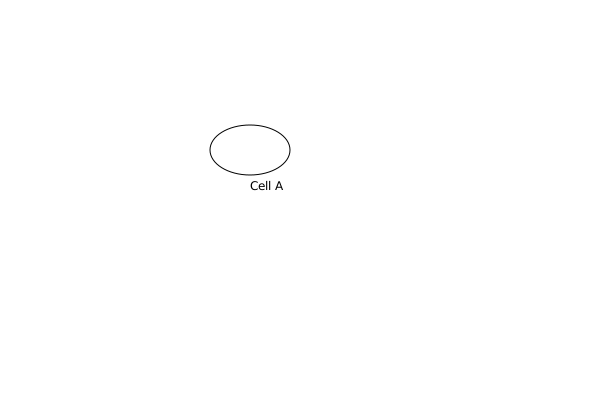
A diagram of a plant cell is shown below. What is the function of the structure labeled 'A'?
A. To regulate the movement of materials in and out of the cell
B. To synthesize proteins
C. To store genetic information
D. To provide structural support to the cell
Question 10
In the context of evolutionary theory, what is the term for the process by which a species becomes better adapted to its environment over time?
A. Natural selection
B. Genetic drift
C. Mutation
D. Gene flow
Question 11
In the process of osmoregulation, what is the primary function of the kidneys in maintaining the balance of electrolytes and water in the body?
A. To regulate blood pressure
B. To remove excess electrolytes and water from the body
C. To maintain acid-base balance
D. To regulate body temperature
Question 12
The process of photosynthesis in plants involves the conversion of light energy into chemical energy. Which of the following is a byproduct of photosynthesis?
A. Oxygen
B. Carbon dioxide
C. Water
D. Glu\cose
Question 13
In a tropical rainforest e\cosystem, what is the primary role of the leafy canopy in the nutrient cycle?
A. To absorb and store nutrients from the soil
B. To release nutrients into the soil through leaf litter
C. To facilitate the movement of nutrients between trophic levels
D. To regulate the amount of sunlight reaching the forest floor
Question 14
In the process of digestion, what is the primary function of the enzyme amylase?
A. To break down proteins into amino acids
B. To break down carbohydrates into simple sugars
C. To break down fats into fatty acids
D. To synthesize proteins
Question 15
The process of evolution is responsible for the diversity of life on Earth. Which of the following is a mechanism of evolution?
A. Mutation
B. Genetic drift
C. Gene flow
D. All of the above

Master the Exam!

You've seen a preview, but there are thousands more questions plus AI tutor to break down complex solutions.

Unlock Full Access Available for Android & Windows
Help others prepare! Share this practice hub: