POST UTME COAL CITY UNIVERSITY 2022 Biology | Objective

Practice these randomly selected questions to test your readiness.

Question 1
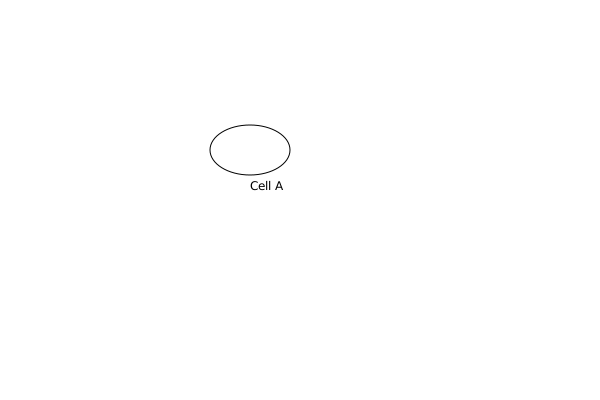
A diagram of a plant cell is shown below. Identify the part labeled 'A'.
A. Nucleus
B. Mitochondria
C. Chloroplast
D. Vacuole
Question 2
In the context of cell division, what is the primary function of the spindle fibers during anaphase?
A. Separation of sister chromatids
B. Formation of the nuclear envelope
C. Condensation of chromatin
D. Attachment of chromosomes to the spindle fibers
Question 3
The process by which an organism becomes dep\endent on a particular subs\tance, such as a drug or a toxin, is called
A. Addiction
B. Tolerance
C. Withdrawal
D. Habituation
Question 4
The process of speciation is a key aspect of evolutionary bio\logy. Which of the following is a mechanism by which allopatric speciation occurs?
A. Geographic isolation
B. Genetic drift
C. Mutation
D. Gene flow
Question 5
A muscle fiber has a maximum contraction force of 100 N. If the muscle is stretched by 10% of its original length, what is the new contraction force?
A. 90 N
B. 100 N
C. 110 N
D. 120 N
Question 6
In a population of Drosophila melanogaster, the frequency of the recessive allele 'a' is 0.2. If the population is in Hardy-Weinberg equilibrium, what is the frequency of the homozygous dominant genotype 'AA'?
A. 0.36
B. 0.64
C. 0.72
D. 0.84
Question 7
A population of bacteria is growing in a controlled environment. If the initial population size is 100 and the growth rate is 20% per hour, what will be the population size after 3 hours?
A. 1600
B. 1800
C. 2000
D. 2200
Question 8
The system of the body that is responsible for the production of urine is called
A. Circulatory System
B. Respiratory System
C. Digestive System
D. Urinary System
Question 9
In a population of 1000 individuals, 70% are homozygous dominant (BB), 20% are heterozygous (Bb), and 10% are homozygous recessive (bb). If a random sample of 50 individuals is taken, what is the probability that the sample will contain at least one homozygous recessive individual?
A. 0.5
B. 0.7
C. 0.9
D. 0.95
Question 10
A diagram of the respiratory system in a human is shown below. Which of the following is a function of the alveoli?
A. Exchange of oxygen and carbon dioxide between the lungs and the bloodstream
B. Filtering of the blood to remove pathogens and other foreign subs\tances
C. Production of mucus to trap dust and other particles
D. Regulation of body temperature
Question 11
In the process of osmoregulation, the kidneys play a crucial role in maintaining the balance of electrolytes and water in the body. Which of the following is a mechanism by which the kidneys help to regulate the concentration of ions in the blood?
A. Reabsorption of ions in the proximal convoluted tubule
B. Secretion of ions in the distal convoluted tubule
C. Excretion of ions in the collecting duct
D. Reabsorption of ions in the loop of Henle
Question 12
The tissue that connects, supports, and binds other tissues and organs together is called
A. Connective Tissue
B. Epithelial Tissue
C. Muscle Tissue
D. Nervous Tissue
Question 13
A 10-mL sample of a 0.5 M solution of NaCl is mixed with 20 mL of distilled water. What is the concentration of the resulting solution?
A. 0.25 M
B. 0.5 M
C. 0.75 M
D. 1.0 M
Question 14
A diagram of the human eye is shown below. Which part of the eye is responsible for detecting light?
A. Cornea
B. Iris
C. Retina
D. Lens
Question 15
In a eukaryotic cell, the process of cell division that results in the production of four daughter cells, each with the same number and kind of chromosomes as the parent cell, is called
A. Mitosis
B. Meiosis
C. Binary Fission
D. Endosymbiosis

Master the Exam!

You've seen a preview, but there are thousands more questions plus AI tutor to break down complex solutions.

Unlock Full Access Available for Android & Windows
Help others prepare! Share this practice hub: