POST UTME COAL CITY UNIVERSITY 2017 Biology | Objective

Practice these randomly selected questions to test your readiness.

Question 1
In a population of Drosophila melanogaster, the frequency of the recessive allele 'a' is 0.2. If the population is in Hardy-Weinberg equilibrium, what is the frequency of the homozygous dominant genotype 'AA'?
A. 0.6
B. 0.4
C. 0.8
D. 0.2
Question 2
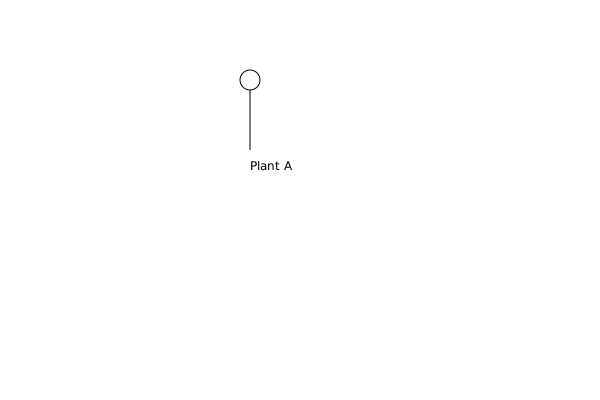
A diagram of a simple e\cosystem is shown below.
A. The herbivore is the primary producer in the e\cosystem.
B. The carnivore is the primary consumer in the e\cosystem.
C. The plant is the primary producer in the e\cosystem.
D. The herbivore is the secondary consumer in the e\cosystem.
Question 3
The process of mitosis is a type of cell division that results in two daughter cells that are genetically identical to the parent cell.
A. True
B. False
C. Mitosis results in four daughter cells
D. Mitosis results in two daughter cells that are genetically different from the parent cell
Question 4
A plant with a genotype of 'Tt' is crossed with a plant with a genotype of 'tt'. What is the probability that the offspring will have the genotype 'TT'?
A. 0.25
B. 0.5
C. 0.75
D. 0.9
Question 5
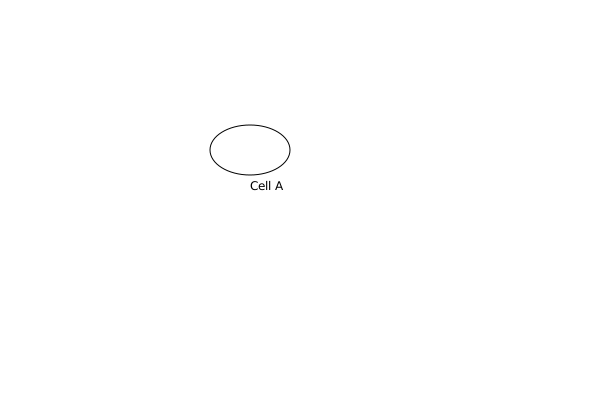
A diagram of a plant cell is shown below.
A. The cell wall is located outside the cell membrane.
B. The chloroplasts are responsible for photosynthesis.
C. The vacuole is responsible for storing water and nutrients.
D. The cell membrane is permeable to all subs\tances.
Question 6
The process of cellular respiration is a series of chemical reactions that occur in the mitochondria of a cell, which converts glu\cose into carbon dioxide and water.
A. True
B. False
C. Cellular respiration occurs in the chloroplasts
D. Cellular respiration occurs in the nucleus
Question 7
A plant with the genotype AaBbCcc is crossed with a plant with the genotype aabbCC. What is the probability that the offspring will have the genotype AaBbCc?
A. 1/4
B. 1/2
C. 3/4
D. 1
Question 8
A bio\logist is studying the respiration of a plant in a controlled environment. The plant is placed in a sealed chamber with a cons\tant temperature of 25°C and a relative humidity of 60%. The plant is illuminated with a light intensity of 100 μmol/m²s. What is the rate of photosynthesis in the plant?
A. 1.5
B. 2.5
C. 3.5
D. 4.5
Question 9
In the context of excretion and osmoregulation, what is the primary function of the kidneys in maintaining acid-base balance?
A. To regulate the concentration of ions in the blood
B. To remove excess hydrogen ions from the body
C. To maintain the pH of the blood through the excretion of bicarbonate ions
D. To regulate the concentration of glu\cose in the blood
Question 10
A researcher is studying the effect of temperature on the growth rate of a microorganism. The researcher measures the growth rate at different temperatures and plots the data on a graph. Which of the following is a likely conclusion from the graph?
A. The growth rate increases with increa\sing temperature.
B. The growth rate decreases with increa\sing temperature.
C. The growth rate remains cons\tant with increa\sing temperature.
D. The growth rate has a maximum value at a certain temperature.
Question 11
In a population of 1000 individuals, 70% are heterozygous for the gene controlling flower color. If 20% of the population are homozygous recessive, what is the frequency of the recessive allele?
A. 0.2
B. 0.3
C. 0.4
D. 0.5
Question 12
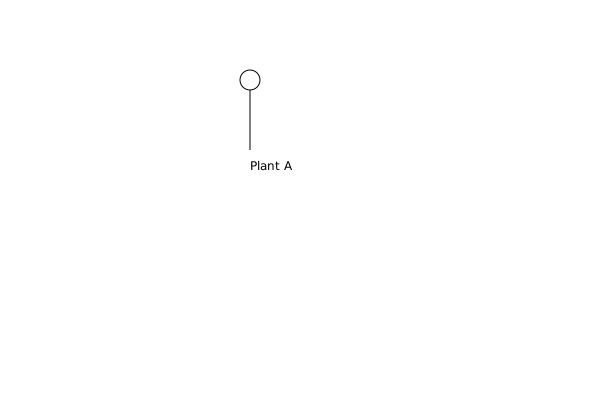
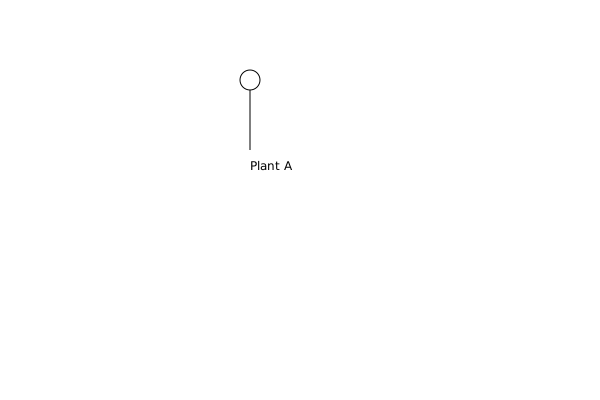
A diagram of a simple food chain is shown below.
A. The herbivore is the primary producer in the food chain.
B. The carnivore is the primary consumer in the food chain.
C. The plant is the primary producer in the food chain.
D. The herbivore is the secondary consumer in the food chain.
Question 13
A geneticist is studying the inheri\tance of a trait in a family. The trait is determined by a \single gene with two alleles: 'A' and 'a'. The geneticist wants to determine the genotype of the offspring of a cross between two heterozygous parents. What is the probability that the offspring will be homozygous recessive?
A. 0.25
B. 0.50
C. 0.75
D. 0.90
Question 14
A cell is undergoing mitosis. Which of the following is a characteristic of the prophase stage?
A. The chromosomes are condensed and visible under a microscope
B. The nuclear envelope is broken down and the chromosomes are released
C. The chromosomes are duplicated and the cell is preparing for cytokinesis
D. The cell is in the process of interphase and the chromosomes are not visible
Question 15
A company produces 1000 units of a product per day. If the demand for the product is normally distributed with a mean of 1200 units per day and a s\tandard deviation of 100 units per day, what is the probability that the company will produce more than 1500 units per day?
A. 1/4
B. 1/2
C. 3/4
D. 1

Master the Exam!

You've seen a preview, but there are thousands more questions plus AI tutor to break down complex solutions.

Unlock Full Access Available for Android & Windows
Help others prepare! Share this practice hub: